April 26

Who was the subject of an advertisement in a colonial American newspaper 250 years ago this week?

Apr 26 - 4:23:1767 Massachusetts Gazette
Massachusetts Gazette (April 23, 1767).

“Will also sell … a Negro Man that understands Brewing and Distilling.”

As he prepared to leave Boston for Nova Scotia, Robert Whatley had the eighteenth-century version of a moving sale. He scheduled a “Public Vendue” (or auction) to sell many of his personal belongings, including beds, tables, chairs, and even a “fine large Canoe with Sails.” Whatley, a brewer by trade, also wished to sell his equipment, including “a Copper Boiler with a brass Cock to it, fit for a Coffee-House or Tavern” and his “Brewing Utensils with all Things necessary for that Business.”

In addition to his household furniture and the tools of his trade, Whatley also offered to sell “a Negro Man that understand Brewing and Distilling.” The Adverts 250 Project recently examined an advertisement that included enslaved artisans, including carpenters and coopers, exploited for their expertise and specialized skills in addition to their labor. Whatley’s advertisement further demonstrates the range of occupations and crafts enslaved men and women pursued in the colonial and Revolutionary eras.

Both the copy and the layout of Whatley’s notice suggest that colonists would not have considered it in any way extraordinary that “a Negro Man that understands Brewing and Distilling” played a role in operating the business. Readers who skimmed the advertisements in the Massachusetts Gazette might even have missed the portion of Whatley’s advertisement that mentioned the enslaved brewer; that sentence was nestled in the middle of two dense paragraphs. In some respects, Whatley’s attempt to sell his slave was hidden in plain sight. It was part of his advertisement, but not its main purpose.

As my students and I have pursued the Slavery Adverts 250 Project for the past seven months, the frequency of advertisements like this one has been a striking feature. We expected to encounter advertisements exclusively devoted to slavery, especially those that offered one or more slaves for sale and others concerning runaway slaves. We have been a bit more surprised by how often slaves for sale incidentally appeared in advertisements, listed alongside consumer goods and real estate. The practice of slavery – the presence of slavery in everyday life and commerce – pervaded early American print culture, especially advertising, more subtly and to a much greater extent than we initially expected.
May 3

What was advertised in a colonial newspaper 250 years ago this week?

May 3 - 5:2:1766 Virginia Gazette
Virginia Gazette (May 2, 1766).

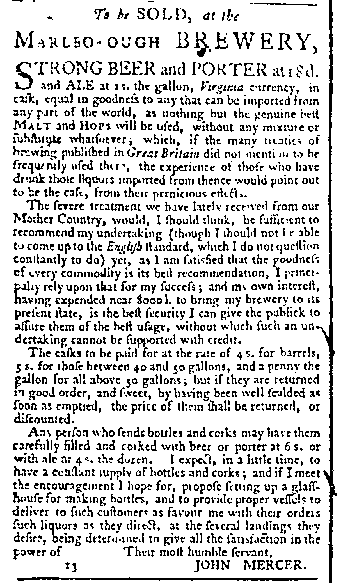
“To be SOLD, at the MARLBOROUGH BREWERY.”

Brewer John Mercer took an interesting approach in his advertisement for “STRONG BEER and PORTER … and ALE” available from the Marlborough Brewery: quite frankly, he confessed, it was not as good as beer from England.

Actually, Mercer presented a mixed message in his lengthy advertisement. He initially stated that his beer was “equal in goodness to any that can be imported from any part of the world, as nothing but the genuine best MALT and HOPS will be used, without any mixture of substitute whatsoever.” Mercer seems to have been a stickler for quality control! He also made an increasingly common appeal. In the 1760s many American artisans asserted that their goods were equal or superior to imports.

Later in the advertisement, however, he acknowledged “I should not be able to come up to the English standard” despite his constant efforts. Still, since “goodness of every commodity is its best recommendation,” Mercer “principally rel[ied] upon that for my success.” In effect, Mercer seemed to be saying, “You’ll like my beer if you try it. Sure, it may not be as good as English beer, but it’s more than good enough and you’re sure to enjoy it. Buy some and prove it for yourself.”

That seems like a curious and daring appeal to make, but consider the other context he provided to promote his brewery: “The severe treatment we have lately received from our Mother Country, would, I should think, be sufficient to recommend my undertaking.” Once again we see how politics and commerce converged in the wake of the Stamp Act, its repeal, and the promulgation of the Declaratory Act. Even if his beer did not “come up to the English standard,” quality was not the only – or event the primary – concern that potential customers should consider. Thanks to the strained relationship between the colonies and “our Mother Country,” imported beer, porter, and ale was bound to leave a bad taste in consumers’ mouths. They were better off trusting Mercer to supply their beverages, brewed from the “best MALT and HOPS.”

**********

I have included the image available via Readex’s Early American Newspaper database.  Colonial Williamsburg’s online resources include the same issue of the Virginia Gazette.  You may find portions of the advertisement more legible via that resource.  I worked back and forth between the two in order to read the entire advertisement.