
What was advertised in a colonial American newspaper 250 years ago today?
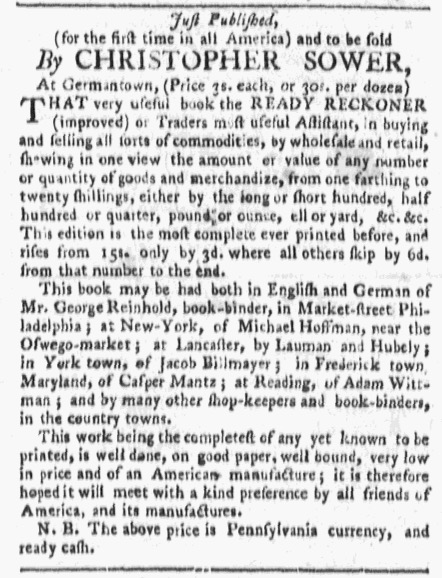
“It is therefore hoped that it will meet with a kind preference by all friends of America, and its manufactures.”
As the final days of 1774 approached, Christopher Sower, the printer of the Germantowner Zeitung, advertised an American edition of Daniel Fenning’s The Ready Reckoner; or Trader’s Most Useful Assistant, in Buying and Selling All Sorts of Commodities Either Wholesale or Retail. The handy reference volume had been through several London editions, published it “for the first time in all America” and established a network of local agents to sell copies “both in English and German” in several cities and towns. His advertisement in the December 8, 1774, edition of Rivington’s New-York Gazetteer listed his own printing office in Germantown, Pennsylvania, and named associates in Lancaster, Reading Philadelphia; New York City; Fredericktown, Maryland; and Yorktown, Virginia. In addition, Sower claimed that “many other shop-keepers and book-binders, in the country towns” stocked the volume. For those interested in selling copies at their shops, he offered a discount, thirty shilling for a dozen copies compared to three shillings for a single copy. In other words, those who bought ten copies received two additional copies for free.
Sower declared that he issued an “improved” edition, “the most complete ever printed.” The table it contained were supposed to save time and avoid errors in calculations, as the lengthy subtitle explained: “shewing at one view the amount or value of any number of quantity of goods from one farthing to twenty shillings … in so plain and easy a manner, that persons quite unacquainted with arithmetic may hereby ascertain the value of any number … at any price whatever.” Sower considered it the “most complete” edition because it featured increments of three pence instead of six pence. Yet that element alone did not recommend the book to prospective customers. The publisher described it as “well done, on good paper, well bound and of an American manufacture.” He did not specify whether “American manufacture” referred to the “good paper” as well as the labor undertaken in setting type, working the press, and binding the book. Still, he expected that an American edition “will meet with a kind preference by all friends of America, and its manufactures” who might otherwise opt for a London edition published in 1773. Sower’s call to purchase the American edition likely had even greater resonance given that the Continental Association, a nonimportation agreement adopted in response to the Coercive Acts, had recently gone into effect.