
What was advertised in a colonial American newspaper 250 years ago this week?
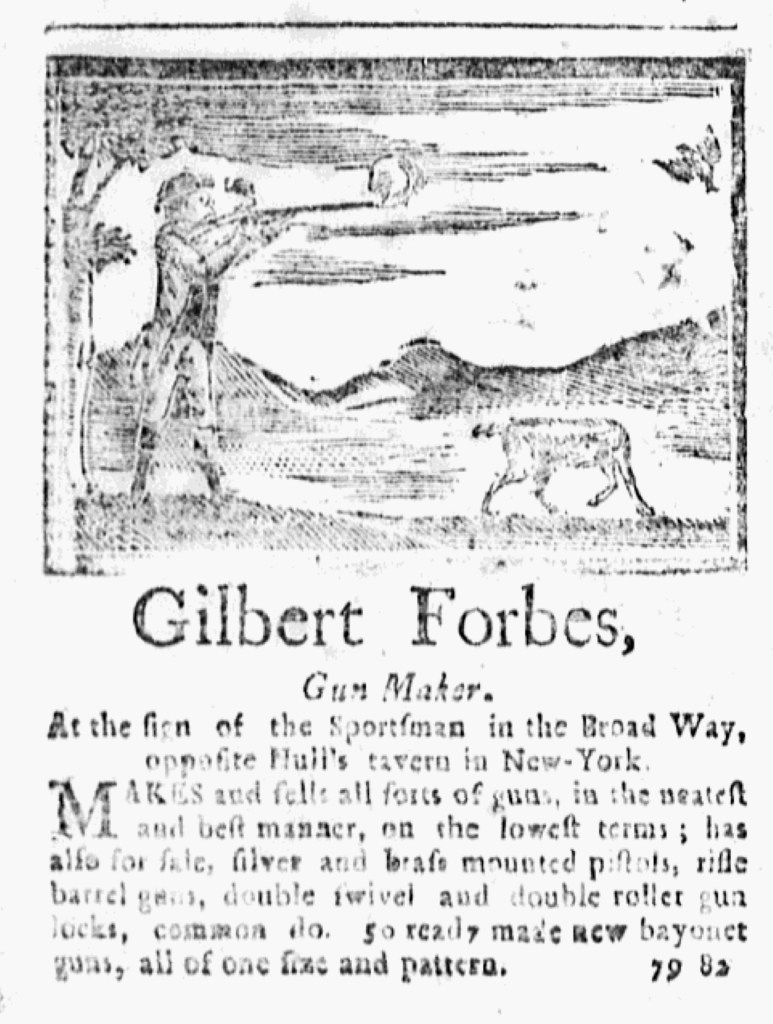
“Gilbert Forbes, Gun Maker, At the sign of the Sportsman.”
Gilbert Forbes, “Gun Maker, At the sign of the Sportsman in the Broad Way,” took to the pages of the New-York Journal to advertise “all sorts of guns” that he made “in the neatest and best manner “and sold “on the lowest terms” as spring approached in 1775. He made some of the standard appeals deployed by artisans – quality and price – yet those were not the focal point of his advertisement. A woodcut dominated his notice, accounting for more than half the space he purchased in the newspaper.
Commissioning the woodcut may very well have been worth the investment. It almost certainly attracted the attention of readers, not only because it appeared on the first page of the March 16 edition. The image depicted a scene of a well-dressed gentleman firing a gun, a bird plummeting out of the sky, and a hunting dog waiting below. A puff of smoke wafted out of the barrel of the gun, capturing the moment just after the gentleman pulled the trigger. Such a scene differed dramatically from other images that appeared in newspaper advertisements during the era of the American Revolution. When advertisers commissioned woodcuts, they usually requested static images that corresponded to some aspect of their business, most often replicating their shop sign or showing an item that they made or sold at their shop. For instance, an image of a fish adorned an advertisement for “CORNISH’s New-England FISH HOOKS” in the Massachusetts Spy and an image of a spinning wheel appeared in James Cunning’s advertisement for dry goods he sold “At the Sign of the SPINNING-WHEEL” in the Pennsylvania Journal. In contrast, Forbes provided a scene in motion, distinguishing his advertisement from others.
Relatively few advertisements featured images at all. Those that did most often incorporated stock images of ships at sea, houses, horses, or enslaved people, each of them provided by the printer. Occasionally, advertisers commissioned woodcuts intended exclusively for their own use. Among that small number, an image of a scene, one that invited viewers to imagine events in motion, was exceptionally rare. As such, it demanded attention.