March 3

What was advertised in a colonial American newspaper 250 years ago today?

FRENCH SCHOOL.”

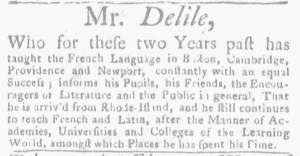
Massachusetts Gazette and Boston Weekly News-Letter (March 3, 1774).

In late February 1774, Mr. Delile, a French tutor, returned to the pages of Boston’s newspapers to alert readers that he had returned to the area and “continues to teach French and Latin.”  In an advertisement in the February 24 edition of the Massachusetts Gazette and Boston Weekly News-Letter, he reminded residents that “for these two Years past [he] has taught the French language in Boston, Cambridge, Providence and Newport.”  He had previously taken to the public prints in two colonies to keep current and prospective pupils advised to his whereabouts, explaining to students in Massachusetts, some of them presumably enrolled at Harvard College, that the “Present Vacation at Cambridge” meant “he can be absent without an Injury to his Pupils.”  He pledged to return to the area to guide them in their studies.  His new advertisement underscored his previous affiliation with Harvard students and his desire to once again teach them and their peers.  He declared that he provided lessons “after the Manner of Academies, Universities and Colleges of the Learning World, amongst which Places he has spent his Time.”  Delile offered a proper curriculum, drawing on his own experience and familiarity with educational institutions of the era.

Massachusetts Gazette and Boston Weekly News-Letter (March 3, 1774).

A week after Delile’s notice appeared, Francis Vandale published his own advertisement for a “FRENCH SCHOOL” in the March 3 edition of the Massachusetts Gazette and Boston Weekly News-Letter.  Although they competed for some of the same clients, Vandale took a different approach than Delile.  Rather than targeting young men studying at Harvard, Vandale sought “Gentlemen or Ladies” as pupils.  Instead of promoting his method of instruction, he emphasized the genteel qualities of the French language and the social standing his students could achieve under his direction.  He conjured an image of how “the French Language when taught agreeable to its native Purity & Elegance, is acquired with that becoming Ease and Gracefulness, as renders it truly Ornamental.”  His pupils, through the “Ease and Gracefulness” that Vandale’s tutelage instilled in them, took on the qualities of the language itself.  He did not mention any prior affiliations with academies or colleges, instead “profess[ing] to be a compleat Master of [French] in all its original Beauty and Propriety, entirely free from any false Mixture or bad Pronunciation.”  For Vandale, speaking French was not an academic exercise but rather a means of artistic expression.

Residents of Boston, Cambridge, and nearby towns who wished to learn or improve their French encountered more than one option when they perused the pages of the Massachusetts Gazette and Boston Weekly News-Letter.  They could take into account both the reputations and methods of Delile and Vandale when deciding if they wished to hire the services of either French tutor.

September 1

What was advertised in a colonial American newspaper 250 years ago today?

Sep 1 - 9:1:1768 Virginia Gazette Purdie and Dixon
Virginia Gazette [Purdie & Dixon] (September 1, 1768).
“RUN away … Negro woman named GRACE … appears to be young with child.”

In many instances, newspaper advertisements for runaways may be the only documents that testify to the experiences of some enslaved men and women. Each runaway advertisement tells a story of someone who might otherwise have disappeared from the historical record, but these are only partial stories told by aggrieved masters rather than by the fugitive slaves themselves. Still, these truncated narratives allow us to reconstruct the past, granting insight into the thoughts and experiences of enslaved people even though they do not provide direct testimony.

Consider the story of Grace, described by James Johnson as “a likely Virginia born Negro woman … of a very black complexion.” When Grace ran away in early August 1768, Johnson placed an advertisement offering a reward for her capture in Purdie and Dixon’s Virginia Gazette. He provided a short biography, though it likely did not include the details that Grace would have chosen were she telling her own story about her life. The young woman had been born in Virginia, like most of the other enslaved men, women, and children advertised in the same the Virginia Gazette at the time she made her escape. She was not a “new negro” who had survived the Middle Passage from Africa and then transshipment within the colonies, but she had not always resided with the same master in the same town. Johnson reported that she ran away from Amelia, well inland, and would “endeavour to get on board some vessel in James river, or make for Hampton town” on the coast. Johnson was at least her third owner, having acquired Grace from James Machan who “said she had lived with Mr. Collier” near Hampton.

Johnson provided one other important detail about Grace, reporting she was “somewhat fat, middling large, and appears to be young with child.” Every fugitive had good reason for running away, but Grace may have had more motivation than others. She was probably aware that she could be separated from her child at any time. Another advertisement in the same issue listed several prizes in a lottery, including “a likely breeding woman named Agnes” valued at fifty pounds as one prize and “Agnes’s child, named Rose, 18 months old” valued at fifteen pounds as another. Mother and daughter were almost certain to be separated when the tickets were drawn and the so-called “Prizes” awarded. In addition to Agnes, the “Prizes” included another “likely breeding woman named Ruth.” Grace may not have fled merely to avoid being separated from her child. She may have been escaping sexual abuse and exploitation that led to her pregnancy, whether perpetrated by Johnson or others. In a society that treated her as a “likely breeding woman,” Grace may have been attempting to assert control over her own body and reproductive choices.

It is impossible to know for certain the precise reasons that Grace chose to run away or why she ran at the time she did, but Johnson’s advertisement suggests some likely possibilities. He did not acknowledge the abuses Grace may have suffered, but readers can fill in those silences by imagining Johnson’s narrative of the enslaved woman’s life had it been told by Grace herself.