
What was advertised in a colonial American newspaper 250 years ago this week?
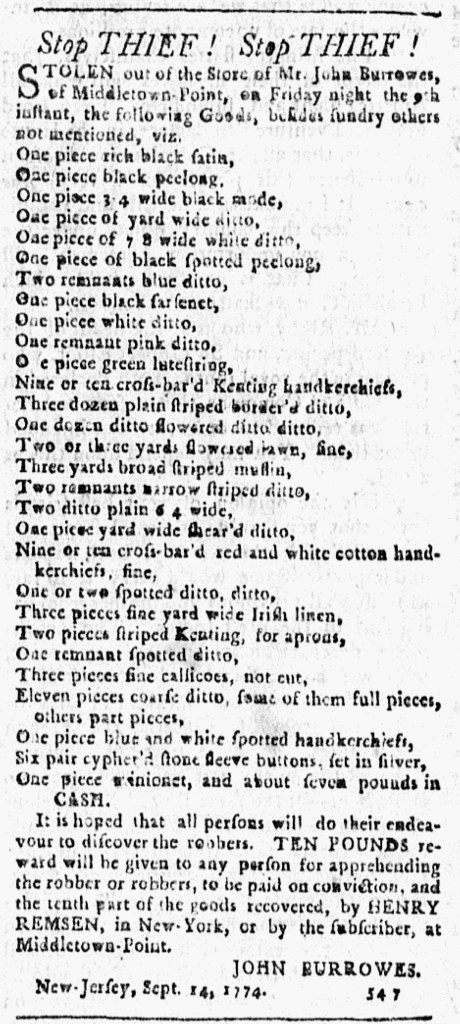
“Stop THIEF! Stop THIEF!”
The headline attracted attention: “Stop THIEF! Stop THIEF!” John Burrowes of Middletown Point, New Jersey, was the victim of a crime, one that occurred on the night of September 9, 1774. A “robber or robbers” stole a variety of goods from his store, including “One piece rich black satin,” “Nine or ten cross-bar’d red and white cotton handkerchiefs, fine,” “Eleven pieces coarse [calico], some of them full pieces, others part pieces,” and “Six pair cypher’d stone sleeve buttons, set in silver.” In addition, they made off with “sundry others not mentioned.”
A few days after the theft, Burrowes dispatched messages to two printing offices in New York, the nearest town with one or more newspapers. Advertisements featuring identical copy, but very different formats, soon appeared in the New-York Gazette and Weekly Mercury and the New-York Journal. Despite the differences in their layouts, both proclaimed ““Stop THIEF! Stop THIEF!” That suggests that Burrowes had been quite specific in his instructions about the headline even as he left the rest of the design to the discretion of the compositors who set type for the two newspapers.
The shopkeeper realized that the robbers would likely attempt to sell some or all the stolen merchandise rather than keep it for their own use. By publishing notices, he alerted readers in New York and far beyond to be wary if offered any of the items he listed. He sought to enlist their help in capturing the culprits and, if possible, recovering the stolen goods. To that end, he designated a local agent, Henry Remsen, in New York to represent him should the robbers and the goods turn up there, while also directing readers to contact him in Middletown Point if the robbers were apprehended in the area.
Burrowes’s advertisement appeared in the New-York Journal at the same time that John Holt, the printer, published accounts of the Suffolk County Resolves from Massachusetts. Those measures called for a boycott of goods imported from Britain until Parliament repealed the Boston Port Act and the other Coercive Acts. Holt ran other news about the imperial crisis under a masthead that included the “UNITE OR DIE” political cartoon that encouraged resistance to the various abuses perpetrated by Parliament. Whatever else happened to be taking place in terms of current events, however, Burrowes likely considered the contents of his advertisement, a form of local reporting from his small town, among the most important news in the New-York Journal. Advertisements often served as mechanisms for disseminating news that did not appear elsewhere in colonial newspapers.