
What was advertised in a colonial American newspaper 250 years ago today?
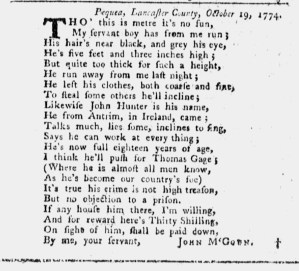
“THO’ this is metre it’s no fun, / My servant boy has from me run.”
It was a novel means of drawing attention to the description of an indentured servant who ran away from his master. Rather than the usual sort of advertisement that crowded the pages of newspapers from New England to South Carolina, John McGoun rejected writing a paragraph of dense text in favor of composing a series of rhyming couplets that gave readers all sorts of information about John Hunter and offered a reward for imprisoning or returning him. On occasion, aggrieved masters composed and published such poems, yet they were rare enough to merit a closer look when McGoun inserted his advertisement. In the first couplet, he played with the form, asserting that his situation was a serious matter even as he sought to entertain readers so they would take note of the details he presented: “THO’ this is metre it’s no fun, / My servant boy has from me run.”
Five other advertisements for the same purpose appeared on the final page of the October 26, 1774, edition of the Pennsylvania Gazette, yet readers may have been more likely to linger over McGoun’s notice. The others filled the space purchased by the advertisers, running from one side of the column to the other, while McGoun’s poem had white space on each side, making his advertisement visually unique among those on the page. That aspect initially drew the eyes of readers, with the couplets offering enough “fun” for a subject that was “no fun” for them to peruse the entire poem. In addition to relaying details about the runaway’s age, height, hair, and eyes, that “fun” included an interesting way of stating that he would disguise himself with new garments: “He left his clothes, both coarse and fine, / To steal some others he’ll incline.” Likewise, McGoun described Hunter’s habits and comportment: “Talks much, lies some, inclines to sing, / Says he can work at every thing.” The master apparently did not find the servant as skilled at a variety of tasks as the servant claimed. McGoun even managed to reference politics and current events in expressing his suspicion that Hunter headed to Boston: “He’s now full eighteen years of age, / I think he’ll push for Thomas Gage.” He did not need to name the city: “(Where he is almost all men know, / As he’s become our country’s foe).” The Pennsylvania Gazette and other newspapers certainly provided plenty of coverage of Gage and his role in enforcing the Coercive Acts as governor of Massachusetts.
Readers constantly encountered advertisements about runaway indentured servants, apprentices, and convict servants during the era of the American Revolution. They usually followed a standard format, yet occasionally masters resorted to verse to distinguish their notices from others that competed for attention in the public prints.