May 18

What was advertised in a revolutionary American newspaper 250 years ago today?
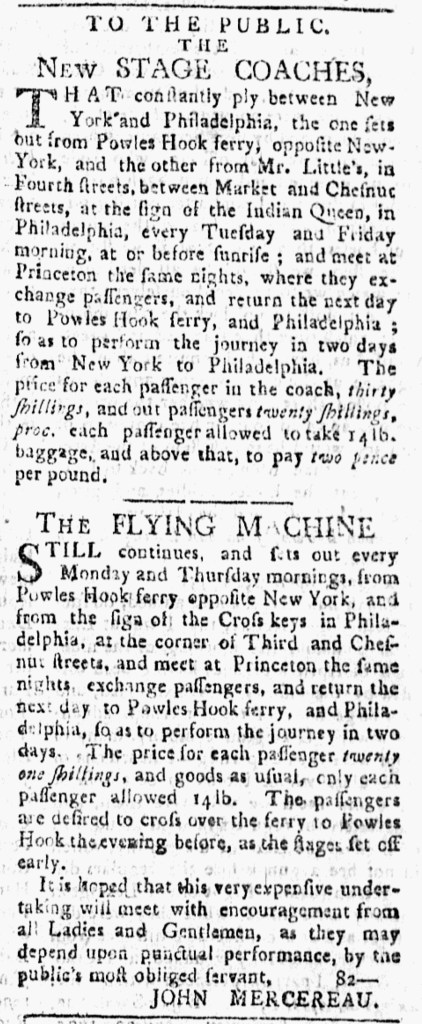
New-York Journal (May 18, 1775).

“THE FLYING MACHINE.”

When it came to stagecoaches that connected New and York and Philadelphia at the beginning of the American Revolution, travelers had more than one option.  One line, the “NEW STAGE COACHES,” left the Powles Hook ferry, on the New Jersey side of the Hudson River “opposite New-York,” and “the sign of the Indian Queen” in Philadelphia on Tuesday and Friday mornings at sunrise.  They met at Princeton in the evening, exchanged passengers, and returned to their respective points of departure the next day.  Another line, the “FLYING MACHINE,” followed a similar route, one stagecoach leaving from Powles Hook ferry and the other from the “sign of the Cross keys” in Philadelphia.  They also met in Princeton, exchanged passengers, and completed the journey in two days.  That did not, however, include crossing the Hudson River.  John Mercereau instructed passengers departing from New York that they should “cross over the ferry to Powles Hook the evening before, as the stages set off early.”  With coaches departing from each city four mornings each week, customers could choose which line best fit their schedules.

Not unlike passengers traveling by bus, train, or airplane today, stagecoach customers considered the prices of each service.  The New Stage cost thirty shillings “for each passenger in the coach,” but “out passengers” paid a bargain rate of only twenty shillings.  Each had to decide if the comfort of an inside seat was worth the additional cost and fit their budget.  The weather on the day of travel likely influenced the choices made by some travelers.  The Flying Machine charged twenty-one shillings per passenger, presumably for inside seats.  That made it a good deal compared to the New Stage for those who traveled with little luggage.  Each passenger was allowed up to fourteen pounds, with no mention of arrangements for anything in excess.  The New Stage, on the other hand, allowed fourteen pounds of baggage as part of the fare and then charged two pence per pound for anything above that.  Like passengers checking luggage at airports today, travelers apparently went through a process of having their bags weighed and potentially assessed additional fees prior to departure.  Those taking more than the allotted amount may have opted for the New Stage over the Flying Machine, resigned to paying more for the excess weight.  Like marketing for modern travel that highlights on-time rates, Mercereau promised “punctual performance.”  The mode for getting from one place to another has evolved over time, but the many of the considerations that passengers take into account have remained quite similar.

August 8

What was advertised in a colonial American newspaper 250 years ago this week?

Aug 8 - 8:6:1770 Pennsylvania Chronicle
Pennsylvania Chronicle (August 6, 1770).

“The FLYING MACHINE.”

Partners John Barnhill and John Mercereau took different approaches to adverting their stage wagon service between New York and Philadelphia in 1770.  Barnhill was responsible for operations in Philadelphia, while Mercereau ran his portion of the business in New York.  Presumably, each partner handled marketing in the city at his end of the circuit.

Barnhill placed a brief advertisement in the August 6, 1770, edition of the Pennsylvania Chronicle.  Extending only three lines, it announced that “The FLYING MACHINE, kept by JOHN BARNHILL in Elm-street, sets out for New-York, on Mondays and Thursdays, and performs the Journey in TWO DAYS.”  A small manicule directed readers to the notice, but otherwise it was unadorned.  (The printing ornaments below the advertisement were part of the colophon that appeared in every issue rather decoration Barnhill selected for his advertisement.)  Barnhill seemingly relied on an established reputation for the stage wagon, emphasizing the speed of the journey.  In just “TWO DAYS” passengers and freight practically flew to New York like birds in the wonderous “FLYING MACHINE” that Barnhill maintained.

Aug 8 - 8:6:1770 New-York Gazette or Weekly Post-Boy
New-York Gazette or Weekly Post-Boy (August 6, 1770).

That same day, Mercereau placed a much more lavish advertisement in the New-York Gazette or Weekly Post-Boy.  It featured a woodcut depicting a covered wagon drawn by two horses.  A driver wielded a whip encouraged even greater speed, enhancing the image of horses and wagon in motion.  The woodcut occupied one-third of the space of the advertisement.  Except for the masthead and an image of a ship in another advertisement, this was the only image in that issue of the New-York Gazette or Weekly Post-Boy.  As a result, it likely attracted even greater attention to Mercereau’s advertisement.  (Absent other evidence, it would be tempting to assume that Mercereau made an additional investment to commission a unique woodcut to represent his business, but earlier in the year a competitor used a nearly identical image on the same page as Mercereau’s advertisement.  The presence of both suggests that they were lesser-used stock images that belonged to the printer, not unlike images of ships, houses, horses, and enslaved people.  See the July 23 and 30 editions.)

In the advertising copy, Mercereau acknowledged his partner “in Elm Street, in Philadelphia” and listed his sign, “the New Blazing-Star,” near New York as his address.  Like Barnhill, he conjured up impressions of speed, but with a blazing star or comet rather than a flying machine.  Mercereau provided a much more extensive overview of the schedule.  The stage wagons left both Philadelphia and Powles Hook Ferry across the river from New York at sunrise on Mondays and Thursdays.  They met at Princeton in the evening.  The following morning, the drivers exchanged passengers and freight before returning to their respective cities.  With that schedule in mind, Mercereau assured prospective clients that it was “very safe for any Person to send Goods” because with only two drivers “they may exchange their Goods without any Mistake” at the only stop along the route.  He also stressed that a round trip took only five days: two days to get to Philadelphia, then “two Nights and one Day to do their Business in” Philadelphia, and finally two days to return to New York.

Mercereau also promoted the “best of Waggons,” the “sober Drivers,” and “four Setts of fresh Horses” that made the journey comfortable, safe, and speedy for passengers and freight.  Furthermore, he promised that “this Road is much the shortest” between New York and Philadelphia.  He also listed the prices so prospective clients could determine the value for themselves.

Why did Barnhill and Mercereau take such different approaches to advertising their shared enterprise in Philadelphia’s newspapers and New York’s newspapers?  Perhaps Barnhill established a more robust clientele in Philadelphia than Mercereau had managed in New York.  No matter the reason, the advertisements placed in both cities provide greater detail for understanding the operations in each city.

December 4

What was advertised in a colonial American newspaper 250 years ago today?

Dec 4 - 12:4:1769 New-York Gazette or Weekly Post-Boy
New-York Gazette or Weekly Post-Boy (December 4, 1769).

“Stage-Waggons.”

Eighteenth-century newspapers featured few visual images. Many had some sort of device in the masthead, but usually delivered the news unadorned. Advertisements sometimes included images, but those were the exception rather than the rule. Those that did have woodcuts relied on stock images that belonged to the printer, primarily ships for notices about vessels preparing to depart, horses for advertisements about breeding, houses for real estate notices, and men or women fleeing for advertisements about apprentices and indentured servants who ran away or enslaved people who escaped. Such woodcuts were used interchangeably for advertisements from the appropriate genre. Other images that accompanied advertisements usually appeared because advertisers commissioned a woodcut specific to their business, either replicating their shop signs or depicting their most notable products.

When Joseph Crane and Josiah F. Davenport turned to the pages of the New-York Gazette or Weekly Post-Boy to advertise the stagecoach service they operated between New York and Philadelphia, they included a woodcut depicting a team of horses pulling a covered wagon. This was not one of the standard stock images, suggesting that Crane and Davenport had commissioned it for exclusive use in their advertisements. However, in their advertisements for “Stage-Waggons” that ran between New York and Philadelphia, John Mercereau and John Barnhill published what appeared to be the same image. This was not merely a case of using the woodcut in an advertisement that appeared on one page and then using it again in another advertisement on a page printed on the other side of the sheet. In the December 4, 1769, edition of the New-York Gazette or Weekly Post-Boy, Crane and Davenport’s advertisement featuring the woodcut ran on the same page as Mercereau and Barnhill’s advertisement featuring the woodcut. They had to have been printed simultaneously, indicating that James Parker, the printer, possessed more than one woodcut depicting horses pulling wagons, just as he had multiple woodcuts of ships and houses. It seems unlikely that Crane and Davenport or Mercereau and Barnhill would have commissioned a woodcut that looked so nearly identical to one used by a competitor as to be indistinguishable. Apparently Parker’s collection of stock images was at least a little bit larger than the frequent reiteration of the most common woodcuts suggested. That did not, however, significantly alter the frequency of visual images accompanying either news or advertising in his newspaper. His publication, like other colonial newspapers, consisted almost exclusively of text and a limited number of stock images. That made any visual image, but especially those seen infrequently, all the more notable.

Dec 4 - 12:4:1769 Woodcuts New-York Gazette or Weekly Post-Boy
New-York Gazette or Weekly Post-Boy (December 4, 1769).