
Who was the subject of an advertisement in a revolutionary American newspaper 250 years ago today?
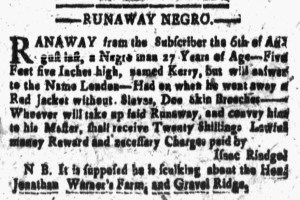
“RUNAWAY NEGRO … named Kerry, but will answer to the Name London.”
During the first year of the Revolutionary War, Daniel Fowle, the printer of the New-Hampshire Gazette, sometimes experienced disruptions to his paper supply that forced him to resort to broadsheets of alternate sizes. His newspaper carried less content, both news and advertising, on such occasions. That was the case on October 3, 1775, when he inserted an “Apology” that stated that “he could not procure any other” paper. Compared to the usual three columns on each of four pages, that issue had only two columns on each of two pages. Fowle did not include any advertisements.
The following week, Fowle managed to acquire broadsheets of the usual size, but apparently not enough of them for a four-page issue. Instead, he published a half sheet edition that had three columns on each of two pages. He found room for advertisements and even a poem, “On LIBERTY.” On October 17, however, the New-Hampshire Gazette returned to the smaller sheet from two weeks earlier, but he had enough to publish four pages instead of two. With twice as much space compared to the October 3 edition, he had room for five advertisements, including one by Mrs. Hooper, a milliner, and another for John Williams’s “House of Entertainment … at the Sign of the SALUTATION.”
Another advertisement featured a headline that proclaimed, “RUNAWAY NEGRO.” Isaac Rindgel described a “Negro man 27 Years of Age … named Kerry, [who] will answer to the Name London.” Kerry liberated himself by escaping from his enslaver on August 6. For two and a half months he managed to elude capture, though Rindgel suspected that Kerry “is sculking about Hon. Jonathan Warner’s Farm, and Gravel Ridge.” He did not indicate why he thought Kerry might be in that area. Perhaps Kerry had a wife, a parent, a sibling, or a friend at Warner’s farm. The advertisement, composed by an enslaver seeking to recover his human property, did not include the details about Kerry’s life and experiences that mattered most to the fugitive seeking freedom. In addition to not explaining why Kerry may have been in the proximity of Warner’s farm, Rindgel did not speculate on why the enslaved man departed when he did. Kerry was likely aware of the disruptions caused by the battles at Lexington and Concord in April, the ensuing siege of Boston, and the Battle of Bunker Hill in June. The same events that affected Fowle’s access to paper created an opportunity for Kerry to liberate himself by running away. It is impossible to know for certain that was the case since the newspaper advertisement reflected his enslaver’s perspective and included only the details Rindgel chose. Kerry certainly would have told a different and more complete story had he been given the opportunity.