
What was advertised in a colonial American newspaper 250 years ago this week?
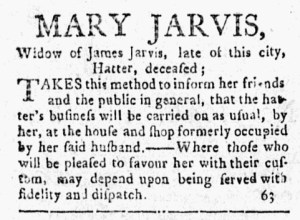
“The hatter’s business will be carried on as usual, by her.”
Mary Jarvis assumed responsibility for the family business following the death of her husband, James, a hatter. In an advertisement that ran in the New-York Journal for several weeks in November and December 1774, she “inform[ed] her friends and the public and general, that the hatter’s business will be carried on as usual, by her, at the house and shop formerly occupied by her said husband.” Like many others who advertised goods and services in colonial newspapers, she promised that “those who will be pleased to favour her with their custom, may depend upon being served with fidelity and dispatch.” Jarvis may have consulted with John Holt, the printer, on the wording for her notice when she made arrangements for its publication, though that may not have been necessary. Considering that she knew enough about the enterprise to continue its operations following the death of her husband, she may very well have been familiar enough with the usual contents of newspaper advertisements to compose it herself. In addition, she could have perused similar notices many times as a consumer and learned for herself what they should contain.
The widow’s role in the business changed following the death of her husband, yet she likely had experience with many of the tasks from assisting him over the years. When she declared that “the hatter’s business will be carried on as usual, by her,” she suggested that she did the work herself rather than managing employees previously affiliated with the business or hired after her situation changed. Although James had been the public face of the venture, Mary no doubt made valuable contributions and learned much about the trade. She sought to leverage that knowledge to support herself through her own industry, joining many other women – milliners and seamstresses – in the garment trades. Historian Laurel Thatcher Ulrich distinguishes between what was probable for women and what was possible for women in early America. In this case, Jarvis embodied both. It was probable that she assisted James in his business as a “deputy husband” (a concept developed by Ulrich) and that made it possible for her to work as a hatter in her own right when circumstances demanded.