
What was advertised in a colonial American newspaper 250 years ago today?
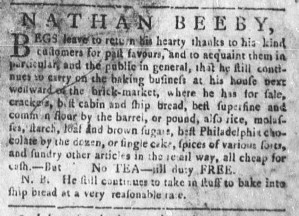
“No TEA – till duty FREE.”
When Thomas Green advertised a variety of grocery items in the April 3, 1775, edition of the Newport Mercury, he listed “SUGAR, FLOUR, COFFEE, … CHOCOLATE, … PEPPER, … NUTMEGS, CLOVES, and MACE.” Tea, one of the commodities that so often appeared in such lists, was conspicuously absent. Many shopkeepers had refused to stock, advertise, or sell tea in the aftermath of the Boston Tea Party in December 1773, just as many consumers refrained from purchasing tea. Abstaining from tea was not universal, however, as some advertisers did continue to include it in their advertisements even after the colonies received word of the Boston Port Act, the Massachusetts Government Act, and the other Coercive Acts that Parliament passed in response to the destruction of the tea by colonizers who masqueraded as Indigenous Americans. Tea even merited particular notice in the Continental Association, the nonimportation pact devised by the First Continental Congress during its meetings in Philadelphia in September and October 1774, yet Peter Oliver, a noted Loyalist judge in Boston, alleged in his Origin and Progress of the American Rebellion that colonizers, especially women, manufactured all sorts of justifications for continuing to drink tea.
Nathan Beeby, a baker in Newport, took a stand regarding tea in the same issue of the newspaper that carried Green’s advertisement. He thanked his “kind customers for past favours” and advised the public that “he still continues to carry on the baking business at his house, where he has for sale, crackers, best cabin and ship bread, [and] best superfine and common flour by the barrel, or pound.” He also peddled “rice, molasses, starch, loaf and brown sugars, best Philadelphia chocolate …, spices of various sorts, and sundry other articles in the retail way.” As many retailers did at the time, he specified that he did not extended credit, accepting only cash, and then he added: “– But No TEA – till duty FREE.” Green left it to readers to realize that tea did not appear in his advertisement, while Beeby made a point of announcing that he did not stock or sell the problematic commodity. The amount of space that appeared between “But” and “No TEA” amounted to a dramatic pause, further emphasizing Beeby’s commitment and perhaps serving as a reminder to readers of the pledges they made to refuse to consume that beverage. The baker practiced politics in his advertisement, using the space he purchased in the Newport Mercury to participate in public discourse.