October 26

What was advertised in a colonial American newspaper 250 years ago today?

South-Carolina Gazette and Country Journal (October 26, 1773).

“A GENTEEL ORDINARY [and] a COFFEE-ROOM.”

Just six months after advertising that he moved to a new location, Francisco Morrelli (sometimes Francis Morelli), “PASTRY-COOK,” took to the public prints once again to alert “those Gentlemen who were so kind to favour him with their Custom,” along with prospective new customers, that he had moved to a “large and commodious HOUSE” at the corner of Church and Elliott Streets in Charleston.  He invited “Gentlemen only” to enjoy “the best Entertainment this Province can possibly afford.”  With that invitation, Morelli established his “GENTEEL ORDINARY” as a homosocial space, like many taverns and coffeehouses, for men to gather to eat, drink, conduct business, socialize, discuss politics, conduct business, and gossip.  In asserting that “Gentlemen only may be accommodated” at his ordinary, may have also signaled that he welcomed only the better sorts.  Others should congregate elsewhere.

Morelli also promoted new services.  In his previous advertisement, he invited patrons to imbibe “Wine, Punch, [and] Beer” at his ordinary, while this “large and commodious HOUSE” had space for a “COFFEE-ROOM for the Reception of those Gentlemen who may chuse to drink Tea or Coffee” and “read Papers.”  He reported that he “intends to be furnished with every News Paper that can be procured.”  That meant local publications, perhaps all three of the newspapers printed in Charleston at the time, as well as newspapers from other cities and towns, especially major ports like Boston, New York, and Philadelphia.  Eighteenth-century coffeehouses often subscribed to newspapers as a service to a clientele that perused them to keep informed about both politics and commerce.  The shipping news and prices current from places near and far, for instance, aided merchants in transacting business.

The pastry cook also delivered takeout meals to prospective customers, a service not limited to “Gentlemen only.”  Morelli declared that “any Family wanting Dinners or Suppers drest [or prepared] and sent Home to their Houses, may be genteelly served on the shortest Notice.”  Other entrepreneurs provided similar services in early America.  For instance, when Edward Bardin opened a “compleat Victualing-House” in New York in June 1770, he offered meals “ready dressed, sold out in any Quantity, to such Persons who may find it convenient to send for it.”  Meal delivery in American cities dates back at least as far as the eighteenth century.

Morelli concluded his advertisement with a short note about “PASTRY and DESERTS as usual,” hawking the “Pies, Tarts, Cakes, Jellies,” and other treats that he mentioned in an earlier advertisement.  They accounted for only a portion of the services and amenities that he presented to current and prospective customers.  In addition to selling and delivering meals and pastries, Morelli hoped to make his “GENTEEL ORDINARY” and “COFFEE-ROOM” a destination for merchants, planters, and other local gentry.
April 20

What was advertised in a colonial American newspaper 250 years ago today?

South-Carolina Gazette and Country Journal (April 20, 1773).

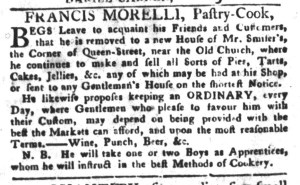
“He likewise proposes keeping an ORDINARY, every Day.”

When Francis Morelli, a pastry cook, moved to a new location in the spring of 1773, he informed “his Friends and Customers” in Charleston with an advertisement in the South-Carolina. Gazette and Country Journal.  He assured them that he continued to offer the same services, baking “all Sorts of Pies, Tarts, Cakes, Jellies,” and other pastries that customers could purchase at his shop or have “sent to any Gentleman’s House on the shortest Notice.”

Morelli also took the opportunity to announce that he “proposes keeping an ORDINARY, every Day, where Gentlemen who please to favour him with their Custom, may depend on being provided with the best the Markets can afford.”  He also served “Wine, Punch, Beer,” and other beverages.  The context makes clear to modern readers that Morelli served food.  The Oxford English Dictionary gives additional information about how the term “ordinary” was used in the British Atlantic world in the eighteenth century.

Three related definitions concern foods, including “customary fare; a regular daily meal or allowance of food; (hence, by extension) a fixed portion, an allowance of anything,” and “a meal regularly available at a fixed price in a restaurant, public house, tavern, etc. Formerly also: the company frequenting such a meal, the ‘table.’”  The OED describes the former as “Obsolete” and the latter as “Now chiefly historical.”

The third definition captures the term “ordinary” as used by Morelli in his advertisement: “an inn, public house, tavern, etc., where meals are provided at a fixed price; the room in such a building where this type of meal is provided.”  Similar to the other entries associated with foods and serving meals, this definition is “Now historical and archaic.”  The entry includes more than a dozen examples of the word in use, the earliest dating from 1590, as well as additional notes about its usage.  “In Britain in the 17th-18th centuries,” the entry explains, “the more expensive ordinaries were frequented by men of fashion, and the dinner was usually followed by gambling; hence the term was often used as synonymous with ‘gambling-house.’”  Another note addresses the use of the word in America: “In the U.S., the southern states, esp. Virginia, continued to use ordinary in this sense into the 19th cent., while other states used tavern.”

I plan to file away this advertisement for teaching purposes because it is such a great example of the English language as spoken and written in the eighteenth century sometimes requires “translation” when twenty-first century readers encounter “historical and archaic” terms, even when the words look familiar.  In addition, it presents an opportunity for teaching students how to use the Oxford English Dictionary as a “translation tool.”  I envision an in-class exercise in which I direct students to the entry for “ordinary” but allow them to seek out the relevant definitions (in this case 12a, 12b, and, especially, 12c) on their own before having a discussion about what we all learn from examining the various elements of those definitions provided by the OED.

August 5

What was advertised in a colonial American newspaper 250 years ago today?

Aug 5 - 8:5:1767 Georgia Gazette
Georgia Gazette (August 5, 1767).

“THE subscriber intends opening a COFFEE ROOM.”

Mary Hepburn placed an advertisement in the Georgia Gazette in the summer of 1767 to announce that she had entered the service and hospitality industry. She operated two related enterprises from her house, a coffee room and an ordinary. For each, she offered comparisons to similar establishments in larger cities – London and Charleston, respectively – to give readers and potential clients a frame of reference, yet also imbue her business with cosmopolitan flair.

The Oxford English Dictionary suggests that an eighteenth-century coffee room had a slightly different function than the more familiar coffeehouse. It describes a coffee room as “a public room where coffee and similar refreshments are served; now, generally, the name of the public dining-room in a hotel.” On the other hand, a coffeehouse was “a house of entertainment where coffee and other refreshments are supplied. (Much frequented in 17th and 18th c. for the purpose of political and literary conversation, circulation of news, etc.)” The OED adds an additional note that “[t]he places now so called have lost this character, and are simply refreshment-houses.” Coffeehouses had distinctive cultural functions in the early modern Atlantic world, but it does not appear that Hepburn attempted to operate that sort of establishment, at least not initially. Perhaps once she successfully established her coffee room she hoped to expand its offerings. At its initial launch, however, she limited it to breakfast alone. She did not advertise a gathering place for merchants and others to meet at all times throughout the day.

The OED also sheds light on what Hepburn and potential customers imagined when they thought of an ordinary: “an inn, public house, tavern, etc., where meals are provided at a fixed price; the room in such a building where this type of meal is provided.” (This meaning is now considered historical and archaic.) Hepburn did not, however, extend an open invitation to residents and visitors to Savannah to visit her ordinary to purchase meals. She restricted it to “eight Gentlemen” who would also board at her house for an extended period. She planned to open her coffee room immediately, but the ordinary was delayed until “the number of her boarders is compleated.”

Hepburn sold food and drink and provided lodging, yet she did not operate a tavern, an inn, or a coffeehouse. She sought to establish a different, yet related, kind of service in Savannah for select clientele, “the first attempt of this kind” in the city. If her efforts met with success, perhaps she considered expanding the scope of her enterprise, but she started on a smaller scale while she established her footing in the local marketplace.