What was advertised in a colonial American newspaper 250 years ago today?
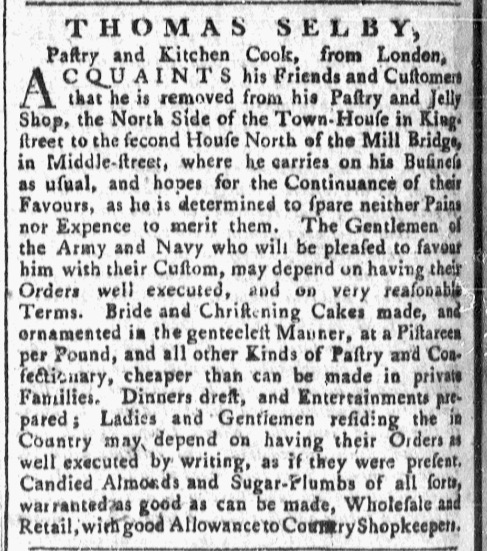
“Bride and Christening Cakes.”
Despite the distresses that Boston experienced in the fall and winter of 1774 because of the Boston Port Act, the Massachusetts Government Act, and the Quartering Act, Thomas Selby, a “Pastry and Kitchen Cook, from London,” advertised that he “carries on his Business as usual” and declared to his “Friends and Customers” that he “hopes for the Continuance of their Favours, as he is determined to spare neither Pain nor Expence to merit them.” Apparently, he did not intend to discriminate when it came to prospective customers since he also confided that the “Gentlemen of the Army and Navy who will be pleased to favour him with their Custom, may depend on having their Orders well executed.” Selby chose to look beyond politics, figuring that a customer was a customer during hard times. Notably, he advertised in the Massachusetts Gazette and Boston Post-Boy, known for its more sympathetic stance toward the government than other newspapers published by Patriot printers. He also advised “Country Shopkeepers” that he would make a “good Allowance” for those who submitted orders for “Candied Almonds and Sugar-Plumbs of all sorts.” In other words, he gave discounts for purchasing in volume to retailers outside the city.
Selby filled many kinds of orders at his “Pastry and Jelly Shop.” He prepared and sold “Pastry and Confectionary, cheaper than can be made in private Families,” making it smart and economical to engage his services. He offered the eighteenth-century version of take-out food, advertising “Dinners drest” at his shop, and catered functions for his clients, highlighting “Entertainments prepared.” In addition, he baked and decorated cakes for special events: “Bride and Christening Cakes made, and ornamented in the genteelest Manner.” Bakers occasionally advertised such items. In November 1773, for instance, Frederick Kreitner marketed “Wedding-Cakes” among the many “Sorts of Confections” that he made in Charleston. The term “bride cake” was more widely used in England and America, including in Selby’s advertisement. Such cakes contained candied fruits, symbolizing fertility and prosperity. At about the time that Selby advertised his bride cake, icing became an essential element, as Carol Wilson explains in “Wedding Cake: A Slice of History.” Selby suggested that his “Bride and Christening Cakes” featured elaborate decorations to help commemorate the occasions. Even as the imperial crisis intensified, some colonizers paused to mark important milestones, including weddings and baptisms, and incorporated special foods into those observances.