February 4

GUEST CURATOR:  Nicholas Arruda

What was advertised in a revolutionary American newspaper 250 years ago this week?
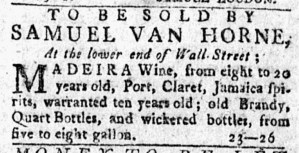
New-York Journal (February 1, 1776).

“MADEIRA Wine.”

Samuel Van Horne advertised “MADEIRA Wine, from eight to 20 years old, Port, Claret, Jamaica spirits, [and] old Brandy” in the New-York Journal on February 1, 1776.  Mentioning that the Madeira was aged between eight and twenty years might have meant that Van Horne was focusing on elite consumers who used imported wines to show their refinement since Madeira wine was not an everyday beverage.  As David Hancock explains, in the eighteenth century, Madeira was “an expensive, exotic, status-laden, and highly processed wine produced on the Portuguese island of Madeira, 500 miles west of Morocco.”[1]  Its status came from its position in Atlantic trade networks. Hancock argues that the status of the wine was created through “an Atlantic network of producers, distributors, and consumers in intense conversation with one another,” which transformed Madeira into a commodity that was recognized across the British Empire.[2]  Van Horne’s advertisement thus shows that selling aged Madeira was not just about selling alcohol but even more importantly participating in elite identity.

**********

ADDITIONAL COMMENTARY:  Carl Robert Keyes

Regular readers of the New-York Journal saw Samuel Van Horne’s advertisement for Madeira and other wines and spirits three times before they encountered it in the February 1, 1776, edition.  As the colophon at the bottom of the final page explained, “Advertisements of no more Length than Breadth are inserted for Five Shilling[s for] four Weeks, and One Shilling for each Week after, and larger Advertisements in the same Proportion.”  Many newspapers printed in the colonies solicited advertisements, but they did not always indicate the fees.  John Holt, the printer of the New-York Journal, hoped to entice advertisers by letting them know how much they would pay to insert notices in his newspaper.  The initial charge covered the space that an advertisement occupied in four consecutive issues at one shilling per week and an additional shilling for setting the type, keeping the books, and other work undertaken in the printing office.

That makes it easy to determine that Van Horne invested five shilling in running his advertisement.  Its length certainly was no more than its breadth, so the printer did not increase the fee in proportion as he did for longer advertisements.  The notation in the lower right of the advertisement, “23-26,” makes clear that Van Horne intended for the advertisement to run only for the four weeks covered by the initial expense.  “23” referred to the issue number for the first issue that carried the advertisement, “NUMBER 1723” on January 11, while “26” indicated the final issue to carry the advertisement, “NUMBER 1726” on February 1.  At a glance, the compositor knew whether to include Van Horne’s advertisement in a new issue or remove it.  The notation, intended for employees in the printing office rather than readers of the newspaper, made it unnecessary to consult a ledger, instructions from the advertiser, or other documents.  Van Horne apparently decided that he did not wish to extend the run of this advertisement.  The compositor did indeed remove it rather than publish it once again in the February 8 edition.

**********

[1] David Hancock, “Commerce and Conversation in the Eighteenth-Century Atlantic: The Invention of Madeira Wine,” Journal of Interdisciplinary History 29, no. 2 (Autumn 1998): 197.

[2] Hancock, “Commerce and Conversation,” 197.
June 25

What was advertised in a colonial American newspaper 250 years ago today?

Jun 25 - 6:25:1767 Pennsylvania Gazette
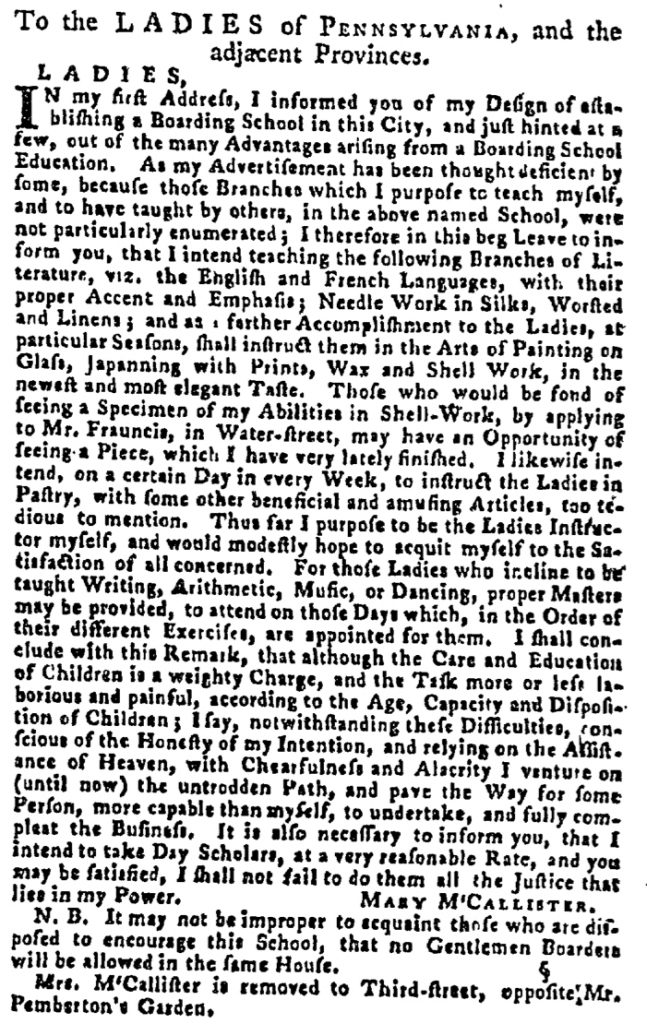
Supplement to the Pennsylvania Gazette (June 25, 1767).

“I informed you of my Design of establishing a Boarding School in this City.”

As spring gave way to summer in 1767, Mary McCallister published proposals for opening a boarding school for young women in Philadelphia. She addressed her announcement to “the LADIES of PENNSYLVANIA, and the adjacent Provinces.” Although she may have been addressing prospective students, it was equally likely that she also intended for their mothers to peruse her advertisement and contemplate sending their daughters to her boarding school. Notably, she confined her audience exclusively to women, suggesting she believed that if she could convince daughters and wives to choose her school that would be sufficient to sway fathers and husbands concerinf “the many Advantages arising from a Boarding School Education.”

The curriculum she outlined in her advertisement likely played a role in excluding men from McCallister’s efforts to market her academy. It differed significantly from the course of study described in notices about boarding schools for male scholars. McCallister supplemented instruction in “the English and French Languages” with “Needle Work in Silks, Worsted and Linens.” Her pupils could expect to become proficient in embroidery on several fabrics. Once a week, McCallister also assisted her students to cultivate their baking skills, focusing on “Pastry” in particular. In addition, she planned to rotate through lessons “in the Arts of Painting on Glass, Japanning with Prints, [and] Wax and Shell Work, in the newest and most elegant Taste.” McCallister taught all of these subjects herself, but she indicated that the curriculum could be supplemented with “Writing, Arithmetic, Music, or Dancing,” taught by “proper Masters” who would visit the boarding school at appointed times.

McCallister envisioned a school for the local gentry and middling sorts who aspired to join their ranks. Accordingly, this was not a school devoted to general education in the basics of reading, writing, and arithmetic with some sewing thrown in for good measure. Instead, it was an academy for young ladies of a certain status to learn skills in the decorative arts and other genteel pursuits that would allow them to demonstrate their affluence, leisure, and, especially, refinement to other colonists.

June 19

What was advertised in a colonial American newspaper 250 years ago today?

Jun 19 - 6:19:1767 New-Hampshire Gazette
New-Hampshire Gazette (June 19, 1767).

“He proposes to open a DANCING SCHOOL.”

Peter Curtis wished to open a dancing school in Portsmouth, New Hampshire, and inserted an advertisement to that effect in the local newspaper. In the decade before the Revolution, dancing masters frequently advertised their services in newspapers published in the largest port cities, especially Charleston, New York, and Philadelphia. Fewer of them, however, placed notices proposing to open schools or teach private lessons in smaller towns. Curtis’s advertisement in the New-Hampshire Gazette was rather out of the ordinary.

Still, Curtis must have suspected that he could cultivate a market for his skills in Portsmouth and the surrounding area. After all, the “Gentlemen” and “Ladies” he addressed in his advertisement participated in the same consumer culture as their counterparts in major port cities. Many colonists adopted various consumption practices – outfitting themselves in the latest styles and displaying fashionable furnishings and housewares – to demonstrate they belonged among the ranks of the genteel. Yet possessions alone did not guarantee that others would acknowledge the gentility of those who acquired them. Personal comportment became a measure for distinguishing the truly genteel from crass pretenders who merely made purchases. Manners, conversation, and dancing, among other pursuits, all played a role. Dancing well, completing the latest steps with grace while interacting easily with others in attendance at social gatherings, testified to an individual’s inner refinement that could not be counterfeited by wearing the right sorts of apparel and adornments. To that end, Curtis pledged to teach his pupils “in the most polite and genteel Manner.”

The colonial gentry in the major port cities availed themselves of lessons from dancing masters because they wished to assert that they were as cosmopolitan as their cousins in London. Other residents sought social mobility; they identified dancing as a means of demonstrating their own refinement matched their elite neighnors. For both, anxiety provided motivation. Curtis’s advertisement suggests that interest in dancing as a means of exhibiting refinement was not limited to urban ports in early America. Instead, with the help of advertisements to incite demand, it filtered out to smaller cities, like Portsmouth, and beyond. Curtis solicited customers “within Twenty Miles,” pledging to visit their homes for private lessons. He believed that some residents in the countryside, especially the “Gentlemen” and “Ladies” considered the local elite and who wanted to safeguard that position, could be convinced that they desired to become as cosmopolitan and refined as the better sorts in colonial cities.