February 11

Who was the subject of an advertisement in a colonial American newspaper 250 years ago today?
feb-11-georgia-gazette-slavery-2
Georgia Gazette (February 11, 1767).

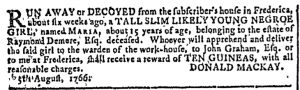
“RUN AWAY … NEGROE GIRL, named MARIA, about 15 years of age.”

This advertisement about a “TALL SLIM LIKELY YOUNG NEGROE GIRL, named MARIA” who ran away from her master would have been very familiar to readers of the Georgia Gazette. Dated August 5, 1766, it first appeared in the August 6, 1766, issue. It then appeared in almost every issue published for the next six months; the February 11, 1767, issue marked half a year that Donald Mackay inserted this runaway notice in the newspaper published in Savannah.

The longevity of this advertisement may be interpreted in more than one way. It might testify to the value that Mackay placed on Maria or how intensely he chafed for her return. As I noted when I first examined this advertisement last August, the physical description of Maria suggested that Mackay valued the “TALL SLIM LIKELY YOUNG NEGRO GIRL” for more than just her capacity to labor in the household or the fields. The expenses incurred by placing an advertisement for her return almost every week for six months (plus an award and reimbursement for “al reasonable charges” associated with Maria’s capture and transport) indicated that Mackay was willing to make a significant investment in reclaiming his human property. Maria’s potential resale value possibly more than justified such expenses.

That line of reasoning, however, assumes that Mackay instructed James Johnston, printer of the Georgia Gazette, to insert this advertisement each week and that he agreed to pay for each appearance. Like other newspapers published in smaller cities, such as the Providence Gazette, the [Portsmouth] New-Hampshire Gazette, and the [Hartford] Connecticut Courant, the Georgia Gazette featured significantly fewer advertisements than newspapers in the major urban ports. That the advertisement for the runaway Maria consistently appeared for six months may have been a function of the printer seeking to fill the pages with any sort of content, especially considering how many other advertisements in the Georgia Gazette ran for extended periods, often much longer than similar notices in newspapers published elsewhere.

Perhaps the real story combines elements of these two possibilities. Maybe Donald Mackay was so eager to have Maria returned and James Johnston was so eager to fill the columns in his newspaper that they worked out a payment schedule that included discounted rates. Whatever the circumstances, the frequency that this and other advertisements appeared in the Georgia Gazette raises suspicions that not all notices were indeed paid notices.

December 17

What was advertised in a colonial American newspaper 250 years ago today?

dec-17-12171766-georgia-gazette
Georgia Gazette (December 17, 1766).

The advertisement concerning the sale of negroes … was printed in the last page of this paper by mistake.”

James Johnston, the printer of the Georgia Gazette, issued a retraction of one of the advertisements that appeared in the December 17 issue: “The advertisement concerning the sale of negroes, &c. belonging to the estate of Mr. William Smith, deceased, was printed in the last page of this paper by mistake.”

That advertisement by Matthew Roche, the Provost Marshal, would have looked familiar to readers of the Georgia Gazette. Dated “12 Nov. 1766,” it had appeared in previous issues in order to give interested parties sufficient advance notice that slaves, cattle, horses, and fifty acres of land that included a “handsome dwelling house, garden, tan-yard, and several other convenient buildings” would be auctioned “on Tuesday the 16th day of December, 1766.”

That’s right: December 16, the day before the issue was dated and distributed for public consumption. Johnston did not publish the retraction because the sale had been canceled but instead because it truly had been printed “by mistake,” a mistake made in the office of the printer.

That Johnston overlooked this advertisement, not noticing that the new issue included an outdated advertisement until after the broadsheet had already been printed on one side, raises some interesting questions about advertisements that ran for more than a few weeks. Did advertisers contract and pay to have those advertisements repeatedly inserted? Or, did some advertisements serve as filler, published gratis, when printers lacked other content?

Johnston may have been distracted with filling the final page with advertisements already set in type; that would explain how he overlooked the date of the auction of William Smith’s estate. The same issue included other advertisements that ran for months (not just for weeks): Donald Mackay’s advertisement for a runaway slave (dated “5th August, 1766”) and the sale of Baillie’s Island by the executors of Colonel Kenneth Baillie (first published in November 1766 and repeated well into 1767). Mackay and Baillie’s executors may very well have arranged for their advertisements to appear so many times.

If they did not, however, that suggests that printers sometimes used advertisements for their own purposes in constructing complete issues of their newspapers. While it may be tempting to argue that some advertisers repeated their notices frequently because they believed in the power of advertising (or, in the case of Mackay, because he really wanted to retrieve Maria, “a TALL SLIM LIKELY NEGROE GIRL”), it is also important to question whether the advertisers themselves were indeed responsible for how frequently their notices appeared.

June 17

What was advertised in a colonial newspaper 250 years ago this week?

Jun 17 - 6:16:1766 Newport Mercury
Newport Mercury (June 16, 1766).

“TO BE SOLD By JAMES LUCENA, At his Store on the Point.”

James Lucena’s advertisement for the “BEST sort of Teneriffe Wine of the Madeira Grape” and other wines would have looked familiar to readers of the June 16, 1766, issue of the Newport Mercury. It had also appeared in the previous issue. It would look increasingly familiar over the next month. Lucena’s advertisement appeared in the Newport Mercury in six consecutive issues: June 9, 16, 23, and 30 and July 7 and 14. Although it moved around from page to page and column to column within the newspaper, the type had been set and it retained its original appearance.

Repeating an advertisement multiple times helped sellers inform potential customers about their wares, but this practice also aided in building their brand (to use today’s marketing parlance). Through sheer repetition, Lucena prompted consumers to associate the “BEST sort” of wine from Tenerife (the largest of the Canary Islands) with his shop. The brevity of this advertisement did not allow Lucena to expand on that appeal, to say more about the qualities of the wine he sold, but he may have balanced the relative costs of running a longer advertisement fewer times or a short advertisement a greater number of times. The recognition gained from having the short advertisement appear so many times may have been one of the results Lucena desired. Some readers who saw Lucena advertise “Teneriffe Wine of the Madeira Grape” likely came to associate this product with him even when his advertisement ceased its run in the Newport Mercury.

January 19

What was advertised in a colonial newspaper 250 years ago this week?

Jan 19 - 1:17:1766 New-Hampshire Gazette
New-Hampshire Gazette (January 17, 1766)

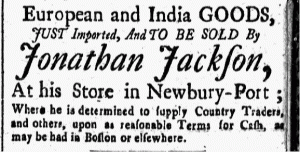
“European and India GOODS … TO BE SOLD By Jonathan Jackson, At his Store in Newbury-Port.”

Jonathan Jackson advertised his wares frequently.  Readers of the New-Hampshire Gazette would have been very familiar with his promise to sell imported goods at the same costs they would encounter in the larger port city of Boston.  Indeed, readers would have been aware of this because Jackson inserted the same advertisement in the newspaper repeatedly.  Some wholesalers and retailers that advertised regularly either revised existing notices or devised entirely new ones.  Jackson, on the other hand, repeatedly placed the same advertisement.

Nov 15 - 11:15:1765 New-Hampshire Gazette.gif
New-Hampshire Gazette (November 15, 1765)

Those who have followed the Adverts 250 Project since its origins on Twitter may recognize this advertisement and realize that I have broken one of my rules:  this advertisement was previously featured on November 15, 2015.  Why have I done this instead of providing new content?  Jackson’s (repeated) advertisement raises several issues that merit consideration when considering the history of marketing in early America.  I’ll raise two of them here.

First, did Jackson actually place this advertisement after its initial appearance?  Or was the printer responsible for each subsequent insertion?  Did it generate revenue for the printer?  Or, as a relatively short advertisement, was convenient for filling space?

In addition, did readers and potential customers pay any attention to this advertisement over time?  The promise that merchandise was “JUST Imported” certainly lost its luster over time.  The advertisement continued to prompt potential customers to visit Jackson’s shop.  Perhaps that was sufficient justification for repeating it throughout the winter months, especially since new ships were unlikely to arrive during that period.