May 28

What was advertised in a revolutionary American newspaper 250 years ago this week?

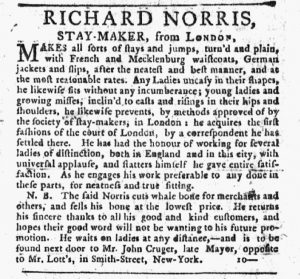
New-York Journal (May 25, 1775).

He has settled a Correspondence in London, whereby he acquires the first fashions of the Court.”

Richard Norris, a “STAY MAKER, from LONDON,” regularly placed advertisements in New York’s newspapers during the era of the American Revolution.  Even as the imperial crisis heated up following the battles at Lexington and Concord in the spring of 1775, he emphasized his connections to London and knowledge of the current fashions there as he marketed the corsets he made.  After all, most colonizers still looked to the largest and most cosmopolitan city in the empire for the latest trends even if they happened to have concerns with how the Coercive Acts and other abuses perpetrated by Parliament.

In an advertisement in the May 25, 1775, edition of the New-York Journal, for instance, Norris declared that he fitted his clients “by methods approved by the Society of Stay Makers in London” and noted that he “has had the honour of working for several ladies of distinction, both in England and this City, with universal applause.”  By that time, he had been in New York for nearly a decade.  He placed an advertisement in the New-York Mercury on March 3, 1776.  The Adverts 250 Project first featured Norris with his advertisement that ran in the New-York Journal on June 23, 1768.  Even though he continued to describe himself as a “STAY MAKER, from LONDON” in 1775, it had been quite some time since he practiced his trade there.  Yet his clients did not need to worry about that because Norris “has settled a Correspondence in London, whereby he acquires the first fashions of the Court.”  That being the case, he proclaimed with confidence that he delivered the “newest fashions from London.”  In addition, he asserted “his work to be as good as any done in these parts, for neatness [and] true fitting.”

Norris also resorted to a familiar marketing strategy, encouraging women to feel anxious about their appearance, especially the shape of their bodies, to convince them to seek out his services.  He addressed “Ladies who are uneasy in their shapes” and emphasized that wearing his stays “prevents the casts and risings in the hips and shoulders of young Ladies and growing Misses, to which they are often subject.”  Norris considered this copy so effective that he recycled it several times over the years, honing a strategy that eventually became a staple of marketing in the modern beauty industry.
April 4

What was advertised in a colonial American newspaper 250 years ago this week?

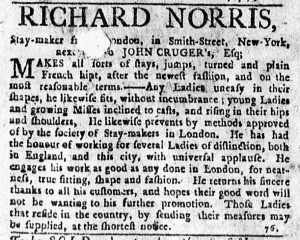
New-York Journal (April 1, 1773).

“Any Ladies uneasy in their shapes, he likewise fits, without incumbrance.”

Richard Norris billed himself as a “Stay-maker from London” even though he had resided and worked in New York for several years by the time he published his advertisement in the April 1, 1773, edition of the New-York Journal.  He considered his connection to the largest and most cosmopolitan city in the empire a selling point.  Norris informed readers that he previously served the best sorts of clients on both sides of the Atlantic, declaring that he “has had the honour of working for several Ladies of distinction, both in England, and this city.”  The quality of his stays (or corsets) and his skill in producing them yielded “universal applause” from his clients.

Although Norris had been in New York for some time, he also suggested that he maintained his connection to London.  For instance, he made stays “after the newest fashion” in that city.  In another advertisement, he described how he “acquires the first fashions of the court of London by a correspondent he has settled there.”  Furthermore, he adhered to “methods approved of by the society of Stay-makers in London” in designing and making his stays, especially those for “young Ladies and growing Misses inclined to casts, and rising in their hips and shoulders.”

Norris frequently coupled appeals to the latest fashions from London with attempts to make women feel anxious about their bodies.  “Any Ladies uneasy in their shapes, he likewise fits, without incumbrance,” the staymaker asserted in 1768 and reiterated in 1770 and 1773.  In return for helping them address purported physical shortcomings that he helped them to overcome (or at least disguise) with his stays, Norris asked his clients to recommend him to others.  He extended “his sincere thanks to all his customers, and hopes their good word will not be wanting to his further promotion.  Not unlike modern marketing for clothing and beauty products, Norris encouraged “young Ladies and growing Misses” to feel uncomfortable with their bodies, purchase his product to ease their anxieties, and reward him for his part in addressing a supposed shortcoming that he highlighted and did not allow them to overlook.

October 4

What was advertised in a colonial American newspaper 250 years ago today?

New-York Journal (October 4, 1770).

“They render the skin delicately white and soft.”

Amid advertisements for textiles and housewares. James Thompson marketed cosmetics in the New-York Journal in September and October 1770.  He informed readers that he had recently acquired a “Parcel of the Queen’s pearl wash balls” that would “render the skin delicately white and soft.”  For only three shillings, consumers could use this balm for “removing sun burning, freckles, roughness of the skin, and pimples.”  Thompson also presented this product as a restorative for their skin after contracting smallpox, recommending that they dissolve the “Queen’s pearl wash balls” in milk for maximum effectiveness.  Upon applying the mixture to the face, neck, arms, and hands, they would discover that it “heals the skin, takes off the redness, and prevents it from being pitted or marked.”  Thompson also declared that the product was “well known and esteemed by the nobility and gentry in Europe, particularly in England and France.”  He encouraged consumers to associate celebrities and cosmetics in the eighteenth century, anticipating the famous spokespeople, predominantly women, who would promote cosmetic lines and brands in the twentieth and twenty-first centuries.

Thompson also stocked “La Cieur’s celebrated ointment for thickening and preserving the hair.”  He received his inventory “from the original warehouse.”  This ointment both “prevents the hair from falling off” and “when rubbed on bald places, with certainty promotes its growth.  In marketing the “Queen’s pearl wash balls” and “La Cieur’s celebrated ointment,” Thompson encouraged colonists to experience anxiety about their appearance and make purchases to alleviate them.  Richard Norris, a staymaker, adopted a similar strategy in his advertisements that ran for months in the New-York Journal.  He addressed “Ladies uneasy in their shapes,” especially “young ladies and growing misses.”  Thompson did not target female consumers exclusively, though women may have been his primary audience.  Norris, on the other hand, specifically sought to stoke anxiety among female consumers and promised them relief from their apprehensions about their appearance.  Such trends continue today, with marketers playing on the apprehensions of all consumers but targeting women much more intensively when it comes to cosmetics and other products intended to enhance their appearance and “correct” any shortcomings.

January 14

What was advertised in a colonial American newspaper 250 years ago this week?

Jan 14 - 1:11:1770 New-York Journal
New-York Journal (January 11, 1770).

“Any Ladies uneasy in their shapes, he likewise fits without any incumberance.”

Richard Norris, “STAY-MAKER, from LONDON,” made a variety of appeals to prospective customers in an advertisement he inserted in the January 11, 1770, edition of the New-York Journal. When it came to making stays (corsets) and other garments, he promised high quality (“the neatest and best manner”) and low prices (“the most reasonable rates”). He proclaimed the superiority of his work compared to local competitors, stating that his stays were “preferable to any done in these parts, for neatness and true fitting.”

Norris developed two appeals in even greater detail. In one, he emphasized his London origins and continuing connections to the empire’s largest city. Despite political tensions between Parliament and the colonies, London remained the metropolitan center of fashion. Norris assured prospective clients that “he acquires the first fashions of the court of London, by a correspondent settled there.” Although the staymaker had migrated to the colonies, he maintained access to the latest styles in the most cosmopolitan of cities in the British Atlantic world. He also underscored that he constructed stays according to “methods approved of by the society of stay-makers, in London,” implying that his training and experience in that city ranked him above any of his rivals in New York.

While most of these appeals focused on Norris and his abilities, the other strategy that he developed in greater detail targeted female readers of the New-York Journal. He attempted to incite demand for his services by prompting women to feel “uneasy in their shapes.” He made a special point of exhorting “young ladies and growing misses” to question whether they were “inclin’d to casts and risings in their hips and shoulders,” compelling them to imagine that their bodies were misshapen. Young women could hide such imperfections from observers by wearing the stays that Norris made and sold, even though they would retain the knowledge that there was supposedly something wrong or undesirable about their bodies. In eighteenth-century America, quite like today, advertisers often relied on provoking anxieties among consumers, especially young women, and offering to reduce those anxieties as a means of promoting their products.

June 23

What was advertised in a colonial American newspaper 250 years ago today?

Jun 23 - 6:23:1768 New-York Journal
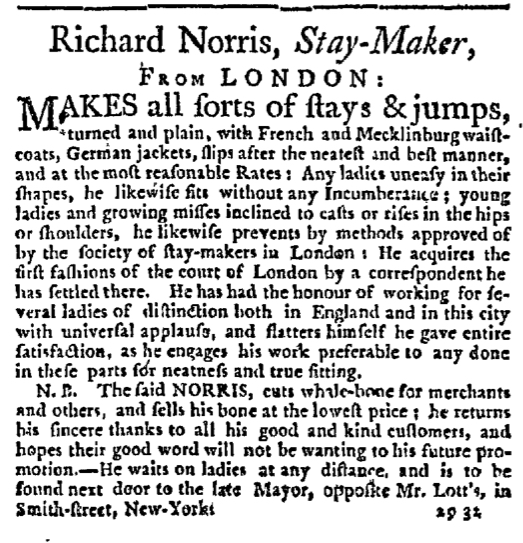
New-York Journal (June 23, 1768).

“Young ladies and growing misses inclined to casts or rises in the hips or shoulders, he likewise prevents.”

Richard Norris, a “Stay-Maker, FROM LONDON,” followed many of the usual conventions in the advertisement he placed in the June 23, 1768, edition of the New-York Journal, but he also included one significant innovation. After informing prospective clients of the variety of stays and other garments he made, he also noted that “Any ladies uneasy in their shapes, he likewise fits without any Incumberances.” Furthermore, “Young ladies and growing misses inclined to casts or rises in the hips or shoulders, he likewise prevents by methods approved of by the society of stay-makers in London.” Staymakers regularly offered implicit commentary about women’s appearances in their advertisements, but Norris explicitly named reasons that women might feel uncomfortable about their bodies. He purposefully attempted to induce anxiety about their physical features among female readers as a means of attracting clients.

He gave priority to that marketing strategy before turning to more common appeals made by staymakers and others in the garment trades. He asserted that he produced apparel as fashionable as any currently worn in London, rather than lagging behind the styles en vogue in the cosmopolitan center of the empire. Prospective patrons could be confident this was the case because Norris “acquires the first fashions of the court of London by a correspondent he has settled there.” Norris realized some sort of research was necessary and cultivated a relationship to make sure he received the most current information about the fashions currently popular among the most influential women in England. In addition, he had previously served prominent women of taste, having “had the honour of working for several ladies of distinction both in England and in this city.” Not only had he made stays and other garments for the elite, his efforts had earned him “universal applause” among his clients.

Like many artisans, Norris emphasized skill and quality in addition to his extensive experience. He pledged that he made garments “after the neatest and best manner,” but in addition to invoking that familiar phrase he proclaimed “his work preferable to any done in these parts for neatness and true fitting.” In other words, Norris considered himself the best staymaker in New York – and encouraged readers of the New-York Journal to adopt that attitude as well.

Norris combined several common appeals with an innovative marketing strategy designed to cause or enhance uneasiness among women by explicitly mentioning various qualities of their bodies. He offered the standard appeals as a remedy to those concerns. Like many modern advertisers, especially advertisers of products intended primarily for women, he attempted to create anxiety among prospective customers and then conveniently provided consumption of his goods and services as the remedy.