
What was advertised in a colonial American newspaper 250 years ago today?
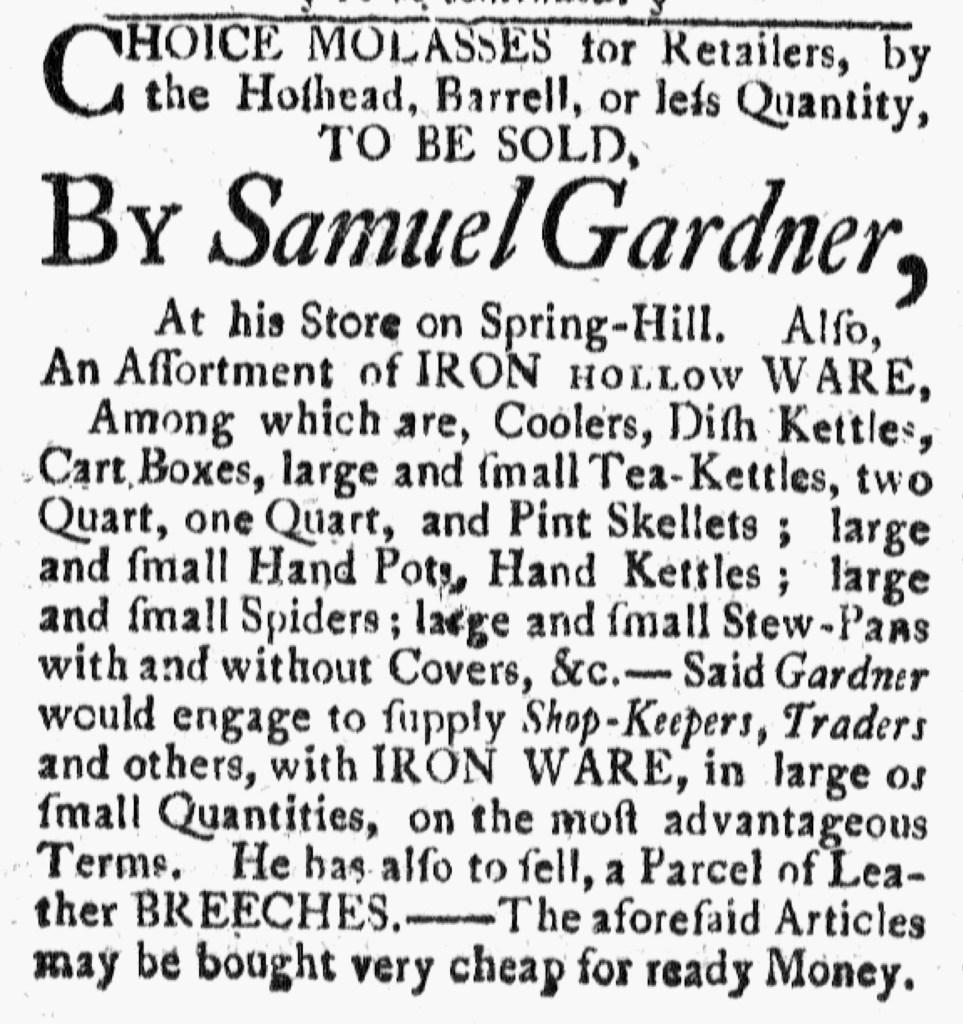
“TO BE SOLD, BY Samuel Gardner, At his Store on Spring-Hill.”
When it came to interspersing advertisements among news, editorials, and other content in colonial newspapers, the New-Hampshire Gazette was the exception to the rule. Not all newspapers took the same approach to where advertisements appeared, but they generally avoided mixing advertisements and other content. For instance, some newspapers reserved advertising for the final pages, printing all the news and editorials first, then the shipping news from the custom house to signal the transition to advertising, and finally the paid notices. Others ran advertising on the first and last pages, printed first on the same side of the broadsheet, and saved the second and third pages for the latest news that arrived. In some instances, news and advertising appeared on the same page. The front page, for example, could include a column of paid notices and two columns of news with the advertisements in either the left column or the right column. No matter the order, individual advertisements did not appear interspersed with news …
… except in the New-Hampshire Gazette. Daniel Fowle, the printer, took a novel approach that may have looked haphazard to contemporary readers, though later generations came to expect news and advertising alternating in newspapers. The layout of the New-Hampshire Gazette often required active reading to determine which portions featured advertising and which delivered news. Consider the December 30, 1774, edition. A short advertisement placed by George Whipple, “Attorney at LAW,” ran as the first item in the first column on the first page. News constituted the remainder of the content on that page. The second page began with news from the “Continental Congress continu’d” from the previous issue.” It spilled over into a second column, followed by an advertisement for goods available at Samuel Gardner’s store, and then a lengthy essay about conditions in Boston by “MASSACHUSETTENSIS.” That essay occupied most of the third page. Three advertisements completed the third column. More news and editorials appeared in the first column on the final page. In addition, news from New York and the shipping news from the custom house ran at the top of the third column. George Craigie’s lengthy advertisement for “A General Assortment of English Goods” interrupted the news and editorials. Half a dozen advertisements appeared below the shipping news in the final column. In other issues, Fowle interspersed short advertisements and short news items even more indiscriminately, giving readers of the New-Hampshire Gazette a different sort of visual experience in terms of organizing content compared to what they encountered in other colonial newspapers.