
What was advertised in a colonial American newspaper 250 years ago today?
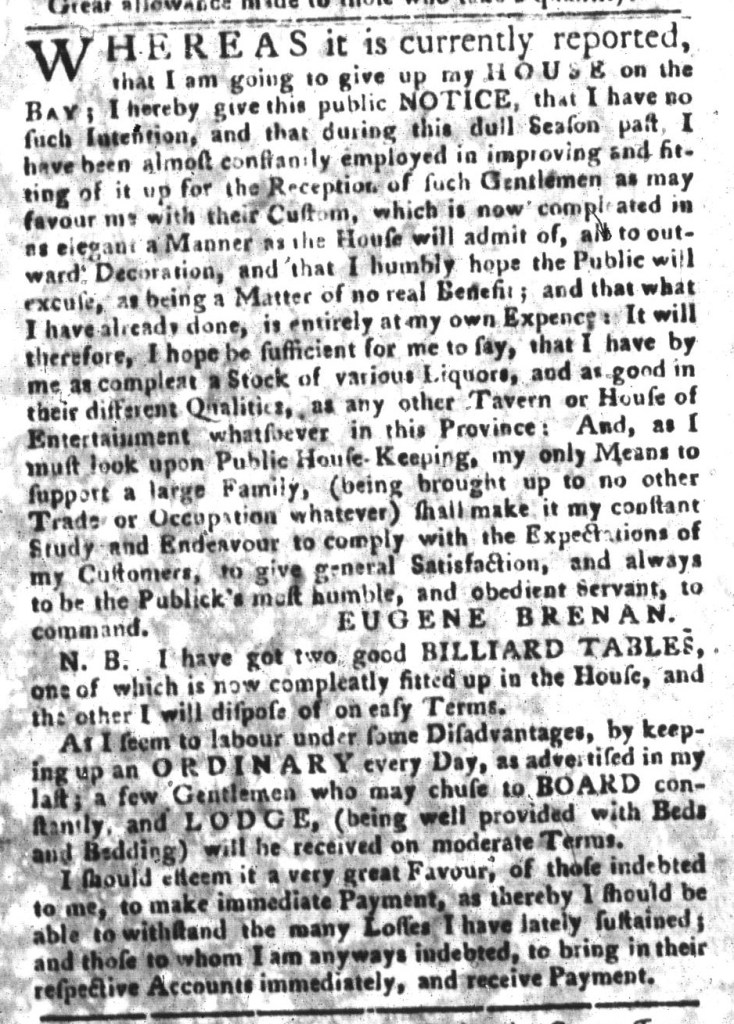
“As compleat a Stock of various Liquors … as any other Tavern or House of Entertainment whatsoever in this Province.”
Eugene Brenan worried that rumors purporting that he planned to “give up my HOUSE on the BAY” would damage business at his public house in Charleston. To dispel whatever gossip circulated about the fate of his establishment, he ran an advertisement in the December 7, 1773, edition of the South-Carolina Gazette and Country Journal. Though he acknowledged “many Losses …lately sustained,” he underscored his determination to run a public house that rivaled all others. Quite the opposite of what some reported about Brenan closing his doors, he had been “constantly employed in improving” and furnishing his public house “for the Reception of such Gentlemen as may favour [him] with their Custom.” His guests would convene in a gathering space “as elegant … as the House will admit of.” The “outward Decoration,” however, did not matter as much as other amenities that Brenan provided.
He attempted to entice customers with promises of “as compleat a Stock of various Liquors, and as good in their different Qualities, as any other Tavern or House of Entertainment whatsoever in this Province.” Whatever their tastes, gentlemen could order their favorite spirits at Brenan’s public house. He also equipped the establishment with a billiard table for the enjoyment of his patrons, allowing for some friendly competition as they socialized and sampled the “various Liquors.” Brenan encouraged readers to think of spending time at his public house as an experience, one that he “shall make it [his] constant Study and Endeavour to comply with the Expectations of [his] Customers.” He was especially motivated “to give general Satisfaction” because he had been “brought up to no other Trade or Occupation whatever.” Brenan put all of his energy into “Public House-Keeping” and tending to his patrons. Whatever the gentlemen of Charleston thought they knew about Brenan’s alleged plans to close his public house, he hoped that an advertisement setting the record straight would convince them to visit and see for themselves the improvements he made, sample the liquors he stocked, play billiards, and socialize with friends and acquaintances. Through his endeavors to serve them, Brenan suggested, his customers would discover a public house as comfortable and inviting as any in the bustling port of Charleston.