January 9

What was advertised in a colonial American newspaper 250 years ago this week?
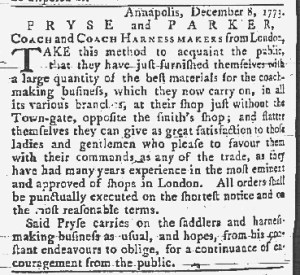
Maryland Gazette (January 6, 1774).

“They have had many years experience in the most eminent and approved of shops in London.”

The partnership of Pryse and Parker constructed coaches and other sorts of carriages as well as harnesses at their shop in Annapolis.  In December 1773, they placed an advertisement in the Maryland Gazette to inform prospective customers that they “just furnished themselves with a large quantity of the best materials for the coach-making business.”  They introduced themselves as “from London,” though that did not necessarily mean that they were recent arrivals in Annapolis.  After all, some artisans continued to burnish their London credentials for years after they set up shop in colonies.  Pryse and Parker’s advertisement did not indicate how long they had pursued their trade in town, though a brief note at the end advised that Pryse “carries on the saddlers and harness-making business as usual, and hopes … for a continuance of encouragement from the public.”  That suggested that Pryse had been in Annapolis long enough to gain some familiarity, even if the partnership with Parker was relatively new.  Just over a year earlier, Pryse did indeed advertise on his own.

No matter how long they had been making carriages in Annapolis, Pryse and Parker considered it helpful to their marketing efforts to tout their connections to the most cosmopolitan city in the empire.  In addition to identifying themselves as “from London,” they trumpeted that “they have had many years experience in the most eminent and approved of shops in London.”  Although they stated that they “flatter themselves they can give as great satisfaction to those ladies and gentlemen who please to favour them with their commands, as any of the trade,” Pryse and Parker thought that the time they labored in those “most eminent and approved of shops in London” should distinguish them from their competitors.  They expected that the local gentry who could afford to purchase and maintain coaches and carriages would place a premium on acquiring those items from artisans with the kind of background they boasted.  Even as colonizers protested against the Tea Act and other measures enacted by Parliament, many of them continued to consider links to London a selling point when engaging the services of artisans.

November 26

What was advertised in a colonial American newspaper 250 years ago today?

Maryland Gazette (November 26, 1772).

“The Publick have been greatly imposed on by many botching Pretenders.”

Artisans often highlighted their skill and experience in their advertisements.  Their skill and experience, they asserted, meant that prospective customers could depend on them producing items of the best quality.  Most artisans who placed newspaper advertisements focused on their own skill and experience, though occasionally some chose to denigrate their competitors.  John Simnet, a watchmaker, for instance, engaged in public feuds with his competitors, first in the New-Hampshire Gazette and later in newspapers published in New York.  Thomas Pryse, a “Coach-Harness-maker, Saddler, and Upholsterer,” did not make as direct references to his competitors, but he did take an aggressive tone in his advertisement in the November 26, 1772, edition of the Maryland Gazette.

Pryse announced that he “opened a Shop … where he intends carrying on his Trade in all its Branches.”  He boasted that he did his work “in a Manner superior to any that ever has attempted it in these Parts,” leaning into his London origins and the training and experience that he gained there before migrating to Annapolis.  Such appeals looked a lot like others deployed by artisans, but Pryse then turned up the temperature.  In a derisive tone, he declared that “the Publick have been greatly imposed on by many botching Pretenders to that Branch of Business,” prompting him to make assurances that “he is the only one that has been regularly bred” or trained “to Harness-making now in this Province.”  That being the case, Pryse was “determined to exert his best Endeavours to give Satisfaction to those that please to favour him with their Custom.”  Following his attack on his competitors, he reverted to promises of customer service that mirrored those that appeared in advertisements placed by other artisans.  Having made his point that his work was supposedly “superior” to anything made by “botching Pretenders,” he concluded with a list of items he made, sprinkling in phrases like “in the neatest and most approved manner” and “done in the best manner” to underscore his skill and experience.

Even if prospective customers did not care for Pryse’s tone in his advertisement, he challenged them to question the quality of the harnesses, saddles, and upholstery produced by his competitors.  In seeding doubts and suggesting that he did better, he may have hoped to convince some consumers to give him a chance even if they had previously been happy with work by other aertisans.