
What was advertised in a revolutionary American newspaper 250 years ago today?
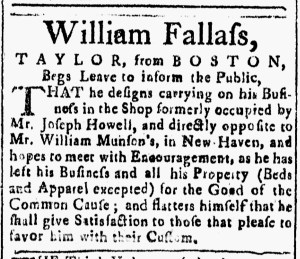
“He has left his Business and all his Property … for the Good of the Common Cause.”
In the summer of 1775, William Fallass, a “TAYLOR, from BOSTON,” relocated to New Haven, Connecticut. Upon arriving in town, he placed a newspaper advertisement to introduce himself to his new neighbors and prospective customers. Fallass announced that he “designs carrying on his Business in the Shop formerly occupied by Mr. Joseph Howell … and hopes to meet with Encouragement.” The locals did not yet know him or his work by reputation, prompting him to declare that he “flatters himself that he shall give Satisfaction to those that please to favor him with their Custom.” The newcomer pledged his best efforts for his clients.
He also offered another reason that residents of New Haven should hire his services. He had not planned to relocate to another town but instead “left his Business and all his Property (Beds and Apparel excepted) for the Good of the Common Cause.” The battles at Lexington and Concord and the ensuing siege of Boston upended Fallass’s life and livelihood. In late April, the Massachusetts Provincial Congress, meeting in Watertown, negotiated with General Thomas Gage, the governor, for safe passage in or out of Boston. Loyalists could move into the city; Patriots and others could depart. In each instance, they could take their “Effects” with them, “excepting their Fire-Arms and Ammunition.” The unfortunate Fallass did not manage to move most of his “Effects,” just his clothing and bedding. He hoped that sacrifice “for the Good of the Common Cause” would endear him to prospective clients and entice them to do business with him, a refugee.
In that regard, Fallass made a more explicit appeal than Polly Allen and Lucy Allen, milliners and mantuamakers from Boston, did when they ran a newspaper advertisement in Providence earlier in the week. In both cases, however, advertisements help in tracing the movement of men and women who departed Boston during the siege. They did not merely leave the city for the countryside; many relocated to other colonies and attempted to revive their businesses in new places as the Revolutionary War began. Articles and “letters of intelligence” relayed some accounts of current events, yet advertisements played another role in revealing the effects of the war on some colonizers.