
GUEST CURATOR: Mary Aldrich
What was advertised in a colonial newspaper 250 years ago today?

“TO BE SOLD By Barnabas Clarke, Near Liberty-Bridge.”
This advertisement caught my eye because it mentioned Liberty Bridge in Portsmouth, New Hampshire. Almost yearly, I have visited Portsmouth, but have never heard of a Liberty Bridge. It turns out that the Liberty Bridge got its name in the year 1766 in connection with the Liberty Pole. On March 22, 1765, King George III signed the Stamp Act, which did not go into effect until November of that same year. It was later repealed on March 18, 1766, because of the strong opposition it met.
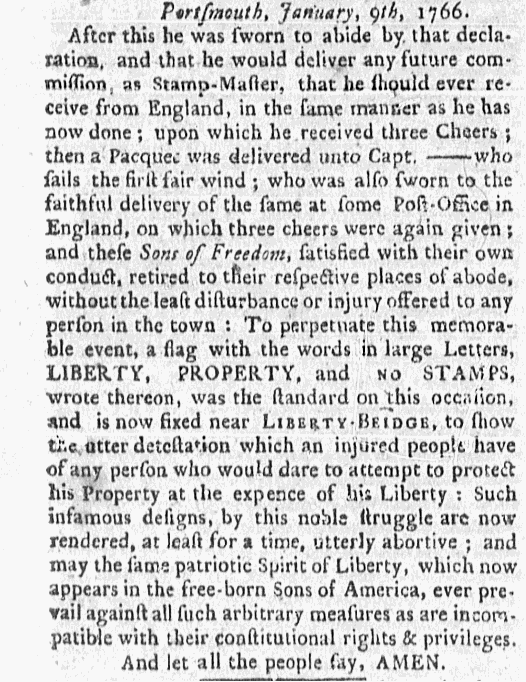
On January 6, 1766, a group of men who called themselves the Sons of Liberty made an effigy of George Grenville, the author of the Stamp Act, paraded it around, and burned it. To commemorate this event they erected a Liberty Pole bearing a flag with “LIBERTY, PROPERTY, and NO STAMPS.” On January 20, the Boston Evening-Post wrote up a story a few weeks after the event.
The Liberty Bridge was the bridge that crossed what used to be Puddle Dock, which has since been filled in. The Liberty Pole did not get its official marker or a permanent pole until 1824. But the Liberty Bridge was notable enough and recent enough to be prominently displayed in this advertisement. People of the region would also have known exactly where this landmark was and would have been able to find the shop.
**********
ADDITIONAL COMMENTARY: Carl Robert Keyes
Even as Barnabas Clarke sold goods imported from England, the location he listed in his advertisement testified to the place he believed he and his fellow colonists inhabited in the British Empire. This place was not exclusively a geographic location but rather a sense of identity. “Near Liberty-Bridge” told potential customers where to find Clarke’s shop, but it also indicated the customary rights and privileges that Clarke and other colonists asserted they possessed. Mary selected an advertisement that, once again, demonstrates that advertising and consumption took on a political valence and encouraged colonists to think about the meanings of goods – social, cultural, and political – in the era of the American Revolution.

The Stamp Act had been repealed on March 18, 1766, ten days before this advertisement appeared, although it would take several weeks for word to arrive in the colonies. When that happened, colonists would also learn that the repeal of the Stamp Act had been accompanied by passage of the Declaratory Act, which asserted that Parliament had the authority to oversee and regulate the colonies. Liberty Poles and Liberty Bridges would continue to serve as potent symbols to colonists.

This advertisement also suggests how quickly colonists reconceived their surroundings. I have previously featured two advertisements Barnabas Clark(e) published in the New-Hampshire Gazette, one on November 1765 and the other in December 1765.* Both predated the activities of the Sons of Liberty on January 6, 1766, that Mary described. Protests by the Sons of Liberty were significant in their own right, but perhaps became increasingly effective as colonists remembered, commemorated, and incorporated them into their daily lives, including listing the location of their shops as “Near Liberty-Bridge.”
**********
*These two advertisements appeared via #Adverts250 on Twitter, prior to this blog launching on January 1, 2016.
[…] chosen an advertisement that mobilized politics in the service of marketing consumer goods. Like Monday’s advertisement that indicated Barnabas Clarke’s shop was located “Near Liberty-Bridge,” Adam Collson […]
[…] and their conceptions of the spaces and places around them, including Barnabas Clarke’s shop “Near Liberty-Bridge” in Portsmouth, New Hampshire, and Adam Collson selling wool “Under the TREE of LIBERTY” in […]
[…] the Mill Dam.” These directions referenced an important landmark with renewed significance: the Liberty Bridge. The Townshend Act went into effect a week earlier, spurring heightened anxieties and contemplation […]
[…] in Portsmouth, New Hampshire, took similar steps when they stated their location in relation to “Liberty-Bridge.” Even if advertisers did not actively endorse particular political positions, their use of […]
[…] colonies, erected a liberty pole that flew a flag that read “LIBERTY, PROPERTY, and NO STAMPS,” according to an account that appeared in the January 20, 1766, edition of the Boston Evening-Post. That same account […]
[…] the Stamp Act that went into effect on November 1, 1765. In November 1765, Barnabas Clarke ran an advertisement that did not include any directions to his shop. A month later, he simply stated that prospective […]
[…] shops that invoked familiarity with recent events (such as stating that a shop was located “Near Liberty-Bridge“). Many colonists were energized to boycott goods imported from Britain, hoping to gain […]