
What was advertised in a colonial American newspaper 250 years ago today?
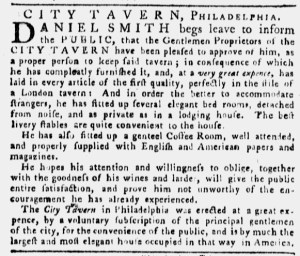
“Perfectly in the stile of a London tavern.”
In February 1774, Daniel Smith took to the pages of the Pennsylvania Gazette and the Pennsylvania Packet to promote his latest enterprise, the City Tavern in Philadelphia. Residents of the urban port had witnessed the building and marketing of the tavern. As Smith explained, the building “was erected at a great expence, by a voluntary subscription of the principal gentlemen of the city.” He billed it as “the largest and most elegant house in that way,” meaning a tavern and inn, “in America.” The previous summer, the proprietors ran an advertisement seeking a tavernkeeper with “an active, obliging disposition” to rent the building, still under construction with completion expected by September, and operate it “for the convenience and credit of the city.” Those “Gentlemen Proprietors” wanted the largest and most cosmopolitan city in the colonies to have a tavern that rivaled any found in London.
Smith asserted that he achieved that goal, doing so “at a very great expence.” He proclaimed that he furnished the building and stocked the storerooms with every necessity. He “laid in every article of the first quality, perfectly in the stile of a London tavern,” just as envisioned by the affluent subscribers who made the City Tavern one of their projects for improving the bustling urban port and enhancing the city’s reputation throughout the British Atlantic world. The amenities included a “genteel Coffee Room” where merchants and others could socialize and conduct business. He “supplied English and American papers and magazines” for their entertainment, but also so they could track the shipping news, prices current, and current events that had an impact on their businesses. Perhaps his subscriptions included the new Royal American Magazine, the only magazine published in the colonies at the time, demonstrating to his patrons the efforts he made to provide the latest and most interesting publications. For “strangers” or visitors to the city, Smith “fitted up several elegant bed rooms, detached from noise,” and the “best livery stables,” located “quite convenient to the house.” Smith expected that all those features, along with “the goodness of his wines and larder,” would “give the public entire satisfaction.”
The City Tavern quickly became a popular meeting place, especially as the imperial crisis intensified. In addition to merchants and the local gentry frequenting the establishment as part of their everyday routines, concerned citizens met there to debate and discuss politics. In May 1774, just three months after Smith ran his advertisement, more than two hundred of them gathered at the City Tavern to determine how to respond to messages from Boston in the wake of the Boston Port Act that closed the port until the colonizers paid for the tea destroyed during the Boston Tea Party. When the First Continental Congress met in Philadelphia in September and October 1774, many influential leaders from throughout the colonies dined and drank at the City Tavern. John Adams praised it as “the most genteel [tavern] in America.”[1]
**********
[1] See entry for August 29, 1774, in John Adams diary 21, 15 August – 3 September 1774 [electronic edition]. Adams Family Papers: An Electronic Archive. Massachusetts Historical Society. http://www.masshist.org/digitaladams/
[…] In February 1774, Daniel Smith took to the pages of the Pennsylvania Gazette and the Pennsylvania Packet to promote his latest enterprise, the City Tavern in Philadelphia. Residents of the urban port had witnessed the building and marketing of the tavern. As Smith explained, the building “was erected at a great expence, by a voluntary subscription of the principal gentlemen of the city.” He billed it as “the largest and most elegant house in that way,” meaning a tavern and inn, “in America.” The previous summer, the proprietors ran an advertisement seeking a tavernkeeper with “an active, obliging disposition” to rent the building, still under construction with completion expected by September, and operate it “for the convenience and credit of the city.” Those “Gentlemen Proprietors” wanted the largest and most cosmopolitan city in the colonies to have a tavern that rivaled any found in London. Smith asserted that he achieved that goal, doing so “at a very great expence.” He proclaimed that he furnished the building and stocked the storerooms with every necessity. Read more… […]
[…] the City Tavern opened in Philadelphia, Daniel Smith inserted advertisements in the Pennsylvania Gazette and the Pennsylvania Packet in February 1774. The opening had been […]