
What was advertised in a colonial American newspaper 250 years ago today?
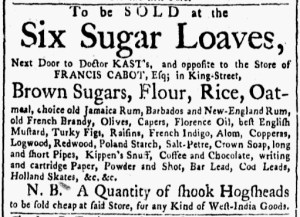
“To be SOLD at the Six Sugar Loaves.”
It was an unusual headline for an advertisement. The name of the store served as the headline, distinguishing it from the other notices in the March 1, 1774, edition of the Essex Gazette. In newspapers throughout the colonies, the name of the merchant, shopkeeper, or artisan often appeared as the headline. Such was the case for advertisements placed by John Appleton, Benjamin Coats, George Deblois, John Prince, and Nathaniel Sparhawk in that issue of the Essex Gazette. Sometimes the merchandise, product, or service served as the headline, as in Walter P. Bartlett’s notice promoting “Garden Seeds,” Ezekiel Price’s advertisement for “INSURANCE,” and auctioneer W.P. Bartlett’s notice about an upcoming “PUBLIC VENDUE.”
In contrast, an unnamed advertiser advised readers of the Essex Gazette that he or she sold a variety of groceries and other wares “at the Six Sugar Loaves … in King-Street.” No doubt the name of the shop matched the image on a sign that marked its location. Other advertisements did not mention shop signs and only a couple made any reference to anything like a shop name. Price gave his location as “the Insurance-Office” and Appleton stated that his store was located “next Door above the PRINTING-OFFICE.” In both instances, the name described the primary enterprise undertaken at each business. The “Six Sugar Loaves” suggested only one of the many commodities sold in that shop. The inventory in the advertisement led with “Brown Sugars” yet also included “Flour, Rice, Oatmeal,” a variety of spirits, olives, “Turkey Figs, Raisins,” “Coffee and Chocolate,” and even soap, pipes, and “Powder and Shot.” The sign that gave its name to the store depicted one kind of merchandise sold there.
Appearing in a large font, the “Six Sugar Loaves” may have been as prominently visible on the page of the Essex Gazetteas the sign it represented was on King Street in Salem. Its inclusion in a newspaper advertisement testifies to the visual landscape of commerce and consumer culture that colonizers encountered as they traversed the streets of port cities on the eve of the American Revolution. Very few of those signs survive today, but advertisements catalog their extensive use in early America.