
What was advertised in a colonial American newspaper 250 years ago today?
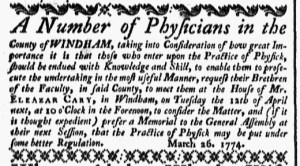
“… that the Practice of Physick may be put under some better Regulation.”
A “Number of Physicians in the County of WINDHAM” inserted an advertisement in the Connecticut Gazette in the spring of 1774. In it, they professed that they had been contemplating “how great Importance it is that those who enter upon the Practice of Physick, should be endued with Knowledge and Skill.” That was necessary, the physicians asserted, “to enable them to prosecute the undertaking in the most useful Manner,” achieving the best results for their patients. That being the case, they called a meeting of “their Brethren of the Faculty” in Windham County to discuss “the Matter, and (if it thought expedient) prefer a Memorial” or petition “to the General Assembly … that the Practice of Physick may be put under some better Regulation.” At a glance, their notice suggested that increased professionalization in their field would yield better care for patients.
The timing of their advertisement, however, suggests that this “Number of Physicians” may have had other motivations. A call for “some better Regulation” may have been an attempt to reduce or eliminate competition from others who provided various forms of medical treatment. Consider the testimonial about the hernia trusses “made and applied by Mr. STEPHEN JOHNSON, of Ashford, in Windham-County” that first ran in the March 25 edition of the Connecticut Gazette. Then note the date, March 26, on the announcement from the “Number of Physicians.” Did a “Number of Physicians” actually consult with each other before inserting that advertisement in the next issue of the Connecticut Gazette? Or did one of them see the testimonial about the trusses that proclaimed Johnson “hath the greatest Skill in that Business of any Man we ever heard of” and determine that such competition threatened the livelihoods and, just as significantly, the status of physicians in the area? Perhaps a single physician called the meeting, hoping to rally support among others. The advertisement also served as a counterpoint to the testimonial about Johnson’s trusses, especially when both appeared in the Connecticut Gazette on April 1 and on the same page on April 8.
Professionalization of the medical field accelerated in the late eighteenth century. Doctors displaced midwives, but women who provided care were not the only targets of physicians who received formal training. These two advertisements seem to tell a story of a “Number of Physicians” (or perhaps just one with a lot of initiative) to limit the medical treatment delivered by other men who did meet the standards of the “better Regulation” they envisioned.