
What was advertised in a colonial American newspaper 250 years ago today?
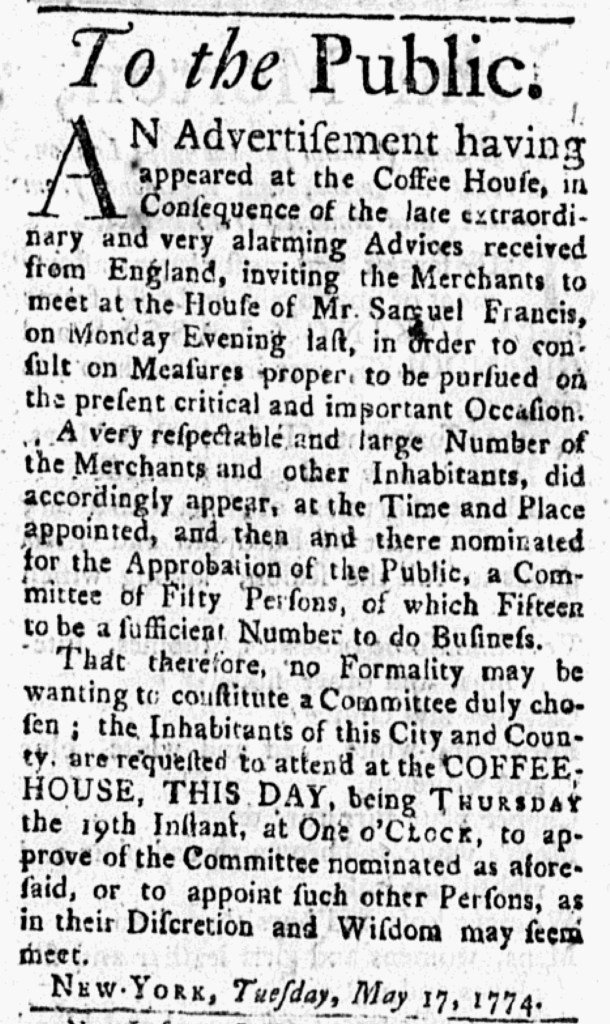
“Meet … to consult on Measures proper to be pursued on the present critical and important Occasion.”
Important news sometimes appeared among the advertisements in colonial newspapers during the imperial crisis that culminated in thirteen colonies declaring independence from Britain. While the rest of the newspaper carried reports, updates, editorials, and extracts of letters meant to keep readers informed of “the freshest ADVICES, both FOREIGN andDOMESTIC” (as the masthead for the New-York Journal and other newspapers proclaimed), readers also needed to peruse the advertisements. Such was the case in the spring of 1774 when New York received word of the Boston Port Act that closed the harbor until such time that resident made restitution for the tea destroyed by colonizers masquerading as Indians the previous December.
A notice in the May 19 edition of the New-York Journal referred to an “Advertisement” or announcement that “appeared at the Coffee House, in Consequence of the late extraordinary and very alarming Advices received from England.” That announcement invited merchants to meet “at the House of Mr. Samuel Francis,” meaning the tavern operated by Samuel Fraunces, “in order to consult on Measures proper to be pursued on the present critical and important Occasion.” In turn, the advertisement in the newspaper reported on what occurred at that meeting. “A very respectable and large Number of the Merchants and other Inhabitants” gathered and nominated a committee “of Fifty Persons, of which Fifteen to be a sufficient Number to do Business.” The advertisement, addressed “To the Public,” called on the “inhabitants of this City and County” to attend another meeting to “approve of the Committee nominated … or to appoint such other Persons, as in their Discretion and Wisdom may seem meet.” The organizers intended to garner as much support as possible to “constitute a Committee duly chosen” to act on behalf of all residents concerned about the most recent abuse perpetrated by Parliament.
Disseminating notice about the meeting as a newspaper advertisement made more colonizers aware of the meeting, though word also spread in conversation. It also kept readers at a distance informed that merchants and others in New York prepared to take action, encouraging them to continue checking the public prints for more news about politics and current events. Those who also read Rivington’s New-York Gazetteer that day encountered the complete text of the Boston Port Act on the front page, an opportunity to assess it for themselves beyond whatever rumors they previously heard. Working back and forth between news and advertisements, colonizers gained a more complete picture of the events unfolding in the wake of the Boston Tea Party.
[…] as the news and editorials would be more likely to see it. John Holt had done the same with a call to meeting that ran in the May 19 edition of the New-York Journal. The press played an important role in […]