
What was advertised in a colonial American newspaper 250 years ago today?
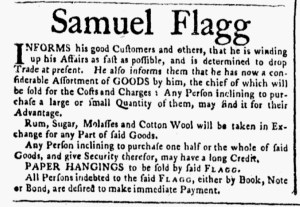
“He is winding up his Affairs as fast as possible, and is determined to drop Trade.”
It was a going out of business sale by another name. As summer approached in 1774, Samuel Flagg took to the pages of the Essex Gazette to inform residents of Salem and nearby towns that “he is winding up his Affairs as fast as possible, and is determined to drop Trade at present.” That meant that he needed to get rid of his existing inventory, “a considerable Assortment of GOODS.” For bargain hunters or any consumers looking for good deals, this was quite an opportunity since Flagg pledged to sell his wares “for the Costs and Charges” without significant retail markup. He attempted to entice customers with promises that they “may find it for their Advantage” to purchase “a large or small Quantity” of his remaining goods. Flagg also presented his decision to “drop Trade” as favorable to other retailers, suggesting that they might be interested in acquiring “one half or the whole of said Goods.” Provided that they “give Security,” Flagg was willing to allow “a long Credit” for payment.
Flagg had a history of publishing colorful advertisements in the Essex Gazette, commenting on the marketing strategies deployed by some of his competitors, and it was not the first time that he announced plans to liquidate his merchandise. A year earlier, he asserted “his present Determination is to go home to London in the Fall; he is therefore determined to sell off the whole of his Goods.” The entrepreneur made bold claims that he would part with his goods “as low as they can be bought at any Store on the Continent, without any Exception.” His “Determination” did not result in returning to London in the fall of 1773, but it may have resulted in some good deals for consumers who took advantage of his intentions. Those who benefited from that sale might have been especially eager to examine Flagg’s goods this time, though others who did not consider the savings all that significant likely would have been wary of renewed promises. Today, consumers become skeptical of retailers who repeatedly hold going out of business sales yet do not close their doors, realizing that liquidation prices are just their everyday prices. Flagg risked the same response if he resorted to this marketing strategy too many times.