
What was advertised in a colonial American newspaper 250 years ago today?
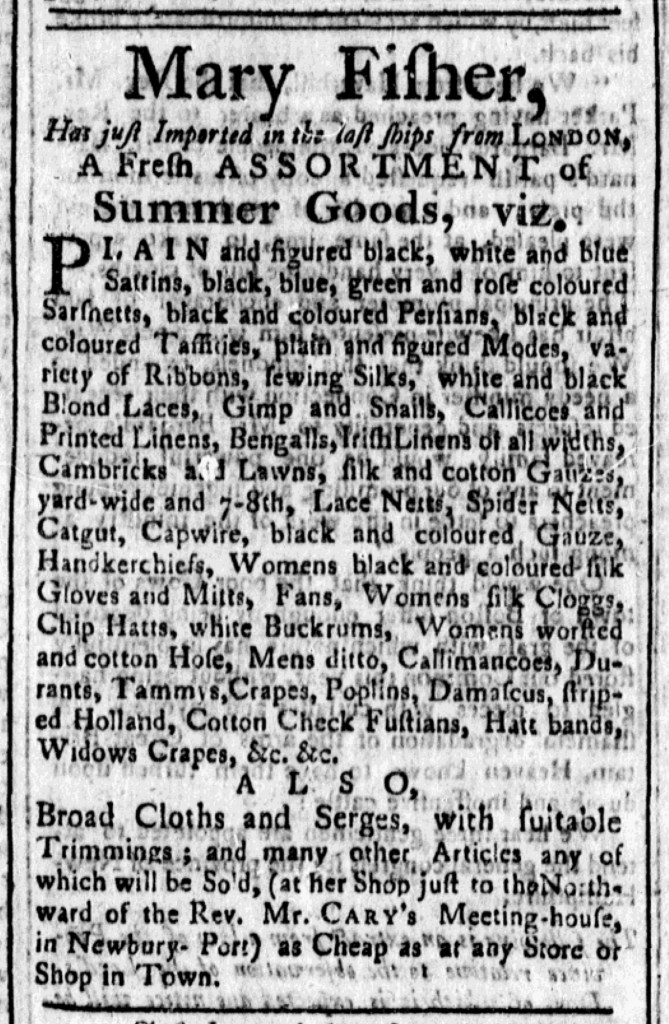
“Imported in the last ships from LONDON, A Fresh ASSORTMENT of Summer Goods.”
As June 1774 came to a close, the final issue of the Essex Journal for that month carried news that arrived from Salem, Boston, New London, New York, Philadelphia, Williamsburg, and Charleston. The editor also selected a short address “To the Farmers in America” from “FREEDOM” to reprint from the most recent edition of the Massachusetts Spy. It advised, “INCREASE your SHEEP and raise WOOL as far as possible, that you from this time wear LIBERTY CLOTH.” Although framed as advice to farmers, the suggestion to wear homespun cloth applied to all consumers who wished to protest various abuses by Parliament, especially the Boston Port Act that went into effect at the beginning of the month. Colonizers discussed their prospects for using commercial means to achieve political ends, recognizing that any boycott of imported goods should be accompanied by encouraging “domestic manufactures” as alternative products. That included clothing made of homespun fabrics to substitute for textiles imported from London.
Even as “FREEDOM” promoted “LIBERTY CLOTH” as a symbol of patriotism, merchants and shopkeepers hawked imported goods elsewhere in the newspaper. No nonimportation or nonconsumption agreement had yet been adopted. George Searle, for instance, “Just Imported from LONDON … an assortment of Painters Oils and Colours.” Similarly, John Stickney and Son, announced that they “imported from London, a large assortment of English, India and hard ware GOODS.” Those goods certainly included garments and fabrics. Mary Fisher provided more detail, advertising that she “just Imported in the last ships from LONDON, A Fresh ASSORTMENT of Summer Goods.” She then listed dozens of items, including an array of textiles that ranged from “PLAIN and figured black, white and blue Sattins” to “black, blue green and rose coloured Sarsnetts [sarcenets]” to “Callicoes and Printed Linens.” Even as such items fell out of favor in some circles, Fisher offered an opportunity for consumers who desired imported textiles, even those who supported the patriot cause, and realized that they should buy what they could before discussions about boycotts became actual boycotts. Fisher offered her wares “as Cheap as at any Store or Shop in Town,” making it possible for consumers to stockpile items they purchased from her. Her imported textiles did not have the appearance of homespun “LIBERTY CLOTH,” but, for the moment, customers could at least equivocate that they had not bought those fabrics while a nonconsumption agreement was in effect. Memories of boycotts in response to the Stamp Act and the duties on certain goods in the Townshend Acts guided consumers in preparing for a new round of protests.
[…] cloth took on greater significance in the face of boycotting fabrics imported from England, from farmers raising sheep for their wool to women participating in spinning bees that put their patriotism on display to consumers choosing […]