October 4

What was advertised in a revolutionary American newspaper 250 years ago today?
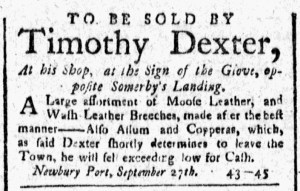
Essex Journal (October 4, 1777).

“The Sign of the Glove.”

In the fall of 1776, Timothy Dexter stocked a “Large assortment of Moose Leather, and Wash Leather Breeches, made after the best manner” at “his Shop … opposite Somerby’s Landing” in Newburyport, Massachusetts.  In an advertisement in the October 4 edition of the Essex Journal, he informed prospective customers that he would sell his wares “exceeding low for Cash” since he intended to leave the town and wished to liquidate his merchandise.  Readers unfamiliar with Dexter’s shop could look for the “Sign of the Glove” once they were in the vicinity of Somerby’s Landing.  Some towns and cities would introduce standardized street numbers by the end of the century, but until that happened shop signs aided in navigating the streets and identifying businesses.

Like many other shopkeepers in both urban ports and smaller towns, Dexter selected a device to identify his business.  As residents and visitors traversed the streets of Newburyport, they spotted the “Sign of the Glove” at Dexter’s shop and other signs that marked the locations of other shops, encountering a landscape of visual images deployed to facilitate commerce and consumption in eighteenth-century America.  Those signs served as precursors to the logos that companies would adopt in later centuries.  Some entrepreneurs used them as a rudimentary form of branding.  Dexter, for instance, not only used the “Sign of the Glove” to mark his location “opposite Somerby’s Landing” but also to promote his business in his notice in the Essex Journal.

Few shop signs from the eighteenth century survive today, yet newspaper advertisements reveal that they were common sights (and sites) in early America.  Not every shop had a sign, but the proprietors of those that did likely hoped that their signs would make their businesses more visible and more memorable.  In a competitive marketplace, every small advantage might help.
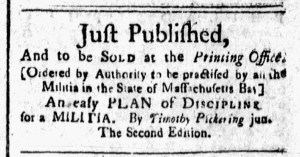
September 27

What was advertised in a revolutionary American newspaper 250 years ago today?

Essex Journal (September 27, 1776).

“Just Published … An easy PLAN of DISCIPLINE for a MILITIA … The Second Edition.”

John Mycall, the printer of the Essex Journal and New-Hampshire Packet, hawked copies of the second edition of Timothy Pickering’s “easy PLAN of DISCIPLINE for a MILITIA” in the fall of 1776.  As was common in many early American newspapers, the first page of the Essex Journal carried both news and advertisements.  In the September 27 edition, an update from London filled the first two columns and overflowed into the third on the first page. Advertisements completed that final column … and Mycall placed his advertisement for Pickering’s popular military manual first among those advertisements, increasing the chances that readers would take note of it.  His advertisement also reminded prospective customers that Pickering’s Easy Plan of Discipline had been “Ordered by Authority to be practised by all the Militia in the State of Massachusetts Bay,” simultaneously an endorsement and an edict to be followed.

Mycall announced that the second edition was “Just Published, And to be SOLD at the Printing Office.”  That did not mean, however, that he printed a Newburyport edition.  Eighteenth-century readers knew to separate the phrases “Just published” and “to be SOLD.”  The former merely meant that a book or pamphlet was available for sale (as opposed to being in the press) but did not necessarily refer to the advertiser.  Printers and booksellers frequently sold items “Just Published” by others.  In this instance, Mycall sold copies of a second edition of Pickering’s Easy Plan of Discipline published by Samuel Hall in Boston.  In June, Hall informed readers of the Continental Journal that the “second Edition … is now in the Press.”  On September 19, he ran a new advertisement in the Continental Journal, this time announcing that the military manual was now available at his printing office in School Street.  Hall apparently sent copies to Mycall to stock at his printing office in Newburyport.  The advertisement in the Essex Journal appeared just a week later.  The second edition that Mycall sold in Newburyport was hot off Hall’s presses in Boston.

September 20

What was advertised in a revolutionary American newspaper 250 years ago today?

Essex Journal (September 20, 1776).

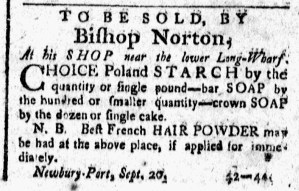
“Best French HAIR POWDER may be had … if applied for immediately.”

The first page of the September 20, 1776, edition of the Essex Journal featured the text of a resolution passed by the Continental Congress near the end of August, extracts of letters “from the West Indies,” “from a Planter in Grenada,” and “from a Merchant in Bermuda,” and news from Newport, Rhode Island.  Bishop Norton’s advertisement for starch and soap for sale at his shop “near the lower Long-Wharf” in Newburyport, Massachusetts, ran at the bottom of the final column.  He sold “CHOICE Poland STARCH by the quantity or single pound” as well as “bar SOAP by the hundred or smaller quantity” and “crown SOAP by the dozen or single cake.”

In a nota bene, Norton also promoted “Best French HAIR POWDER.”  The war did not deter readers from wanting to look their best.  Norton proclaimed that the hair powder “may be had … of applied for immediately,” creating a sense of urgency to acquire the product.  He likely hoped that scarcity would prompt prospective customers to make purchases.  The final line included the town and date, “Newbury-Port, Sept. 20.”  Readers could determine for themselves how recently Norton had placed the advertisement and imagine whether he any of the hair powder might still be available.  The final line also included a notation for the printer, “42-44,” that indicated the advertisement would run in three issues (No. 142 on September 20, No. 143 on September 27, and No. 144 on October 4) before being discontinued.  Norton’s admonition to place orders for his limited supply of hair powder “immediately” gained greater urgency in each subsequent insertion of his advertisement in the Essex Journal, especially when readers took note of the date at the end of the notice.  Not every advertisement included a date, but in this instance the date played an important part in making Norton’s appeal to prospective customers to act “immediately” or risk missing out on his “Best French HAIR POWDER.”

June 14

What was advertised in a revolutionary American newspaper 250 years ago today?

Essex Journal (June 14, 1776).

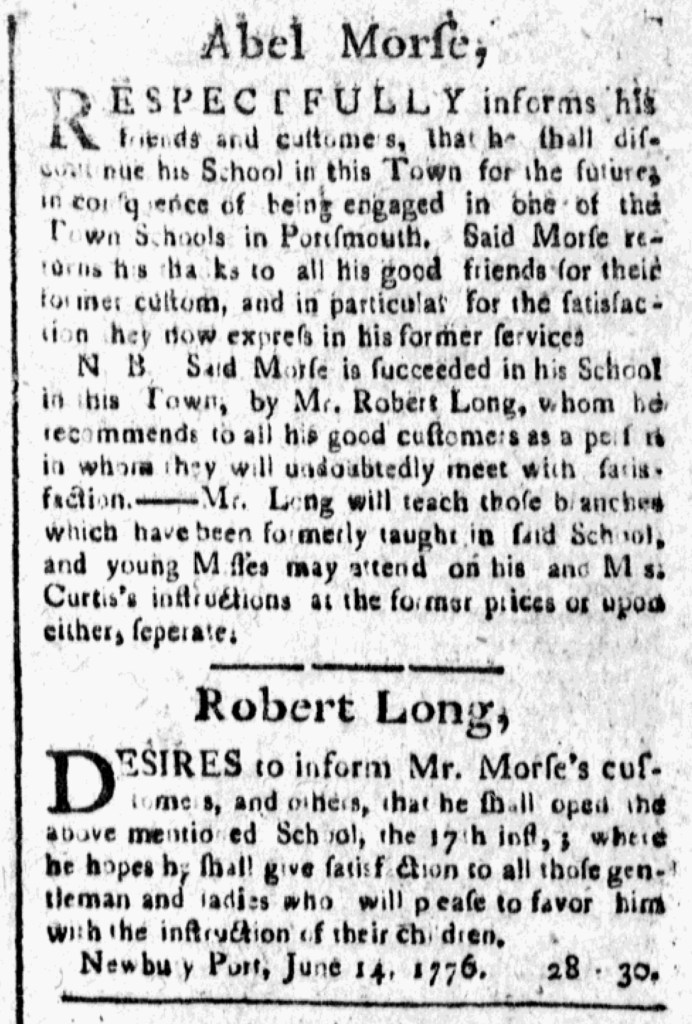
“Said Morse is succeeded in his School in this Town, by Mr. Robert Long.”

In the summer of 1776, Abel Morse, a schoolmaster, took to the pages of the Essex Journal to “RESPECTFULLY” inform the residents of Newburyport, Massachusetts, that “he shall discontinue his School … in consequence of being engaged in one of the Town Schools” in Portsmouth, New Hampshire.  He expressed his appreciation to “all his good friends for their former custom, and in particular for the satisfaction they now express in his former services.”

On the heels of the endorsement he claimed to have earned from his students and their families, Morse inserted a nota bene that announced that Robert Long “succeeded [him] in his School in this Town.”  Morse recommended Long “to all his good customers as a person in whom they will undoubtedly meet with satisfaction.”  Rather than leaving his former pupils to find a new instructor, Morse directed them to his replacement, noting that Long “will teach those branches which have been formerly taught in said School.”  Furthermore, Long would charge “the former prices” so Morse’s students would not incur higher expenses if they continued with the new teacher.

He also mentioned that “young Misses” could continue to benefit from “Mrs. Curtis’s instructions.”  In an advertisement that first ran in the Essex Journal on March 15, 1776, Morse reported that the “Working-School is continued by Mrs. Curtis and daughter as usual, by whom gentlemen and ladies may have sewing work done upon the shortest notice.”  Morse and Long apparently taught subjects like reading, writing, and arithmetic while Curtis and her daughter taught sewing and other traditionally feminine skills.  Students could opt for lessons from Long, Curtis, or both.

Morse’s nota bene served as an introduction to Long’s own address to readers of the Essex Journal.  With his name as a headline, Long stated that he “DESIRES to inform Mr. Morse’s customers, and others, that he shall open the above mentioned School” on Monday, June 17.  The advertisement gave advance notice of only a few days.  He would endeavor to meet the standards established by Morse and “hopes he shall give satisfaction to all those gentlemen and ladies who will please to favor him with the instruction of their children.”  Despite the departure of Morse, the advertisement emphasized continuity for students who could learn the same subjects from Long as well as continue learning household skills from Curtis.

April 26

What was advertised in a revolutionary American newspaper 250 years ago today?

Essex Journal (April 26, 1776).

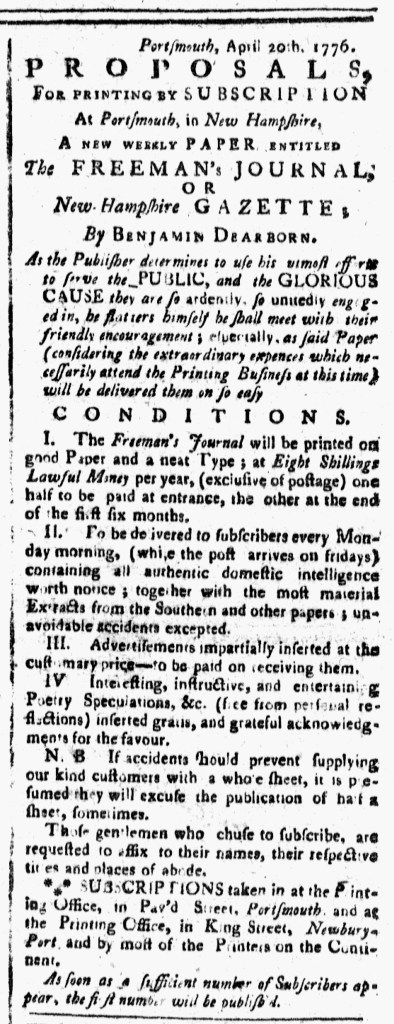
“A NEW WEEKLY PAPER ENTITLED The FREEMAN’s JOURNAL, OR New-Hampshire GAZETTE.”

A year after the battles at Lexington and Concord, Benjamin Dearborn issued “PROPOSALS, FOR PRINTING BY SUBSCRIPTION … A NEW WEEKLY PAPER ENTITLED The FREEMAN’s JOURNAL, OR New-Hampshire GAZETTE.”  Dated April 20, 1776, the subscription proposals appeared in the April 26 edition of the Essex Journal, printed in Newburyport, Massachusetts, though they may have circulated separately as well.  Dearborn intended to publish the Freeman’s Journal in Portsmouth, making it the only newspaper printed in the colony since Daniel Fowle suspended the New-Hampshire Gazette earlier in the year.  The printer asserted that “As soon as a sufficient number of Subscribers appear, the first number will be publish’d.”  A month later, he distributed the first issue on May 25.

The title of the Freeman’s Journal made the editorial stance clear.  So did the explanation that Dearborn gave for establishing the newspaper: “As the Publisher determines to use his utmost efforts to serve the PUBLIC, and the GLORIOUS CAUSE they are so ardently, so unitedly engaged in, he flatters himself he shall meet with their friendly encouragement.”  He took on this service despite the “extraordinary expences which necessarily attend the Printing Business at this time,” simultaneously asking prospective subscribers to “excuse the publication of half a sheet, sometimes,” when “accidents … prevent supplying our kind customers with a whole sheet.”  During the first year of the war, shortages of paper, fears of impending attacks by British forces, post riders arriving behind schedule, and other “accidents” disrupted publication of the newspapers in New England and beyond.

The “CONDITIONS” in Dearborn’s subscription proposals outlined the expectations for the printer and subscribers.  A subscription cost “Eight Shillings Lawful Money per year, (exclusive of postage),” with half due immediately and the other half due in six months.  Newspaper printers often extended generous credit to subscribers, but circumstances did not permit Dearborn to do so for the Freeman’s Journal.  He pledged, “Advertisements impartially inserted at the customary price,” though he did not specify what that was.  He apparently expected that prospective advertisers knew the going rate for running notices in newspapers in the region.  He did declare that advertisements had “to be paid on receiving them.”  The printer did not allow any credit for advertisements.

New issues would circulate “every Monday morning” for as long as “the post arrives on Fridays.”  That allowed time for Dearborn to peruse other newspapers to select items to reprint in the Freeman’s Journal, sift through his own correspondence, and collaborate with others who received letters containing news.  The printer would collate “all authentic domestic intelligence worth notice; together with the most material Extracts from the Southern and other papers.”  He also solicited “[i]nteresting, instructive, and entertaining Poetry Speculations,” presumably for “Poet’s Corner,” a standard feature in many colonial newspapers, that he would publish “gratis” with “grateful acknowledgments for the favour.”

Dearborn accepted subscriptions at his printing office in Portsmouth.  John Mycall, the printer of the Essex Journal, also gathered subscriptions at the printing office in Newburyport.  Dearborn also expected that “most of the Printers on the Continent” would forward any subscriptions they received, signaling to the public that he was part of an expansive network that exchanged news for the benefit of “the PUBLIC, and the GLORIOUS CAUSE.”  Despite the upheavals of the war (or perhaps because of them), Dearborn and other printers established new newspapers during the summer of 1776.

April 19

What was advertised in a revolutionary American newspaper 250 years ago today?

Essex Journal (April 19, 1776).

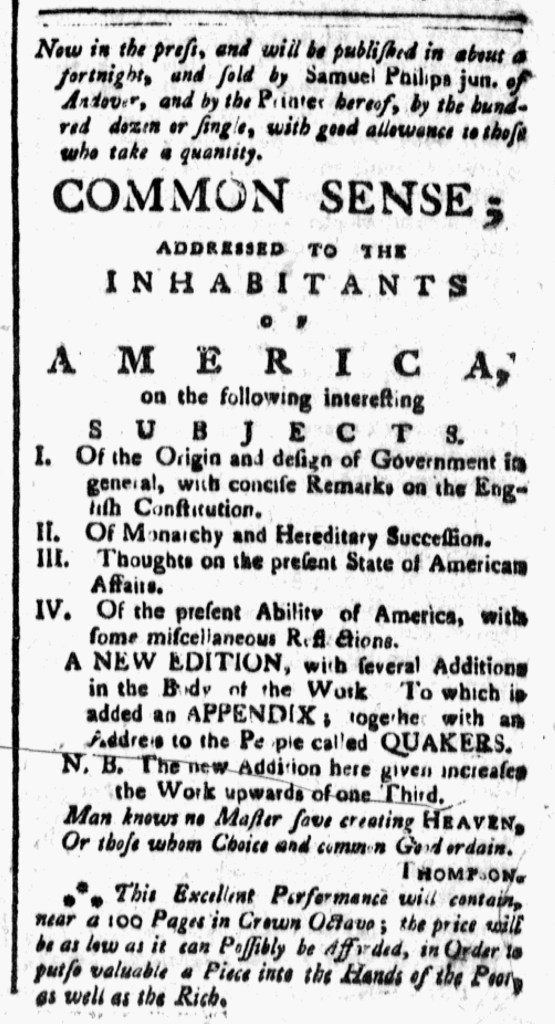
“By the hundred[,] dozen or single, with good allowance to those who take a quantity.  COMMON SENSE.”

One year after the battles at Lexington and Concord that started the Revolutionary War, the first advertisement for Thomas Paine’s Common Sense appeared in the Essex Journal and New-Hampshire Packet.  John Mycall, the printer of that newspaper, prepared a local edition in Newburyport, Massachusetts, just as printers in many other cities and towns in Pennsylvania, New York, and New England had done in the three months since Robert Bell made the first edition available in Philadelphia.

This newest edition was not yet ready for sale.  Instead, Mycall announced that it was “Now in the press, and will be published in about a fortnight.”  He encouraged readers to anticipate its publication, priming the pump for distributing the popular political pamphlet within the next couple of weeks.  His advertisement replicated many that appeared in other newspapers.  He gave the title of the pamphlet, provided an overview of its contents by listing the subject headings, and gave two lines from the poem “Liberty” by Scottish poet James Thompson.  He also described his edition as “A NEW EDITION, with several Additions in the Body of the Work To which is added an APPENDIX; together with an Address to the People called QUAKERS.”  That suggested that Mycall drew the Newburyport edition from one of the expanded editions that Paine collaborated with William Bradford and Thomas Bradford in publishing in Philadelphia after the author parted ways with Bell, though the printer of the first edition pirated that bonus content when he published unauthorized subsequent editions.  A nota bene in Mycall’s advertisement, “The new Addition here given increases the Work upwards of one Third,” echoed the Bradfords’ advertisements.

To increase sales and disseminate the pamphlet widely, Mycall enlisted a local agent in Andover, and both of them sold copies “by the hundred[,] dozen or single, with good allowance to those who take a quantity.”  In other words, he gave a discount to customers who bought multiple copies.  Those who purchased a dozen may have distributed them to friends, while those who purchased “by the hundred” likely planned to sell them retail in their own shops.  The discount for volume allowed them to set competitive prices while turning a profit.  In addition, Mycall proclaimed that “the price will be as low as it can Possibly be Afforded, in Order to put so valuable a Piece into the Hands of the Poor, as well as the Rich.”  Such efforts likely helped Common Sense become the most widely read political pamphlet published in the colonies during the era of the American Revolution.

March 22

What was advertised in a revolutionary American newspaper 250 years ago today?

Essex Journal (March 22, 1776).

“STOP THIEF.”

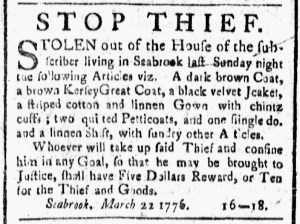
The advertisement had a bold headline: “STOP THIEF.”  Those two words likely attracted the attention of many readers of the March 22, 1776, edition of the Essex Journal.  After all, the headlines for most other advertisements gave the name of the advertiser in a large font, such as “Nicholas Pike,” “Abel Morse,” and “John Sawyer,” or named a product being sold, such as “Garden-Seeds” and “Lemmons by the Box.”  This advertisement reported on a recent burglary: “STOLEN out of the House of the subscriber living in Seabrook last Sunday night the following Articles … A dark brown Coat, a brown Kersey Great Coat, a black velvet J[ac]ket, a striped cotton and linnen Gown with chintz cuffs; two quilted Petticoats, and one single d[itt]o. and a linnen Shift, with sundry other Articles.”

That was quite the haul.  Whoever stole the black velvet jacket and the striped cotton and linen gown was unlikely to wear both items.  They might have kept some of the stolen goods for personal use, but they likely sold or fenced most of them. Burglars, thieves, and shoplifters devised alternate means of participating in consumer culture during the era of the American Revolution.  Reports of their activities frequently appeared as newspaper advertisements alongside other notices that presented all sorts of clothing, textiles, and housewares imported and sold by merchants and shopkeepers.  Another advertisement in the same issue of the Essex Journal had a headline that proclaimed, “Four Dollars Reward.”  In it, Israel Adams described the theft of “Four pair of men’s SHOES; two pair men’s Pumps; six pair women’s Pumps, and two pair boy’s Shoes.”  Both advertisements offered a reward for capturing the culprits and bringing them to justice … and both offered a reward for the return of the stolen goods.  The anonymous advertiser from Seabrook seemingly understood that the goods may have been fenced by the time anyone could “take up said Thief and confine him in any [Jail], so that he may be brought to Justice,” but just in case it was not too late “the subscriber” would double the reward for delivering “the Thief and Goods.”

February 2

What was advertised in a revolutionary American newspaper 250 years ago today?

Essex Journal (February 2, 1776).

“He intends to go with a carriage weekly, from this town to Cambridge.”

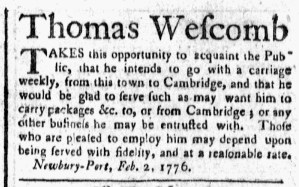
When Thomas Wescomb of Newburyport, Massachusetts, launched a new enterprise, he placed an advertisement in the February 2, 1776, edition of the Essex Journal to promote it to prospective customers.  He described his notice as an “opportunity to acquaint the Public, that he intends to go with a carriage, weekly, from this town to Cambridge.”  Presumably he took passengers, but he did not provide the rates he charged, describe any of the amenities they could expect, or give further details about the schedule.  Other entrepreneurs who advertised carriage or stagecoach service between towns frequently included that kind of information to entice customers.  Just a few days earlier, for instance, John Mercereau ran an advertisement for the “New STAGE COACHES, THAT constantly ply between New-York and Philadelphia” in the January 29 edition of the New-York-Gazette and Weekly Mercury.  It included a schedule and prices per passenger “in the Coach” and “out” on seats exposed to the weather.  He also advised that a second service, called “The Flying Machine” for its speed, “Still continues … from Powles-Hook Ferry, opposite New-York, and from the Sign of the Cross-Keys in Philadelphia.”  Mercereau had years of experience operating and advertising his stagecoaches, with advertisements going back as far as 1769.

While Wescomb’s advertisement was not as elaborate or sophisticated, he did pitch other services that he offered, declaring that he “would be glad to serve such as may want him to carry packages” and other items “to, or from Cambridge; or any other business he may be entrusted with.”  Notably, Wescomb’s route terminated at Cambridge, not Boston.  The Continental Army’s siege of Boston continued, making Cambridge a more significant site than it had been before the Revolutionary War began.  Samuel Hall and Ebenezer Hall relocated the Essex Gazette from Salem to Cambridge and renamed it the New-England Chronicle.  George Washington, appointed commander-in-chief of the Continental Army by the Second Continental Congress, had his headquarters in Cambridge.  Readers of the Essex Journal in Newburyport and other nearby towns likely had a variety of reasons to visit Cambridge or to send packages to officers, soldiers, and others in that town.  Wescomb pledged his “fidelity” in delivering those packages or undertaking any other business assigned to him in his efforts to drum up business for his new venture.

January 19

What was advertised in a revolutionary American newspaper 250 years ago today?

Essex Journal (January 19, 1776).

“He is determined to be regularly supplyed with all the news-papers on the Continent.”

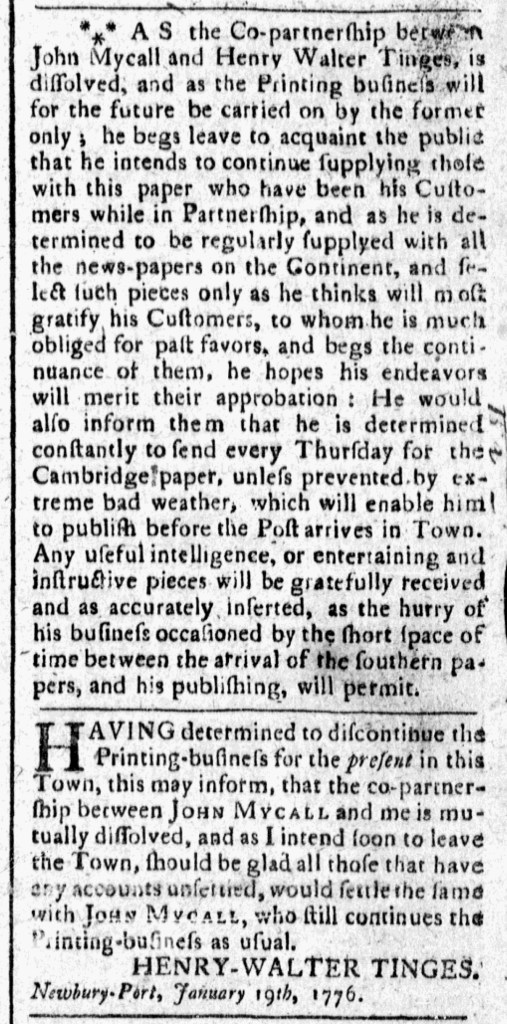
On January 19, 1776, John Mycall and Henry-Walter Tinges, the printers of the Essex Journal, announced the end of their partnership.  Tinges had been a founding partner, commencing publication of the newspaper in Newburyport, Massachusetts, in collaboration with Isaiah Thomas, the printer of the Massachusetts Spy, in December 1773.  As the junior partner, Tinges oversaw the printing office, including publication of the Essex Journal, in Newburyport, while Thomas tended to his printing office in Boston.  That initial partnership lasted only eight months before Thomas withdrew and Tinges began a new partnership with Ezra Lunt in August 1774.  That partnership also lasted less than a year.  In July 1775, Lunt exited and Mycall joined as Tinges’s new partner.  Seven months later, Tinges announced that he “determined to discontinue the Printing-business for the present in this Town” and the “co-partnership between JOHN MYCALL and me is mutually dissolved,” though Mycall “still continues the Printing-business as usual.”  Mycall published the Essex Journal on his own for just over a year.  It folded in February 1777, one of several newspapers that ceased publication during the Revolutionary War.

For his part, Mycall inserted his own advertisement stating that the partnership ended and that he “intends to continue supplying those with this paper who have been his Customers while in partnership.”  He outlined his plan for supplying subscribers with news, declaring that he “is determined to be regularly supplyed with all the news-papers on the Continent, and select such pieces only as he thinks will most gratify his Customers.”  That was the common practice for generating content in printing offices throughout the colonies.  Printers participated in extensive exchange networks, liberally reprinting, word for word, items that appeared in the newspapers they received.  Thus an item originally published in a newspaper in Charleston, for instance, could be reprinted from newspaper to newspaper in Williamsburg, Baltimore, Philadelphia, New York, Hartford, and Boston before appearing in the Essex Journal in Newburyport.  Mycall made a point that he would “send every Thursday for the Cambridge paper, unless prevented by extreme bad weather, which will enable him to publish before the Post arrives in Town.”  He referred to the New-England Chronicle, published Samuel Hall and Ebenezer Hall in Cambridge, Massachusetts.  During the siege of Boston, most of the newspapers previously printed in that city ceased or suspended publication or moved to other towns.  The Halls relocated the Essex Gazette, published in Salem, to Cambridge and renamed it the New-England Chronicle when it became the new paper of record for the latest news about the Massachusetts government and the Continental Army under the command of George Washington.  Mycall underscored that he quickly received the latest edition of the New-England Chronicle, printed on Thursdays, and incorporated “useful intelligence” into the Essex Journal, published on Fridays, ahead of the schedule for post riders to arrive in Newburyport.  In the eighteenth century, Mycall delivered breaking news to readers of the Essex Journal.

October 20

What was advertised in a revolutionary American newspaper 250 years ago today?

Essex Journal (October 20, 1775).

“We hope we need make no further apology to those who are real friends to their country.”

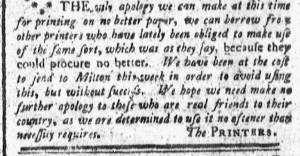
John Mycall and Henry-Walter Tinges, the printers of the Essex Journal, found themselves in a situation similar to the one that Daniel Fowle, the printer of the New-Hampshire Gazette, experienced in the fall of 1775.  A disruption in Fowle’s supply of paper in Portsmouth had forced him to print his newspaper on smaller sheets on a few occasions, including the October 17 edition.  Three days later, Mycall and Tinges did the same in Newburyport.  Instead of four pages of three columns each, that issue had four pages of two columns each.  The masthead featured plain type for the title rather than presenting “Essex Journal” in the usual scrolling script.  The woodcuts that usually flanked the title, an Indigenous man with a bow and arrow on the left and a packet ship at sea on the right, did not appear at all.

Immediately above the advertisements, the printers inserted their own notice to explain what happened.  “THE only apology we can make at this time for printing on no better paper,” Mycall and Tinges stated, “we can borrow from other printers who have lately been obliged to make use of the same sort, which was as they say, because they could procure no better.”  They closely paraphrased portions of Fowle’s notice to his readers a couple of weeks earlier: “The only Apology the Publisher can make for this Day’s Paper, is that he could not procure any other.”  Mycall and Tinges printed their newspaper on different paper only as a last resort.  “We have been at the cost to send [an order for more paper] to Milton this week in order to avoid using this,” they informed readers, “but without success.”  With the disruptions and displacements that occurred in the six months since the battles at Lexington and Concord, securing paper became difficult.  The printers tried to get more from the paper mill on the Neponset River in Milton, but to no avail.  They expected their readers to understand, especially those who held the right sort of political principles.  “We hope we need make no further apology to those who are real friends to their country,” Mycall and Tinges proclaimed, “as we are determined to us [the substitute paper] no oftener than necessity requires.”  They hoped that readers would see the smaller newspaper as a minor inconvenience given the stakes of the contest between the colonies and Great Britain.  They did their best with the resources available to continue to disseminate news and advertising to their subscribers and other readers.