
What was advertised in a colonial American newspaper 250 years ago today?
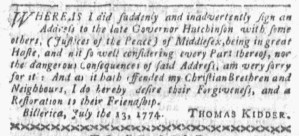
“I did suddenly and inadvertently sign an Address to the late Governor Hutchinson.”
When he published an advertisement in the July 18, 1774, edition of the Boston-Gazette, Thomas Kidder of Billerica attempted to extricate himself from a difficult situation. He explained that he had “suddenly and inadvertently sign[ed] an Address to the late Governor Hutchinson with some others, (Justices of the Peace) of Middlesex.” Thomas Hutchinson, the outgoing governor, had received several letters praising his administration of the colony, each of them signed by dozens of colonizers. Some of those letters found their way into print, revealing to the public which members of the community approved of the way the unpopular royal governor had participated in Parliament’s efforts to establish greater control over Boston, the rest of Massachusetts, and all the colonies.
That garnered the wrong kind of attention for Kidder and others, especially those who then professed that they did not actually harbor loyalist sympathies but had instead been “inadvertently” embroiled in the controversy. Kidder explained that he had signed the letter to Hutchinson “in great Haste, and not so well considering every Part thereof, nor the dangerous Consequences of said Address.” He did not enjoy the reception he received from colonizers who supported the patriot cause, prompting him to apologize. He confessed that he was “very sorry” for signing the letter and “as it hath offended my Christian Brethren and Neighbours, I do hereby desire their Forgiveness, and a Restoration of their Friendship.” Apparently, Kidder’s seeming endorsement of Hutchinson caused so many difficulties in his daily interactions with others that he found it necessary to take to the public prints to disavow an address that he claimed he had not fully considered or understood when he signed it. It was no mistake that he ran his advertisement in the Boston-Gazette, a newspaper noted for advocating the political views of patriots who opposed the policies enacted by Parliament and Hutchinson’s collaboration in executing them.
In “Entering the Lists: The Politics of Ephemera in Eastern Massachusetts, 1774,” William Huntting Howell documents which newspapers published addresses to Hutchinson and broadsides printed in response, some of them identifying the occupations and places of business of the signatories. That amounted to an eighteenth-century version of doxing people based on their political views. Howell argues that such a response was designed “to coerce and secure individual compliance.” He examines several “RECANTATIONS” that appeared in the newspapers as signatories of addresses to Hutchinson attempted to restore their standing among their fellow colonizers.[1] Over the next several months, the Adverts 250 Project will feature advertisements, like the one place by Kidder, placed for similar purposes, demonstrating the pressure that patriots managed to bring to bear against real and perceived loyalists as the imperial crisis intensified in 1774.
**********
[1] William Huntting Howell, “Entering the Lists: The Politics of Ephemera in Eastern Massachusetts, 1774,” Early American Studies 9, no. 1 (Winter 2011): 191, 208-215.
[…] When he published an advertisement in the July 18, 1774, edition of the Boston-Gazette, Thomas Kidder of Billerica attempted to extricate himself from a difficult situation. He explained that he had “suddenly and inadvertently sign[ed] an Address to the late Governor Hutchinson with some others, (Justices of the Peace) of Middlesex.” Thomas Hutchinson, the outgoing governor, had received several letters praising his administration of the colony, each of them signed by dozens of colonizers. Some of those letters found their way into print, revealing to the public which members of the community approved of the way the unpopular royal governor had participated in Parliament’s efforts to establish greater control over Boston, the rest of Massachusetts, and all the colonies. That garnered the wrong kind of attention for Kidder and others, especially those who then professed that they did not actually harbor loyalist sympathies but had instead been “inadvertently” embroiled in the controversy. Read more… […]
[…] signing “an Address to Governor Hutchinson, on his leaving this Province” in May 1774. Like Thomas Kidder had done in July, they took to the public prints to confess their error and beg for the forgiveness of their friends […]
[…] in to sign a certain paper published in Mr. Rivington’s Gazetteer.” When he published an advertisement in the Boston-Gazette to apologize for signing an address to Governor Hutchinson a few months earlier, Thomas Kidder […]
[…] not the first to insert an open letter in the Essex Gazette or other newspapers for that purpose. Thomas Kidder published a similar apology in the Boston-Gazette in July 1774. Samuel Flagg and Joseph Lee each […]
[…] Similar advertisements began appearing in that newspaper and sometimes newspapers printed in Boston as early as July 1774. Stacey explained that he waited several months because he “just returned to the Province after […]
[…] governor, Thomas Hutchinson, when he departed for England had reconsidered their position … or been pressured into recanting by Patriots who did not care for their Tory stance. More recently, similar advertisements […]