
Who was the subject of an advertisement in a colonial American newspaper 250 years ago today?
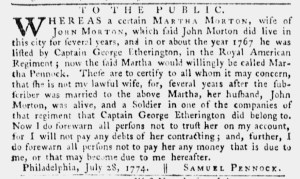
“MARTHA MORTON … is not my lawful wife.”
Notices advising merchants, shopkeepers, and others not to extend credit to wives of aggrieved husbands regularly appeared in colonial newspapers. Termed “runaway wife advertisements” by historians, such notices often followed a familiar format and deployed standardized language. For instance, consider James Paulhill’s advertisement in the August 3, 1774, edition of the Pennsylvania Gazette: “WHEREAS my wife MARY hath eloped from me, I therefore warn all persons not to trust her on my account, as I will pay no debts of her contracting from the date hereof.” Many offered more detail, but each established that a wife absconded from her husband and, in turn, he would no longer cover her expenses. These advertisements revealed marital discord to the community, as well as husbands’ inability to exert masculine authority over their households.
At the same time that Paulhill published his advertisement, Samuel Pennock inserted a much more elaborate notice in which he disavowed his wife, Martha, and accused her of bigamy. According to Pennock, she was actually Martha Morton, wife of John Morton, who “did live in this city,” Philadelphia, “for several years, and in or about the year 1767 he was listed by Captain George Etherington, in the Royal American Regiment.” For her part, she “would willingly be called Martha Pennock,” but Samuel adamantly declared that “she is not my wife” because “her husband, John Morton, was alive” for several years after Samuel married her, not realizing that she already had a husband. Samuel sought to sever his relationship with Martha. That included making a public announcement that he “will not pay any debts of her contracting” so others should not “trust her on [Samuel’s] account.” Furthermore, he “forewarn[ed] all persons not to pay her any money that is due to me, or that may become due to me hereafter.” Samuel aimed to eliminate Martha’s access to any of his financial resources.
As was the case with every runaway wife advertisement, this notice relayed only the perspective of the husband. Cut off from their sources of support, most wives did not have the means to publish responses to defend themselves and tell their side of the story. Husbands almost always wielded the power of the press to their advantage. In this instance, however, Martha inserted a response in the next issue of the Pennsylvania Gazette. The Adverts 250 Project will feature it next week on the 250th anniversary of its publication.
[…] Pennock was not having it. Her husband, Samuel, a hatter, ran a newspaper advertisement that claimed she was not legally his wife because she had previously been married to John Morton of […]