
What was advertised in a colonial American newspaper 250 years ago today?
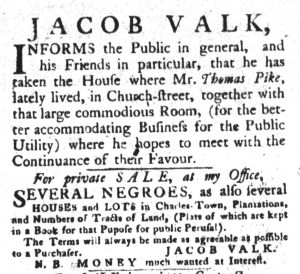
“That large commodious Room, (for the better accommodating Business for the Public Utility).”
Jacob Valk continued to do well as a broker for “Lands, Houses, and Negroes” in Charleston in the summer of 1774. He attracted so many clients that the advertisements he placed on their behalf filled two of the three columns on the first page of the August 9, 1774, edition of the South-Carolina Gazette and Country Journal. In addition to that publication, he regularly bought a significant amount of space in the South-Carolina Gazette and the South-Carolina and American General Gazette. His investment in advertising testified to his belief in its effectiveness, while the number of advertisements demonstrated the extensive demand for his services.
Such success prompted him to move his brokerage office to a new location. He announced that he “has taken the House where Mr. Thomas Pike, lately lived … together with that large commodious Room, (for the better accommodating Business for the Public Utility).” Pike had recently departed the city after offering dancing and fencing lessons to its residents for a decade. He hosted an annual ball for his students to display their talents, most recently in the “New-Assembly Room” where Valk now conducted business. Even while he was still in town, Pike had rented the room for “Public Sales, of Estates, Negroes, [and] Dry Goods.” With Valk on the scene, the space only occasionally used for the buying and selling of enslaved men, women, and children now became a site dedicated to perpetuating the slave trade.
Immediately below his note about his new location, Valk advertised “SEVERAL NEGROES” available “For private SALE, at my Office.” In the subsequent advertisements that filled those two columns, he also sought buyers for “two very valuable Negro Shoemakers” and “TWO or three exceeding good SEAMSTRESSES, and some young Negro Fellows, capable of all Work.” He also put out a call for a “good Negro CARPENTER,” seeking an enslaver interested in selling a skilled artisan. Although most of these enslaved people did not need to appear in the “New-Assembly Room” for Valk to broker the sales, that “large commodious Room” did lend itself to putting enslaved people on display. Colonizers who sought Valk’s services buying and selling enslaved people did conduct business in the space formerly used for dancing lessons. Some of them had likely socialized there during Pike’s annual balls before buying and selling enslaved people in the same space after the dancing master’s departure from the city. Valk seamlessly moved his brokerage office there, a testament to how slavery was so deeply enmeshed in daily life in colonial Charleston and other urban centers.
[…] Jacob Valk continued to do well as a broker for “Lands, Houses, and Negroes” in Charleston in the summer of 1774. He attracted so many clients that the advertisements he placed on their behalf filled two of the three columns on the first page of the August 9, 1774, edition of the South-Carolina Gazette and Country Journal. In addition to that publication, he regularly bought a significant amount of space in the South-Carolina Gazette and the South-Carolina and American General Gazette. His investment in advertising testified to his belief in its effectiveness, while the number of advertisements demonstrated the extensive demand for his services. Such success prompted him to move his brokerage office to a new location. He announced that he “has taken the House where Mr. Thomas Pike, lately lived … together with that large commodious Room, (for the better accommodating Business for the Public Utility).” Pike had recently departed the city after offering dancing and fencing lessons to its residents for a decade. Read more… […]