What was advertised in a colonial American newspaper 250 years ago today?
South-Carolina Gazette and Country Journal (March 7, 1775).
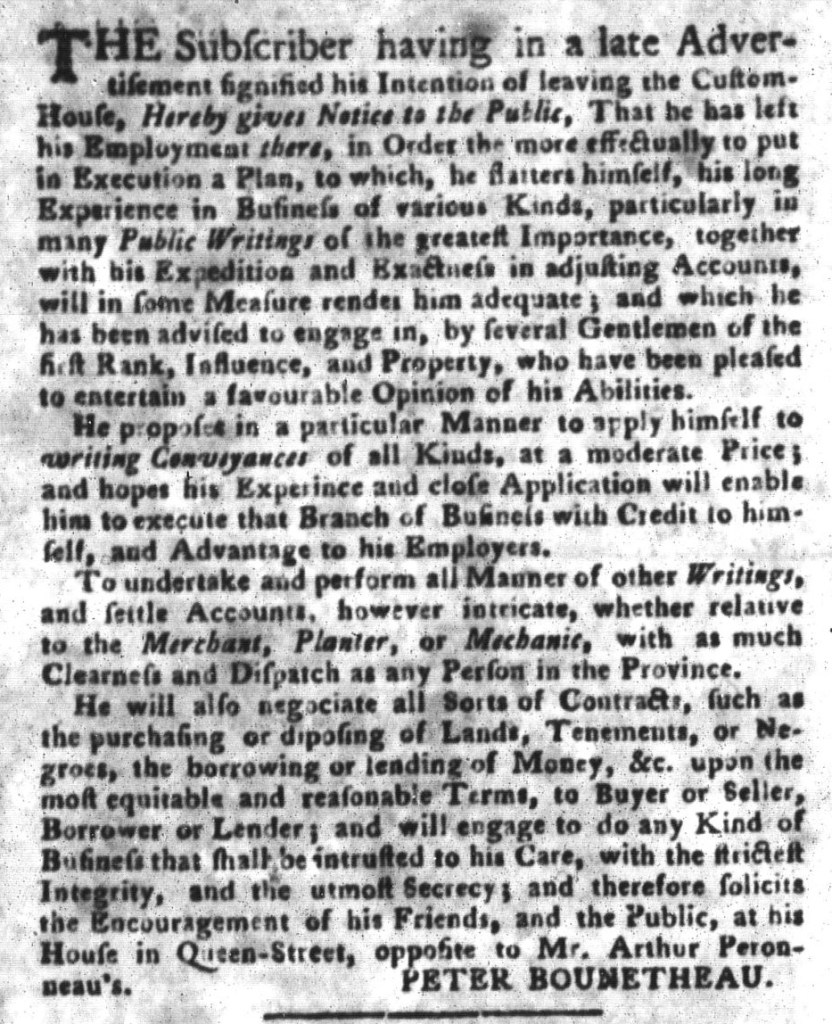
“He proposes … to apply himself to writing Conveyances of all Kinds.”
On the eve of the American Revolution, Peter Bounetheau left his job at the custom house in Charleston and established his own business for “writing Conveyances of all Kinds” and negotiating “all Sort of Contracts, such as the purchasing or disposing of Lands, Tenements, or Negroes [and] the borrowing or lending of Money.” He claimed that he had done so on the advice of “several Gentlemen of the first Rank, Influence, and Property, who have been pleased to entertain a favourable Opinion of his Abilities.” In addition to that endorsement, he emphasized “his long Experience in Business of various Kinds, particularly in many Public Writings of the greatest Importance, together with his Expedition and Exactness in adjusting Accounts.”
By the time his advertisement ran in the March 7, 1775, edition of the South-Carolina Gazette and Country Journal, Bounetheau had been in business for several months. He had established himself well enough to attract clients that accounted for twelve other advertisements of various lengths on the same page. A couple concerned real estate and a couple hawked commodities like mustard and olives, yet most of them offered enslaved people for sale. Six of those advertisements enumerated three enslaved men, ten enslaved women, and six enslaved women that Bounetheau sought to sell on behalf of others. A seventh advertisement listed “Several NEGROES,” but did not specify how many beyond “a complete boatman and jobbing carpenter” and “a complete washer and ironer.” The others were “field slaves.”
Bounetheau’s enterprise meant good business for Charles Crouch, the printer of the South-Carolina Gazette and Country Journal. Week after week, the broker placed multiple advertisements, representing significant revenues for the printing office. In the March 7 edition, his notices filled an entire column and nearly half of another out of twelve total columns in a standard issue of four pages consisting of three columns each. That meant that Bounetheau generating ten percent of the content. Another broker, Philip Henry, inserted fifteen advertisements that occupied the same amount of space, though he focused more on real estate than enslaved people. Still, he offered “TWENTY-TWO young and healthy NEGROES, that have been used to a Plantation” in one notice and “ELEVEN NEGROES, chiefly Country born” in another. These brokerage firms likely increased the number of advertisements that ran in the South-Carolina Gazette and Country Journal and other newspapers published in Charleston in the 1770s. Such endeavors included greater dissemination of advertisements that contributed to perpetuating the slave trade.
What was advertised in a colonial American newspaper 250 years ago today?
Supplement to the South-Carolina Gazette and Country Journal (November 29, 1774).
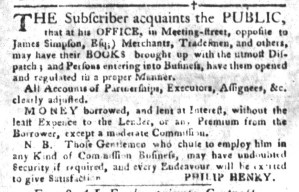
“Employ him in any Kind of Commission Business.”
Philip Henry worked as a bookkeeper and a broker in Charleston on the eve of the American Revolution. In an advertisement in the South-Carolina Gazette and Country Journal, he advised the public that “Merchants, Tradesmen, and others, may have their BOOKS brought up with the utmost Dispatch.” Those considering embarking on a new endeavor could engage his services to have their accounts and ledgers “opened and regulated in a proper Manner” from the start. In addition, he assisted with “any Kind of Commission Business,” whether commodities, real estate, or enslaved laborers.
As part of that aspect of his business, Henry placed many more advertisements on behalf of his clients. In the supplement that accompanied the November 29, 1774, edition of the South-Carolina Gazette and Country Journal, for instance, his advertisement describing the variety of services he offered at his office on Meeting Street served as an introduction for a series of advertisements that ran immediately below it. He inserted eight additional advertisements, six of them for real estate and two offering enslaved people for sale. His brokerage business was good business for Charles Crouch, the printer of that newspaper.
Henry was not alone as a broker or as an advertiser. Peter Bounetheau ran a similar notice, one that also served as an introduction to a series of other advertisements. He placed eleven on another page of the supplement that included Henry’s notices, requiring enough space to fill an entire column and spill over into another. Those included six about enslaved people, two about real estate, one on behalf of the executor of an estate, and one about several lots in the city, a plantation in the country, and “Several NEGROES.” Similarly, Jacob Valk, another broker, inserted advertisements that accounted for a significant amount of space in November 29 edition. He collated most of the real estate handled by his office into a single advertisement that filled a column, yet placed five separate advertisements about enslaved people as well as an estate notice and an advertisement about horses.
Henry, Bounetheau, and Valk industriously placed their notices in the South-Carolina and American General Gazette and the South-Carolina Gazette in addition to the South-Carolina Gazette and Country Journal. Even though brokers ran offices in other urban ports, they did not adopt a similar advertising strategy as part of their business model. That made the rhythm of advertising in South Carolina’s newspapers distinctive compared to those published in Boston, New York, and Philadelphia.
What was advertised in a colonial American newspaper 250 years ago today?
Pennsylvania Journal (August 31, 1774)
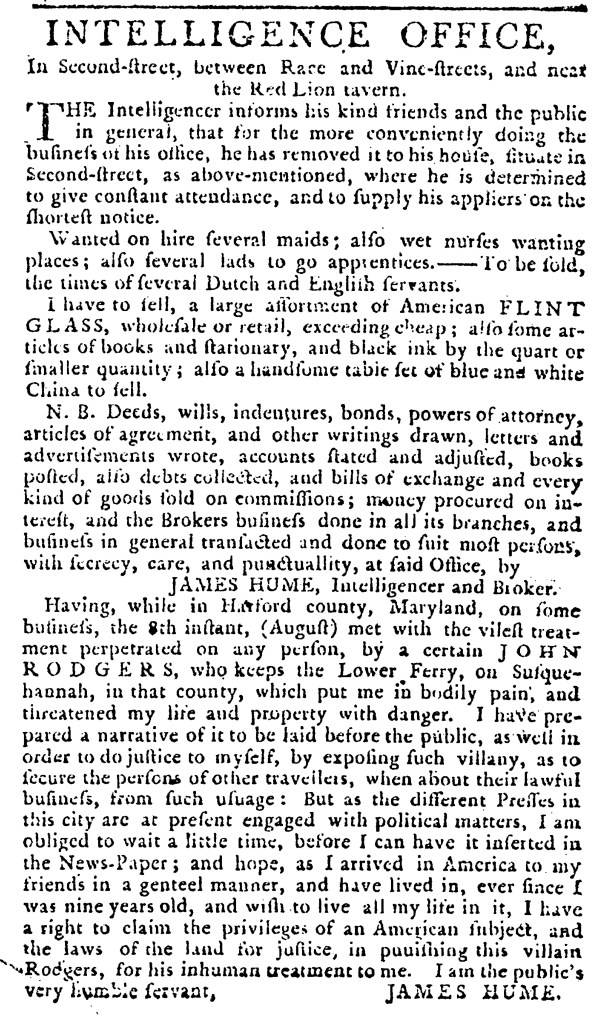
“The vilest treatment perpetrated on any person … threatened my life and property with danger.”
Eighteenth-century advertisers often used the space they purchased in newspapers to pursue multiple purchases. Merchants and shopkeepers, for instance, frequently devoted most of their advertisements to promoting goods for sale and then pivoted to calling on former customers to settle accounts. Sometimes the aims of the different portions of advertisements did not seem related at all. J. Musgrave devoted half of his advertisement in the August 31, 1774, edition of the Pennsylvania Gazette to leasing his “Wet and Dry Goods Houses and Stores” to merchants and the other half to buying and selling horses.
On the same day, James Hume published a lengthy advertisement with two very different purposes in the Pennsylvania Journal. The headline declared, “INTELLIGENCE OFFICE.” The broker described the various services he provided, including drawing up “Deeds, wills, indentures, bonds, powers of attorney, [and] articles of agreement.” He had “wet nurses wanting places” as well as “several lads to go apprentices.” He recorded and settled accounts, sold goods on commission, and even wrote advertisements on behalf of his clients. Rather than focus exclusively on his work as an “Intelligencer and Broker,” Hume used his access to the public prints to air a grievance against John Rodgers, “who keeps the Lower Ferry on Susquehannah” in Harford County, Maryland. According to the Hume, he was the victim of “the vilest treatment perpetrated on any person … which put me in bodily pain, and threatened my life and property with danger.” Following that ordeal, he “prepared a narrative of it to be laid before the public,” which he depicted as a service to the public. By “exposing such villainy” and warning others about Rodgers, he hoped to “secure the persons of other travellers, when about their lawful business, from such usage.”
Yet his intentions had been thwarted so far because “the different Presses in this city are at present engaged with political matters.” Hume had apparently shopped around to Dunlap’s Pennsylvania Packet, the Pennsylvania Gazette, and the Pennsylvania Journal, but none of the printers chose to accept his narrative for publication in their newspapers. Whatever their reasons for rejecting it, they invoked current events as justification. In recent months the imperial crisis intensified as the colonies received word of the Boston Port Act, the Massachusetts Government Act, and the other Coercive Acts passed as punishment for the Boston Tea Party. Parliament sought to restore order, but many colonizers believed their liberties as English subjects were under attack. For his part, Hume had his own concerns about his “right to claim the privileges of an American subject, and the laws of the land for justice, in punishing this villain Rodgers, for his inhuman treatment to me.” That incident, however, did not rise to the level that printers in Philadelphia gave priority to publishing it. Hume circumvented their editorial decisions, at least in part, by including his allegations against Rodgers in a paid notice, thus raising an alarm that others needed to be cautious when interacting with the ferry operator.
What was advertised in a colonial American newspaper 250 years ago today?
South-Carolina Gazette and Country Journal (August 9, 1774).
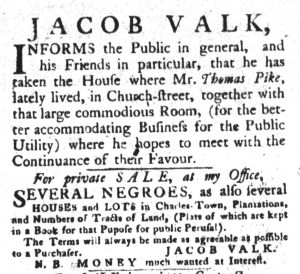
“That large commodious Room, (for the better accommodating Business for the Public Utility).”
Jacob Valk continued to do well as a broker for “Lands, Houses, and Negroes” in Charleston in the summer of 1774. He attracted so many clients that the advertisements he placed on their behalf filled two of the three columns on the first page of the August 9, 1774, edition of the South-Carolina Gazette and Country Journal. In addition to that publication, he regularly bought a significant amount of space in the South-Carolina Gazette and the South-Carolina and American General Gazette. His investment in advertising testified to his belief in its effectiveness, while the number of advertisements demonstrated the extensive demand for his services.
Such success prompted him to move his brokerage office to a new location. He announced that he “has taken the House where Mr. Thomas Pike, lately lived … together with that large commodious Room, (for the better accommodating Business for the Public Utility).” Pike had recently departed the city after offering dancing and fencing lessons to its residents for a decade. He hosted an annual ball for his students to display their talents, most recently in the “New-Assembly Room” where Valk now conducted business. Even while he was still in town, Pike had rented the room for “Public Sales, of Estates, Negroes, [and] Dry Goods.” With Valk on the scene, the space only occasionally used for the buying and selling of enslaved men, women, and children now became a site dedicated to perpetuating the slave trade.
Immediately below his note about his new location, Valk advertised “SEVERAL NEGROES” available “For private SALE, at my Office.” In the subsequent advertisements that filled those two columns, he also sought buyers for “two very valuable Negro Shoemakers” and “TWO or three exceeding good SEAMSTRESSES, and some young Negro Fellows, capable of all Work.” He also put out a call for a “good Negro CARPENTER,” seeking an enslaver interested in selling a skilled artisan. Although most of these enslaved people did not need to appear in the “New-Assembly Room” for Valk to broker the sales, that “large commodious Room” did lend itself to putting enslaved people on display. Colonizers who sought Valk’s services buying and selling enslaved people did conduct business in the space formerly used for dancing lessons. Some of them had likely socialized there during Pike’s annual balls before buying and selling enslaved people in the same space after the dancing master’s departure from the city. Valk seamlessly moved his brokerage office there, a testament to how slavery was so deeply enmeshed in daily life in colonial Charleston and other urban centers.
What was advertised in a colonial American newspaper 250 years ago today?
Supplement to the South-Carolina Gazette and Country Journal (April 26, 1774).
“For further particulars, enquire of JACOB VALK.”
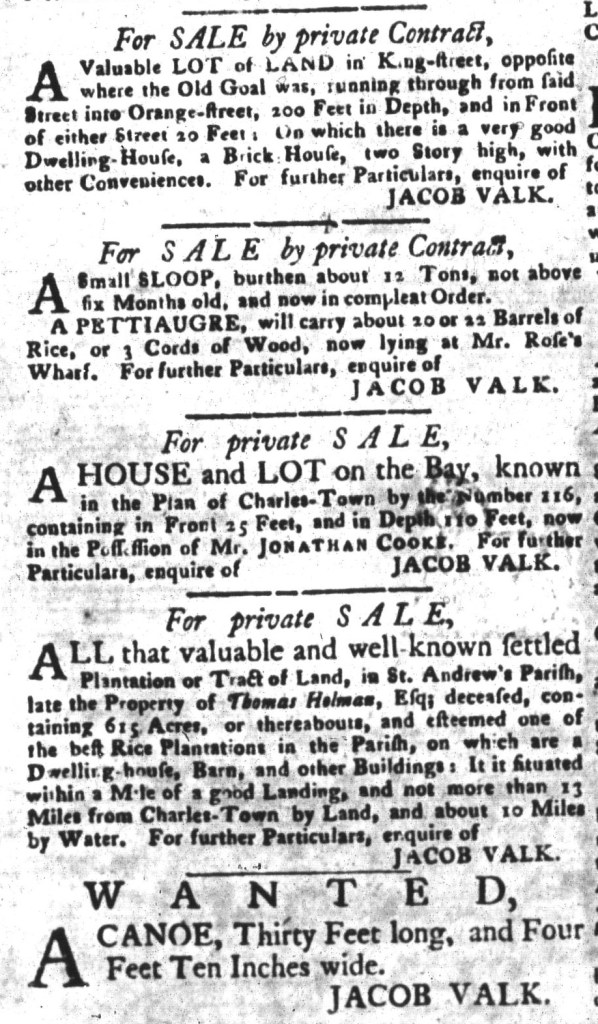
Jacob Valk established a brokerage office in Charleston in the early 1770s. In his newspaper advertisements, he advised, “Lands, Houses, and Negroes, Bought and sold at private Sale, upon the usual Commission.” If the pages of the public prints provide any guidance, many colonizers availed themselves of his services, entrusting the broker to conduct business on their behalf. His name became a familiar sight as he placed advertisement after advertisement for his clients.
Consider the supplement that accompanied the April 26 edition of the South-Carolina Gazette and Country Journal. Valk purchased an entire column on the third page, running fourteen advertisements. Some offered tracts of land for sale, while others included houses and other buildings along with land. Two of them announced sales of enslaved people, one indicating “SEVERAL NEGROES” without giving further details and the other describing “two very valuable Negro Shoe-makers.” Valk sought buyers for “A Small Sloop” and a pettiaugre (or canoe). In each instance, he invoked a familiar refrain: “For further Particulars, enquire of JACOB VALK.” He also assisted executors of estates in calling on those who had unfinished business to settle accounts, inviting them to his office “where the Particulars of that Estate now lay ready for their Perusal.” Four days earlier, Valk purchased a similar amount of space to run many of the same advertisements in the South-Carolina and American General Gazette.
The broker must have factored the cost of advertising into the “usual Commission” that he received for his services, especially considering that he was one of the best customers for the printing offices in Charleston. That he continuously placed newspaper advertisement testifies to his confidence in their general effectiveness, though not every notice may have achieved the desired results. Running so many simultaneously allowed him to distribute the risk and rewards of advertising. Even if some advertisements did not attract buyers, sellers, or associates seeking to settle accounts, others apparently did. When considered collectively, Valk came out ahead on what he invested in advertising. His individual clients, however, would not have had the same experience had they gone it alone. If they paid Valk on commission following a transaction he facilitated, then they paid only for successful advertisements without losing money on notices that did not produce the intended results.
What was advertised in a colonial American newspaper 250 years ago today?
South-Carolina Gazette (August 9, 1773).
“Lands, Houses, and Negroes, Bought and sold at private Sale, upon the usual Commissions.”
Jacob Valk opened a brokerage office in Charleston in the early 1770s. For months in 1773, he ran an advertisement in the South-Carolina Gazette and the South-Carolina Gazette and Country Journal to alert “the PUBLIC in general, and his Friends in particular” about the various services he provided. He presented five primary categories of tasks undertaken in his office: “Merchants and Tradesmen may have their Books regulated,” “Sets of Books opened properly, for Persons newly commencing any Kind of Business and superintended with the utmost Care,” “Persons desirous of settling their yearly Business expeditiously, by sending their Books to him may have it done,” “Money borrowed and lent at Interest,” and “Lands, Houses, and Negroes, Bought and sold at private Sale, upon the usual Commissions.” Among the various jobs that he did on behalf of colonizers who employed him, Valk facilitated buying and selling enslaved men, women, and children.
To that end, he also placed advertisements on behalf of his clients. In the August 9, 1773, edition of the South-Carolina Gazette, one of those advertisements ran immediately below his weekly notice about his various services. On behalf of his clients, the broker described “Four valuable and seasoned Negroes” available “by private Contract” rather than auction. Two young men were “fit for the Field,” but another young man as well as a woman possessed skills for contributing to a household. The “young FELLOW” had experience as a “complete Waiting-Man” who had also seen to the “Care and Management of Horses, and can drive a Carriage.” The woman was a “complete” housekeeper, “who is also a good ordinary Cook.” Valk concluded with instructions that prospective buyers should contact him for more information about the enslaved men and woman and the “Terms of Sale.”
In another advertisement in the same issue, the broker described a house and lot for sale. Valk’s newspaper advertisements outlining his services likely helped generate business in his brokerage office. In turn, he placed additional notices that increased his visibility and, when successful, augmented his reputation among his clients and the general public. Those advertisement also demonstrated that the broker actively worked on behalf of his clients, confirming for prospective customers that they might do better by entrusting sales to him “upon the usual Commissions” rather than invest their own time and effort. In addition, those additional advertisements testified to the fact that others did indeed employ Valk, perhaps elevating the confidence that prospective clients had in his abilities.
What was advertised in a colonial American newspaper 250 years ago this week?
Massachusetts Gazette and Boston Weekly News-Letter (April 8, 1773).
“He will open a Place for Sale of Goods to be known by the Name of The Silent Auction-Room.”
When he established the “Silent Auction-Room” in Boston in the spring of 1773, A. Bowman did not even pretend politeness toward his competitors in his advertisements. In a notice that he placed in the April 8 edition of the Massachusetts Gazette and Boston Weekly News-Letter, he mocked the advertisements placed by three of his competitors. All three advertisements appeared in that issue, making for easy reference for readers, though Bowman previously encountered them in other newspapers.
The auctioneer stated that he would “receive and sell all Sorts of Merchandise, House-Furniture,” and other goods. However, “‘Houses, Lands and Shipping,’ he does not pretend to sell,” he snidely comments, “because he is apprehensive it would be very difficult to get them up Stairs.” Bowman quoted directly from William Greenleaf’s advertisement. His rival stated, “In the Sale of Houses, Lands, Shipping, Merchandize, Household Furniture, &c. &c. my Employers may depend on my exerting myself for their Interest.”
The cantankerous auctioneer then declared that “Goods from ‘Servants and Minors’ will be received if they are properly authorized to deliver them.” In this instance, he taunted Martin Bicker, a broker who handled “all sorts of English and Scotch Goods [and] Household Furniture … to as good Advantage as can be done at any Auction whatever.” Bicker proclaimed that “the Public may rest assured, that no Goods will be received by him of any Servants or Minors.” Bowman established a different policy for his “Silent Auction-Room.” He took another jab at Bicker when he asserted that “His ‘Books’ shall be kept in good Order, so that it gives him no Concern whether they are ‘liable to Inspection,’ or not.” Before noting that he did not accept goods from servants or minors, presumably to avoid peddling stolen items, Bicker confided that “his Books are not liable to Inspection.” Bowman treated such lack of transparency with skepticism.
The final portion of Bowman’s advertisement, a short poem, most directly addressed the source of his anger and frustration. Joseph Russell, the proprietor of an auction room on Queen Street, previously published an advertisement that concluded with a poem that promoted his own business and mocked the demise of Bowman’s auction house. In addition to the poem, Russell announced that he “received a License from the Gentlemen Select-Men, to be an Auctioneer for the Town of Boston, conformable to the late Act for that Purpose.” Similarly, Greenleaf trumpeted that the “Gentlemen Select-Men … approbated me to officiate as one of the Vendue-Masters [or auctioneers] for this Town.” Bicker carefully described himself as a broker and made clear to prospective clients that his services rivaled those offered by auctioneers.
Boston Evening-Post (March 29, 1773).
Bowman apparently did not receive a license. In advertisements in the Boston Evening-Post and the Boston-Gazette on March 22 and in the Massachusetts Gazette and Boston Weekly News-Letter on March 25, he referred to his business as “BOWMAN’s Dying Auction-Room.” His advertisement in the March 29 edition of the Boston Evening-Post featured a thick black border, a symbol of death and mourning in early American print culture. Bowman lamented that his auction room “is soon to be sacrificed for the Good of the Province” and that he will be legally dead, (the taking away a Man’s Bread or his Life being synonymous) before another News-Paper comes out.” That advertisement appeared in the Boston-Gazette on the same day, though without the mourning border that clearly indicated how Bowman felt about the situation. That explains why Bowman described himself as the “late Auctioneer” at the “Dead Auction-Room” in his advertisement in the Massachusetts Gazette and Boston Weekly News-Letter on April 8. That he proposed opening a “Silent Auction-Room” suggests he identified some sort of loophole to defy the licensing act, perhaps as a broker rather than an auctioneer. In subsequent advertisements, he noted that he sold goods on commission.
Russell observed Bowman’s commentary in his advertisements, prompting him to allude to it in the poem he included in his own notice: “While some this Stage of Action quit, / And Dying advertise; / For Cash the Buyers here may meet / With constant fresh Supplies.” Not done with his own editorializing about his competitor, Russell added another stanza: “For Favors past, due Thanks return’d; / New Bargains, cheap and dear, / At the Old Place may still be found / J. RUSSELL, Auctioneer.” Russell pointedly declared that his business continued at a location familiar to residents of Boston.
In response, Bowman published his own poem at the end of his advertisement. “A License granted! pray for what? / To show their Parts in Rhyme; / But hear the Tale the Dead will rise, / And that in proper Time.” Bowman did not think much of Russell’s poetry nor his abilities as an auctioneer. At the same time, he pledged to revive his business, a footnote indicating that the public could anticipate that happening “When the expected Ships discharge their Cargoes.” Bowman critiqued the licensing act in a final stanza: “Fair LIBERTY thou Idol great, / How narrow is thy Sphere! / Ye Men of Sense say where she dwells, / For sure she reigns not here.” As colonizers in Boston debated the extent that Parliament infringed on their liberties, Bowman asserted that the new act, a local ordinance, curtailed liberty in the city.
By and large, auctioneers and other advertisers usually ignored their competitors. The angry and defiant Bowman, however, did not do so. Instead, he mocked several of the auctioneers and brokers who advertised in Boston’s newspapers, parroting their notices when he taunted them. He also continued to protest the new licensing act that caused him to close his auction room. In addition to promoting his next endeavor, the “Silent Auction-Room,” he used advertisements as a means of disseminating his commentary on the state of affairs in Boston.
What was advertised in a colonial American newspaper 250 years ago today?
Boston Evening-Post (April 5, 1773).
“No Good will be received by him of any Servants or Minors.”
Martin Bicker launched a new enterprise in Boston in the early 1770s. He offered his services as a broker who “receive[s] in all sorts of English and Scotch Goods, Houshold Furniture,” and other items and “does engage to raise the Cash for such Goods delivered [to] him for Sale.” In so doing, he put himself in competition most directly with auctioneers in the city, though he also gave consumers another alternative to buying from shopkeepers. Retailers also had the option to purchase wares from Bicker rather than from merchants. Still, Bicker positioned him services primarily as an alternative to those provided by auctioneers in the city. In an advertisement in the April 5, 1773, edition of the Boston Evening-Post, he declared that he paid cash for goods that clients entrusted to him “with as quick Dispatch and to good Advantage as can be done at any Auction whatever.” In addition, he concluded with a nota bene directed at buyers, declaring that he “has for Sale a Variety of English and other Goods, which may be had as cheap as at any VENDUE” or auction. Bicker noted that he ran his brokerage “At the RED FLAG,” a symbol usually associated with auctions but appropriated here for his own purposes.
Given that the broker offered secondhand goods for sale, he aimed to reassure the public that he did not peddle stolen items. Bicker stopped short of allowing others to examine his ledgers, but he did promise that “no Goods will be received by him of any Servants or Minors.” That meant that he did not accept items delivered by all sorts of free and unfree laborers who fell within the category of servants, including indentured servants, apprentices, and enslaved men and women. Bicker realized that these subordinates sometimes stole goods from their employers, masters, or enslavers and then sold or traded them. He also refused items from children and youth who similarly lacked authority when it came to disposing of goods. In his efforts to make his brokerage a success, Bicker pursued two strategies in his advertisement. He presented his services as equal to those in the auction houses already familiar to residents of Boston while simultaneously encouraging confidence in his integrity as an honest dealer who did not accept any and all merchandise sent his way. Instead, he exercised appropriate discretion that testified to his overall trustworthiness.
What was advertised in a colonial American newspaper 250 years ago today?
Pennsylvania Gazette (September 12, 1771).
“OFFICE OF INTELLIGENCE.”
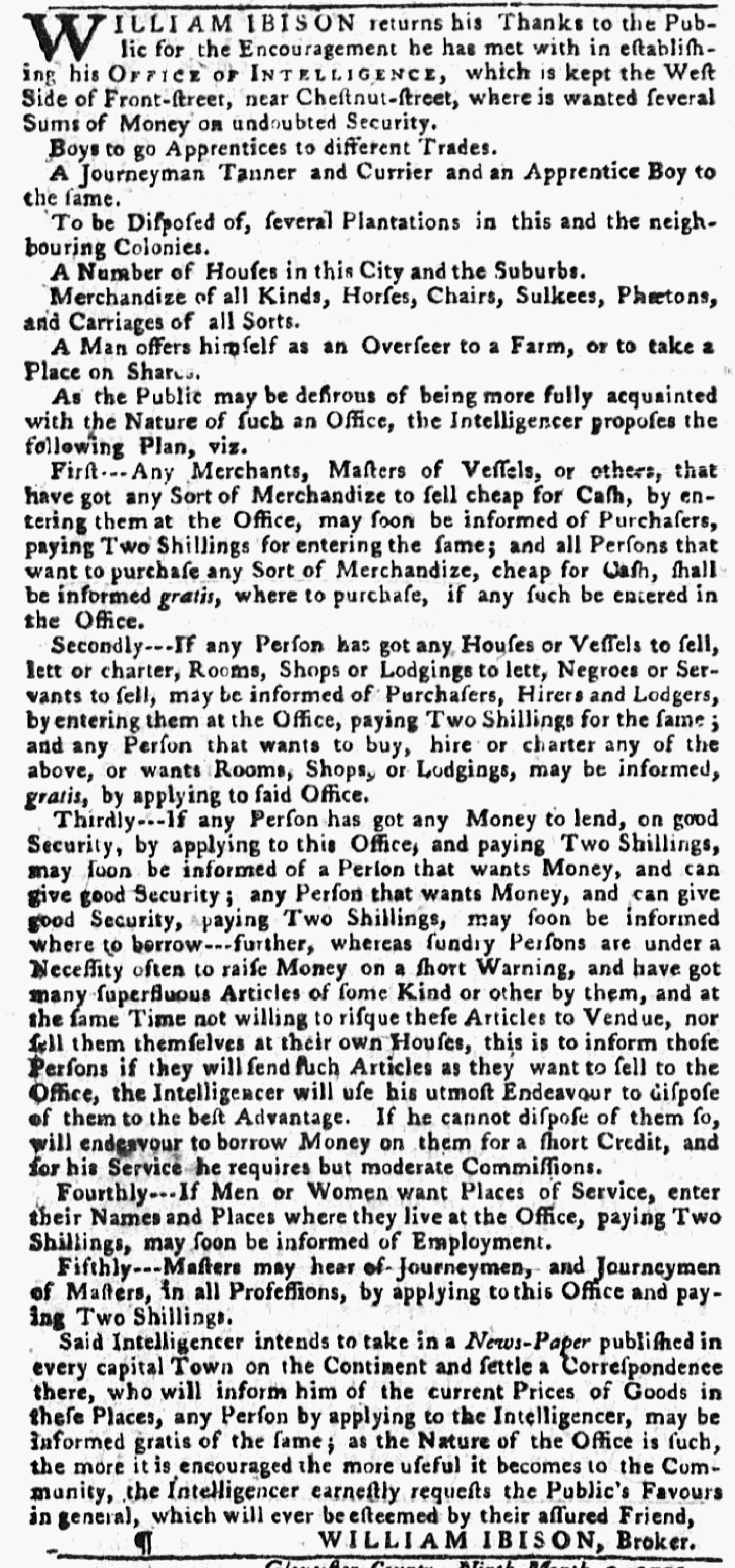
William Ibison offered his services as a broker to prospective clients who saw his advertisement in the September 12, 1771, edition of the Pennsylvania Gazette. He informed them that he established an “OFFICE OF INTELLIGENCE” on Front Street in Philadelphia. At that time, he could provide information about “Boys to go Apprentices to different Trades,” “A Number of Houses” for sale “in this City and the Suburbs,” and “Merchandize of all Kinds.”
Realizing that some readers might not have been familiar with the work of a broker or, as Ibison called himself, an “Intelligencer,” he offered an overview of his services. For a small fee, he collected information about goods for sale from “Merchants, Masters of Vessels, or others,” and then introduced them to prospective buyers. He also facilitated selling houses and ships, renting lodgings and shops, and selling indentured servants and enslaved laborers. In addition, Ibison oversaw loans and investments, placed men and women seeking work into jobs, and introduced masters and journeymen “in all Professions.” For each of those services, he charged “moderate Commissions” or small fees.
Ibison presented his “OFFICE OF INTELLIGENCE” as the hub of an information network. Some of that information he collected directly from clients, but he also relied on newspapers. The broker announced his plan “to take in a News-Paper published in every capital Town on the Continent and settle a Correspondence there.” Doing so would allow him to keep track of “current Prices of Goods in these Places” in order to pass along the intelligence to his clients. Unlike his other services, he offered that information “gratis.” He likely hoped that colonists who called on him for that information would be more likely to share information of their own or hire him for other ventures once they discovered how useful it could be to work with a broker who made it his business to collect, collate, and assess information from so many different sources.
The “Intelligencer” declared that “the Nature of the Office is such, the more it is encouraged the more useful it becomes to the Community.” His services, he asserted, benefited more than just his clients. That being the case, he “earnestly requests the Public’s Favours in general.” Only in combining a growing clientele with correspondents and newspapers from other cities could his “OFFICE OF INTELLIGENCE” achieve its full potential in assisting others in acquiring whatever information they needed to successfully pursue their own endeavors.