
Who was the subject of an advertisement in a colonial American newspaper 250 years ago today?
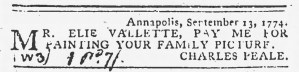
“MR. ELIE VALLETTE, PAY ME FOR PAINTING YOUR FAMILY PICTURE.”
Charles Willson Peale followed through on his threat. He had placed an advertisement in the September 8, 1774, edition of the Maryland Gazette warning that “IF a certain E.V. does not immediately pay for his family picture, his name shall be published at full length in the next paper.” The subject of the painter’s notice had not heeded it, perhaps mistakenly believing that Peale would not have the audacity to actually do what he suggested. If that was the case, he miscalculated because a week later the very first advertisement in the next issue of the Maryland Gazette proclaimed, “MR. ELIE VALLETTE, PAY ME FOR PAINTING YOUR FAMILY PICTURE.” Using all capital letters signaled the artist’s frustration; it also called greater attention to the advertisement.
Another advertisement involving Vallette appeared on the next page of the newspaper. That one, which had first appeared four months earlier, promoted the Deputy Commissary’s Guide, a book that Vallette had authored and invested many months in acquiring subscribers before taking it to press. He had advertised extensively in the Maryland Gazette. His name did not happen to appear in the most recent advertisement; instead, it gave the title of the book and featured an endorsement by William Fitzhugh, the colony’s commissary general. Martha J. King suggests that Vallette did not place the advertisement for the Deputy Commissary’s Guide, asserting that Anne Catherine Greene, the printer of both the Maryland Gazette and Vallette’s book, ran that notice.[1] To whatever extent Vallette was or was not involved in continuing to advertise the Deputy Commissary’s Guide following publication, he was proud enough of his achievement as an author that the book with its engraved title page appeared in the foreground of the family portrait Peale painted. Peale’s notices may not have been the kind of acclaim that Vallette desired, but the painter had given him public notice after seeking payment in private letters for several months.
Readers of the Maryland Gazette witnessed one side of the feud as it escalated from one week to the next in September 1774. Some may have found the spectacle entertaining, a good bit of gossip. Now that he had been named in the public prints, how would Vallette react? Would the disagreement escalate even more? Readers had a new reason to peruse the advertisements in the next edition of the Maryland Gazette.
**********
[1] Martha J. King, “The Printer and the Painter: Portraying Print Culture in an Age of Revolution,” Transactions of the American Philosophical Society 109, no. 5 (2021): 79.