September 22

What was advertised in a colonial American newspaper 250 years ago today?

Maryland Gazette (September 22, 1774).

“YES, YOU SHALL BE PAID; BUT NOT BEFORE YOU HAVE LEARNED TO BE LESS INSOLENT.”

The saga continued.  Elie Vallette, the clerk of the Prerogative Court in Annapolis and author of the Deputy Commissary’s Guide, did not bow to the public shaming that Charles Willson Peale, the painter, undertook in the pages of the Maryland Gazette in September 1774.  Earlier in the year, Peale had painted a family portrait for Vallette and then attempted through private correspondence to get the clerk to pay what he owed.  When Vallette did not settle accounts, Peale turned to the public prints.  He started with a warning shot in the September 8 edition of the Maryland Gazette: “IF a certain E.V. does not immediately pay for his family picture, his name shall be published at full length in the next paper.”  Peale meant it.  He did not allow for any delay in Vallette taking note of the advertisement and acting on it.  A week later, he followed through on his threat, resorting to all capitals to underscore his point, draw more attention to his advertisement, and embarrass the recalcitrant clerk.  “MR. ELIE VALLETTE,” Peale proclaimed in his advertisement, “PAY ME FOR PAINTING YOUR FAMILY PICTURE.”

That still did not do the trick.  Instead, it made Vallette double down on delaying payment.  He responded to Peale’s advertisement, attempting to put the young painter in his place.  In a notice also in all capitals, he lectured, “MR. CHARLES WILSON PEALE; ALIAS CHARLES PEALE – YES, YOU SHALL BE PAID; BUT NOT BEFORE YOU HAVE LEARNED TO BE LESS INSOLENT.”  Vallette sought to shift attention away from his own debt by critiquing the decorum of an artist he considered of inferior status.  That strategy may have worked, though only for a moment.  Peale’s advertisement did not run in the next issue of the Maryland Gazette.  That could have been because Peale instructed the printer, Anne Catharine Green, to remove his notice and returned to working with Vallette privately.  Even if that was the case, it was only temporary.  “MR. ELIE VALLETTE, PAY ME FOR PAINTING YOUR FAMILY PICTURE” appeared once again in the October 6 edition.  Peale was not finished with his insolence.  He placed the advertisement again on October 13 and 20.  Vallette did not run his notice a second time, perhaps considering it beneath him to continue to engage Peale in the public prints.  He had, after all, made his point, plus advertisements cost money.  That being the case, the painter eventually discontinued his notice.  Martha J. King notes that Vallette “eventually settled his account about a year later.”[1]  For a time, advertisements in the only newspaper printed in Annapolis became the forum for a very public airing of Peale’s private grievances and Vallette’s haughty response.

**********

[1] Martha J. King, “The Printer and the Painter: Portraying Print Culture in an Age of Revolution,” Transactions of the American Philosophical Society 109, no. 5 (2021): 79.

September 15

Who was the subject of an advertisement in a colonial American newspaper 250 years ago today?

Maryland Gazette (September 15, 1774).

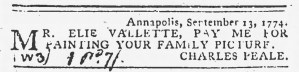
“MR. ELIE VALLETTE, PAY ME FOR PAINTING YOUR FAMILY PICTURE.”

Charles Willson Peale followed through on his threat.  He had placed an advertisement in the September 8, 1774, edition of the Maryland Gazette warning that “IF a certain E.V. does not immediately pay for his family picture, his name shall be published at full length in the next paper.”  The subject of the painter’s notice had not heeded it, perhaps mistakenly believing that Peale would not have the audacity to actually do what he suggested.  If that was the case, he miscalculated because a week later the very first advertisement in the next issue of the Maryland Gazette proclaimed, “MR. ELIE VALLETTE, PAY ME FOR PAINTING YOUR FAMILY PICTURE.”  Using all capital letters signaled the artist’s frustration; it also called greater attention to the advertisement.

Another advertisement involving Vallette appeared on the next page of the newspaper.  That one, which had first appeared four months earlier, promoted the Deputy Commissary’s Guide, a book that Vallette had authored and invested many months in acquiring subscribers before taking it to press.  He had advertised extensively in the Maryland Gazette.  His name did not happen to appear in the most recent advertisement; instead, it gave the title of the book and featured an endorsement by William Fitzhugh, the colony’s commissary general.  Martha J. King suggests that Vallette did not place the advertisement for the Deputy Commissary’s Guide, asserting that Anne Catherine Greene, the printer of both the Maryland Gazette and Vallette’s book, ran that notice.[1]  To whatever extent Vallette was or was not involved in continuing to advertise the Deputy Commissary’s Guide following publication, he was proud enough of his achievement as an author that the book with its engraved title page appeared in the foreground of the family portrait Peale painted.  Peale’s notices may not have been the kind of acclaim that Vallette desired, but the painter had given him public notice after seeking payment in private letters for several months.

Readers of the Maryland Gazette witnessed one side of the feud as it escalated from one week to the next in September 1774.  Some may have found the spectacle entertaining, a good bit of gossip.  Now that he had been named in the public prints, how would Vallette react?  Would the disagreement escalate even more?  Readers had a new reason to peruse the advertisements in the next edition of the Maryland Gazette.

**********

[1] Martha J. King, “The Printer and the Painter: Portraying Print Culture in an Age of Revolution,” Transactions of the American Philosophical Society 109, no. 5 (2021): 79.
September 8

What was advertised in a colonial American newspaper 250 years ago today?

Maryland Gazette (September 8, 1774).

“IF a certain E.V. does not immediately pay for his family picture, his name shall be published at full length in the next paper.”

A private scuffle over paying for a portrait became a public spectacle when Charles Willson Peale resorted to shaming Elie Vallette, author of the Deputy Commissary’s Guide, in a newspaper advertisement.  A notice in the September 8, 1774, edition of the Maryland Gazette advised that “IF a certain E.V. does not immediately pay for his family picture, his name shall be published at full length in the next paper.”  The painter, who signed his name as “CHARLES PEALE,” was near the beginning of his career, though he had already studied with Benjamin West in London for two years and then provided his services in Annapolis for a dozen more.  Still, at the time he sought the overdue payment, he was not yet the prominent figure, one of the most influential America painters and naturalists of his era, that he would become in the decades after the American Revolution.  He gained access to the power of celebrity later in his career, but at the moment he vied with Vallette he sought to leverage public shaming as the most effective tool available.

As Martha J. King notes, Peale “obtained a commission to paint a group portrait of the Vallette family and portrayed the author seated at a table with the engraved title page of the Deputy Commissary’s Guide clearly visible in the foreground.  [His] wife and two children clustered in the picture’s right.”[1]  Vallette had extensively advertised the Deputy Commissary’s Guide in the Maryland Gazette, gaining prominence for himself and his manual for settling estates and writing wills.  Commissioning a family portrait served to further enhance his status, yet the dispute that followed did not necessarily reflect well on Vallette.  On May 28, 1774, Peale sent a letter to Vallette to request payment, explaining that he needed to cover immediate expenses that included rent on the house where his family resided.[2]  The author did not heed that request.  Three months later, Peale decided to escalate his methods for collecting on the debt, placing the advertisement that gave Vallette’s initials and enough information that the author would recognize himself and perhaps enough that some readers could work out his identity, but not so much that readers in Annapolis and throughout the colony knew without a doubt that Peale addressed Vallette.  Was this strategy effective?  Next week the Adverts 250 Project will examine the subsequent issue of the Maryland Gazette to determine whether Peale had to further escalate his demand for payment.

**********

[1] Martha J. King, “The Printer and the Painter: Portraying Print Culture in an Age of Revolution,” Transactions of the American Philosophical Society 109, no. 5 (2021): 78.

[2] King, “Printer and the Painter,” 78.

July 25

What was advertised in a colonial American newspaper 250 years ago today?

Maryland Gazette (July 25, 1771).

“Sundry Books, on Painting, and a Number Prints being sent him.”

Colonists placed newspaper advertisements for a variety of purposes.  Some aimed to incite demand for consumer goods and services.  Others published legal notices or called on customers to settle accounts.  Enslavers offered Africans and African Americans for sale or offered rewards for the capture and return of Black people who liberated themselves by running away.  Aggrieved husbands warned against extending credit to recalcitrant wives.  Clubs informed members of upcoming meetings.  A good number of advertisements concerned lost or stray livestock.  Colonists also inserted other sorts of lost-and-found notices.

When a shipment of “sundry Books, on Painting, and a Number of Prints” from England got misdirected in the summer of 1771, Charles Willson Peale ran an advertisement in the Maryland Gazette, hoping that “Any Gentleman” among the readers who had come into possession of his books and prints would forward them to him or inform him so he could make arrangements to collect them.  He promised that anyone who helped him acquire the missing items “shall be well rewarded for his Trouble.”  Peale had “received Letters” alerting him about the books and prints “being sent him, but by what Ship, or to what Part of Virginia or Maryland they were sent, he is totally at a Loss to find out.”  When he placed the advertisement, Peale was simultaneously frustrated and hopeful.

At the time, Peale had already gained some renown as a painter having studied under John Singleton Copley in the colonies and, for three years, under Benjamin West in England.  He eventually became one of the most influential American painters of the late eighteenth and early nineteenth centuries, known especially for his portraits of prominent leaders now remembered as founders of the nation.  A naturalist and inventor in addition to an artist, Peale established one of the first American museums.  He often harnessed these endeavors to promoting the new nation.  Today, historians and other scholars recognize and continue to examine his contributions to early American politics and culture.

That distinguishes Peale from most of the other colonists who placed advertisements or who were the subjects of advertisements in the Maryland Gazette.  For good reason, the name “CHARLES W. PEALE” at the end of his advertisement draws the attention of modern readers familiar with the era of the American Revolution.  Yet that advertisement by a notable historical figure tells only one story among the many significant narratives contained within advertisements that ran in the same issue, a story in many ways less important than others despite the famous name attached to it.  William Rooke’s advertisement for “a great Variety of GOODS,” for instance, testifies to the consumer revolution that played an important role in colonists participating in politics through their decisions in the marketplace.  Thomas Gassaway Howard’s advertisement offering a reward for the capture and return of “a Negro Man named Harry” demonstrates the tension between liberty and enslavement present at the founding of the nation.  Colonists of all sorts, elites and the lower sorts, enslaved and free, made history in the eighteenth century.  In the twenty-first century, we have a duty to examine their many different stories and incorporate their diverse experiences and perspectives into a more complete narrative of the past.