
What was advertised in a colonial American newspaper 250 years ago today?
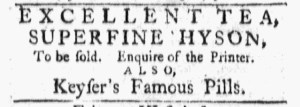
“EXCELLENT TEA, SUPERFINE HYSON.”
Advertisements for tea did not disappear from American newspapers immediately following the Boston Tea Party, nor did they disappear in anticipation of nonimportation agreements enacted in protest of the Coercive Acts that Parliament passed in response. In Tea: Consumption, Politics, and Revolution, 1773-1776, James R. Fichter notes, “Printers Isaiah Thomas (Patriot) and James Rivington (Loyalist) used their newspapers to advertise their own tea.”[1] Rivington did so in the October 13, 1774, edition of Rivington’s New-York Gazetteer, offering both “EXCELLENT TEA, SUPERFINE HYSON,” and “Keyser’s Famous Pills,” one of the most famous patent medicines of the era.
Yet that was not only advertisement for tea in that issue. In the next column, Abraham Duryee provided an extensive list of imported merchandise that concluded with a familiar list: “sugar, tea, coffee, corks, &c. &c. &c.” On the next page, tavernkeeper Edward Bardin once again inserted his advertisement that promoted “TEA and COFFEE every afternoon” among the amenities available at his establishment. In the two-page supplement, filled entirely with advertisements, William Parsons included “Green Tea” among the wares in stock at his store. Peter Elting sold “best Hyson and Bohea tea” along with other groceries. Fichter reports that Rivington’s New-York Gazetteer “carried tea ads until early 1775, reaching colonies where local tea advertising had already ended.”[2] Colonial newspapers tended to circulate across regions, including Rivington’s New-York Gazetteer; or, the Connecticut, Hudson’s Rivers, New-Jersey, and Quebec Weekly Advertiser.
Rivington’s editorial stance as well as the advertisements for tea in his newspaper caught the attention of Patriots in New York and beyond. They often burned Rivington’s New-York Gazetteer, both along with tea and separately. Furthermore, Fichter identifies “[c]ommittees in at least twenty communities from Rhode Island to South Carolina called for boycotts of his Gazetteer” and “also pressed Rivington’s advertisers” by “urg[ing] ‘Friends of America’ to avoid Rivington and his advertisers.”[3] Even as tea became the subject of news coverage and editorials and advertisements for tea no longer appeared in some colonial newspapers, other continued to publish advertisements for tea for more than a year after the Boston Tea Party. The commodity was hotly contested, even as Patriots attempted to impose a boycott of the problematic beverage.
**********
[1] James R. Fichter, Tea: Consumption, Politics, and Revolution, 1773-1776 (Ithaca: Cornell University Press, 2023), 144.
[2] Fichter, Tea, 154.
[3] Fichter, Tea, 208.