
What was advertised in a colonial American newspaper 250 years ago today?
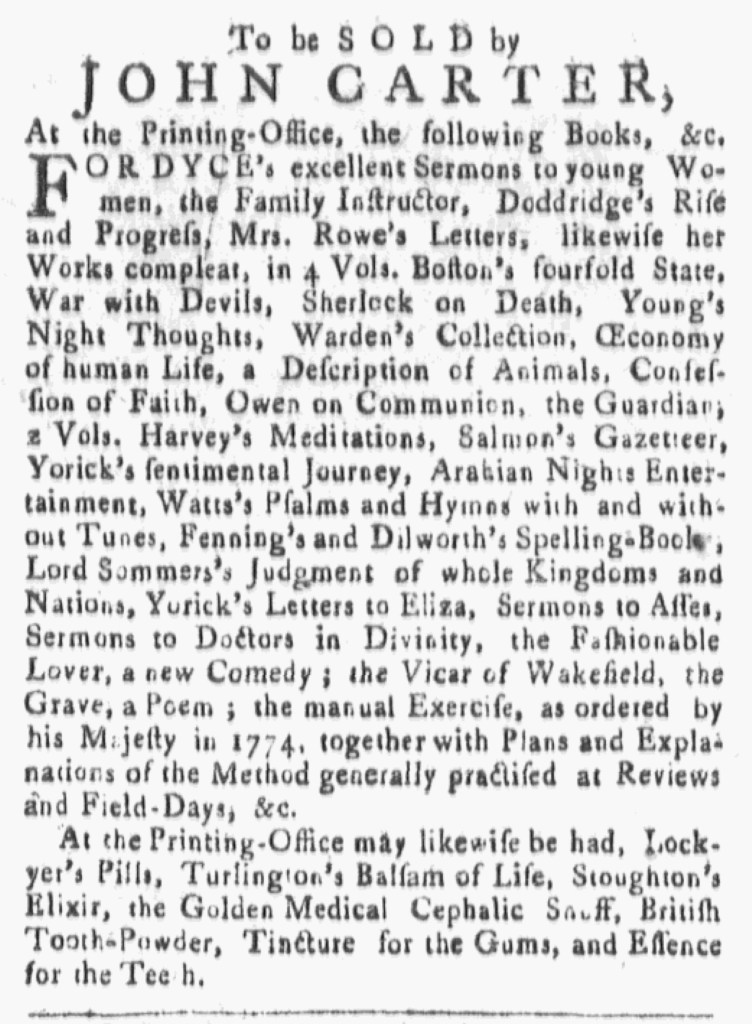
“At the Printing-Office may likewise be had, Lockyer’s Pills, Turlington’s Balsam of Life.”
Colonial printers devised multiple revenue streams to earn their livelihoods. John Carter, the printer of the Providence Gazette, was no exception. In addition to seeking subscribers and advertisers for his newspaper, the colophon in each issue announced that “all Manner of Printing-Work is performed with Care and Expedition” at his printing office. Carter took orders for job printing, everything from handbills and broadsides to printed blanks and circular letters. Like other printers, he was also a bookseller, dealing primarily in imported volumes rather than books and pamphlets produced in his own shop. In the October 15, 1774, edition of the Providence Gazette, Carter inserted an advertisement that listed a couple of dozen titles that he had on hand, including “FORDYCE’s excellent Sermons to young Women, the Family Instructor, Doddridge’s Rise and Progress, Mrs. Rowe’s Letters, likewise he Works compleat, in 4 Vols.” Each fall, Carter collaborated with Benjamin West, an astronomer and mathematician, in publishing an almanac. Separate advertisements for that useful work would commence soon, though the printer did not yet promote it in the middle of October.
His advertisement did, however, conclude with a separate list of patent medicines that he stocked at the printing office: “Lockyer’s Pills, Turlington’s Balsam of Life, Stoughton’s Elixir, the Golden Medical Cephalic Snuff, British Tooth-Powder, Tincture for the Gums, and Essence for the Teeth.” Apothecaries imported and sold these popular remedies, as did merchants and shopkeepers … and printers. Throughout the colonies, printers frequently advertised patent medicines in addition to goods and services associated with the book trade. They did not need to possess any specialized medical knowledge to peddle these eighteenth-century versions of over-the-counter medications. Customers already knew which patent medicines treated which maladies. In addition, the various pills, powders, and elixirs frequently came with printed instructions that absolved printers and other retailers from having to provide any guidance about their use. When it came to acquiring patent medicines, consumers may have found it just as convenient to visit the local printing office as any other shop. For his part, Carter accommodated them, supplementing the revenues he earned from printing and selling books.