
What was advertised in a colonial American newspaper 250 years ago today?
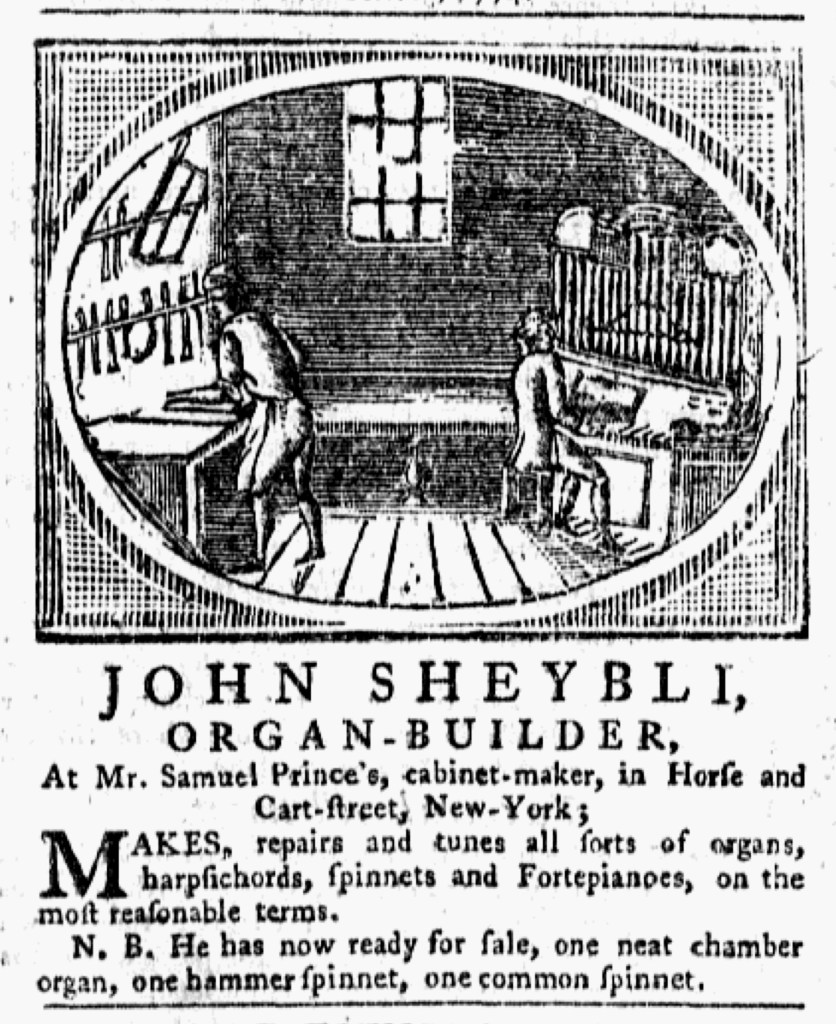
“All sorts of organs, harpsichords, spinnets and Fortepianoes.”
In the fall of 1774, John Sheybli, an “ORGAN-BUILDER,” took to the pages of the New-York Gazette and Weekly Mercury to advise the public that he “MAKES, repairs and tunes all sorts of organs, harpsichords, spinnets and Fortepianoes, on the most reasonable terms.” In addition, he “has now ready for sale, one neat chamber organ, one hammer spinnet, [and] one common spinnet” at the workshop he shared with Samuel Prince, a cabinetmaker.
Readers of the New-York Gazette and Weekly Mercury likely perused the copy in Sheybli’s advertisement only after noticing the visual image that accompanied it. A woodcut featured a scene with two men within an oval frame. The man on the left stood at a workbench with an array of tools hanging on the wall over it and the man on the right was seated at an organ, maybe tuning it or maybe playing it. Perhaps it was a depiction of the workshop where Sheybli built organs and other instruments on Horse and Cart Street, though it may have been an idealized portrait of the artisan at work and a customer enjoying the product of those labors. Readers could determine for themselves how they wished to interpret it.
No matter which narrative they imagined, Sheybli treated them to a visual image unlike others they encountered in the New-York Gazette and Weekly Mercury and other newspapers. Advertisers sometimes included woodcuts that represented some aspect of their business, but they focused on specific goods or replicated their shop signs. They almost never showed people, neither at work producing the items offered for sale nor at leisure enjoying their purchases. The November 28, 1774, edition of the New-York Gazette and Weekly Mercury and its supplement had three advertisements with woodcuts commissioned by the advertisers. Lyon Jonas, a furrier, once again ran his notice with an image of some of the goods he produced, a muff and a tippet, while Nicholas Cox, a hatter, incorporated what may have been a variation of the sign that marked his location. His woodcut showed a crown above a tricorne hat. Readers were accustomed to those kinds of images, but much less often saw the sort of scene that Sheybli presented in his advertisement. That almost certainly helped in making it memorable.