
What was advertised in a colonial American newspaper 250 years ago today?
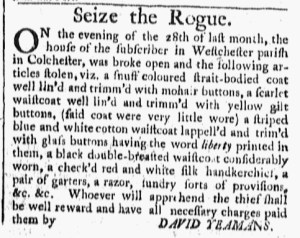
“Glass buttons having the word liberty printed in them.”
The headline for David Yeaman’s advertisement in the December 9, 1774, edition of the Connecticut Gazette alerted readers that it would document some sort of misbehavior. “Seize the Rogue,” it proclaimed. The rogue “broke open” Yeamans’s house and stole several items on November 28. They included clothing, a “check’d red and white silk handkerchief,” a razor, and “sundry sorts of provisions.” The unfortunate advertiser offered a reward to whoever apprehended the thief.
Yeamans’s descriptions of the missing garments revealed his taste and sartorial sensibilities. The thief took a “snuff coloured strait-bodied coat well lin’d and trimm’d with mohair buttons,” a “scarlet waitcoast well lin’d and trimm’d with yellow gilt buttons” that showed very little wear, a “black double-breasted waistcoat considerably worn,” and a “striped blue and white cotton waistcoat lappell’d and trim’d with glass buttons.” That last piece of clothing testified to more than Yeamans’s sense of fashion. It also said something about his politics and how he felt about the imperial crisis that had been intensifying for the year since the Boston Tea Party. Those glass buttons had “the word liberty printed in them.” Yeamans made a statement every time he wore the striped waistcoat adorned with those buttons.
This advertisement, printed immediately below entries from the “CUSTOM-HOUSE, New-LONDON,” and other shipping news in “THOMAS ALLEN’s MARINE LIST,” provided additional coverage of local news, though selected by an advertiser who paid to have it appear in print rather than by the editor who compiled “Fresh Advices from London!” and reports from Boston, New York, Philadelphia, and Hartford. At first glance, it featured a theft, yet the details about one of the stolen garments prompted readers to think about the contents of the articles and editorials in that issue, including discussion of the Continental Association adopted by the First Continental Congress and the impact of the Boston Port Bill on residents of that city. Those buttons with “the word liberty printed in them” contributed to discussions about politics when Yeamans wore his waistcoat and when he advertised its theft.