September 2

What was advertised in a revolutionary American newspaper 250 years ago today?
New-York Gazette and Weekly Mercury (September 2, 1776).

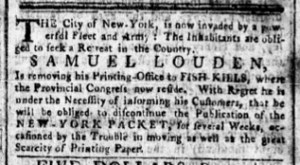
“THE City of New-York, is now invaded by a powerful Fleet and Army.”

Samuel Loudon summarized recent events in the first line of his advertisement in the September 2, 1776, edition of the New-York Gazette and Weekly Mercury.  Residents of the city and nearby towns already knew that the British had captured New York.  Most other readers likely learned about the British occupation of New York before reading Loudon’s advertisement, probably hearing about it before reading about it in any newspaper.

Still, delivering the news was an important precursor for what Loudon needed to share with subscribers to his newspaper, the New York Packet.  Due to the occupation, the “Inhabitants [of New York] are obliged to seek a Retreat in the Country.”  Among those who sight refuge in the countryside, Loudon “remov[ed] his Printing-Office to FISH KILLS, where the Provincial Congress now reside.”  That location offered safety as well as access to news about the state government, once he managed to open a printing office there.  “With regret,” Loudon continued, “he is under the Necessity of Informing his Customers, that he will be obliged to discontinue the Publication of the NEW-YORK PACKET, for several Weeks, occasioned. By the Trouble of moving as well as the great Scarcity of Printing Paper.”

Loudon had been publishing the New York Packet for only eight months before circumstances caused him to retreat to Fishkill.  He distributed the first issue on January 4, 1776, and suspended it with the August 29 edition, just before the British entered the city.  It took longer than he anticipated to resume publication.  According to Clarence S. Brigham, “The first Fishkill issue was undoubtedly that of Jan. 16, 1777, vol. 1, no. 36, but the earliest located is that of Feb. 6, 1777, vol. 1, no. 39.”[1]  Loudon continued the volume and issue numbering uninterrupted despite the suspension and relocation.  The British occupied New York throughout the remainder of the war.  Loudon remained in Fishkill, publishing his newspaper there until the end of August 1783.  He then returned to New York and continued the newspaper without changing the volume numbering in November 1783.  The war disrupted publication of the New York Packet, yet Loudon persevered.  He managed to continue supplying subscribers and other readers with news (and advertisements) despite the challenges of “removing his Printing-Office” beyond occupied New York.

**********

[1] Clarence S. Brigham, History and Bibliography of American Newspapers, 1690-1820 (Worcester, Massachusetts: American Antiquarian Society, 1947), 570.

August 31

What was advertised in a revolutionary American newspaper 250 years ago today?

New-Hampshire Gazette (August 31, 1776).

“THE following new ACTS and LAWS, past at the last Session of the General-Court of this State.”

On August 10, 1776, the Freeman’s Journal, printed in Portsmouth, New Hampshire, carried an advertisement that announced that the “Acts and Laws OF this State, passed since the new Form of Government took Place, are now in the Press, and in a few Weeks will be published at the Printing Office in Exeter.”  That town served as New Hampshire’s capital during the Revolutionary War.  Provincial congresses met there before the war during its first year.  The assembly continued meeting there after the Continental Congress declared independence.  Three weeks after the first advertisement, a new advertisement appeared in the Freeman’s Journal.  It informed readers that the “following new ACTS and LAWS, past at the last Session of the General-Court of this State” was “Just Published at the Printing Office in EXETER.”  Robert L. Fowle, the printer in Exeter, offered for sale “A few Copies exclusive of what the Assembly take off.”

Most of the advertisement consisted of a list of the various acts, including “An Act for establishing Courts of Law for the Administration of Justice within this Colony,” “An Act to establish an equitable Method of making Rates and Taxes, and determining who shall be legal Voters in town and Parish Affairs,” “An Act to prevent the Forgeing & altering Bills of pubic Credit, and for preventing the Depreciation thereof; and for making the Bills of Credit of the United Colonies, and the Bills of this Colony a Tender in all payments.”  Even though Fowle stated that the acts had been passed by the “General-Court of this State,” many of them referred to New Hampshire as a colony.  The provincial congress adopted a new constitution in January 1776, removing the colony from British authority, yet the colonies had not yet declared independence.  Those last colonial laws soon became the first laws of the new state.

When Fowle listed the acts in a newspaper advertisement in hopes of selling surplus copies that the assembly did not “take off,” he also reported the news.  Readers did not have to purchase the acts to learn what kind of work the assembly had undertaken in Exeter, though the list might have prompted some to learn more about those acts that interested or affected them.  The advertisement supplemented the coverage of state government that appeared in newspapers.

August 24

What was advertised in a revolutionary American newspaper 250 years ago today?

Providence Gazette (August 24, 1776).

A male CHILD, about 5 Months old, was taken from the House of Susannah Reiley.”

Early American newspapers did not usually carry a lot of local news.  Printers devoted much more space to news received from distant places, whether elsewhere along the Atlantic coast or across the ocean.  After all, most newspapers came out just once a week.  Some local news was old news before it could appear in print because it already spread via word of mouth.  Consider the August 24, 1776, edition of the Providence Gazette.  News from London filled the first page, followed by news from Williamsburg, Philadelphia, and New York on the second page.  News from Providence ran on the third page, alongside advertisements.  Paid notices filled most of the final page.

Yet those advertisements delivered all sorts of local news that readers wished to disseminate to the public.  For a fee, they purchased space and served as editor when it came to determining what would appear in that space.  Two advertisements described soldiers that deserted from their regiments.  That had become a common enough occurrence that John Carter, the printer, did not necessarily consider it news that he would select to publish, especially not when he could generate revenue by printing it as an advertisement, but the advertisers and readers considered the information newsworthy.

Another advertisement delivered news of a crime that recently occurred in Johnston, a town just west of Providence.  On July 18, “a male CHILD, about 5 Months old, was taken from the House of Susannah Reiley, while she was gone to bring a Pail of Water from a Spring.”  Reiley had not been negligent.  The spring was only fifteen rods (about 250 feet) from her house, but she was away and out of sight long enough that someone kidnapped the baby.  The advertisement did not describe the search undertaken nor other subsequent events.  Instead, it provided what amounted to a headline summary.  With the fate of the child unknown, residents of Johnston issued a plea for “any Intelligence of said Child,” including “if living or dead.”  The advertisement delivered local news and likely spurred conversations and speculation about what had happened.

July 28

What was advertised in a revolutionary American newspaper 250 years ago this week?

Freeman’s Journal (July 27, 1776).

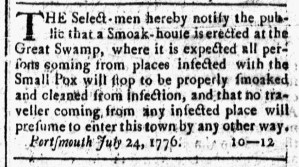
“All persons coming from places infected with the Small Pox will stop to be properly smoaked.”

It was important news, but it appeared among the advertisements in the July 27, 1776, edition of the Freeman’s Journal, or New Hampshire Gazette.  The selectmen for the town of Portsmouth placed the advertisement to “notify the public that a Smoak-house is erected at the Great Swamp, where it is expected all persons coming from places infected with the Small Pox,” such as Boston, “will stop to be properly smoaked and cleaned from infection.”  In addition, the selectmen demanded “that no traveller coming from any infected place will presume to enter this town by any other way.”

The notice could have appeared with the local news from Portsmouth that Benjamin Dearborn, the printer of the Freeman’s Journal, selected for that issue.  Instead, it ran as an advertisement in another column, to the right of the header for news from “PORTSMOUTH,” below an advertisement that offered a “LARGE commodious BRICK HOUSE in York” for rent, and above an advertisement about a horse left at the Globe Tavern.  The notation at the end of the notice, “10—12,” indicated that it was indeed an advertisement.  It first appeared in issue “No. 10” on July 27 and would run in each issue through “No. 12” on August 10 before being discontinued.  The notation was meant for the compositor who set the type rather than for readers.  Dearborn presumably generated revenue from the advertisement.  Treating it as an advertisement had the benefit of disseminating such an important announcement multiple times and increasing the chances that travelers learned about the policy for entering Portsmouth before approaching the town.  Still, Dearborn could have chosen to insert the notice among the news in several consecutive issues of the Freeman’s Journal rather than consigning it to the space reserved for advertisements.  Instead, he followed the same practice as other early American printers who published newspapers.  Within the past week, a notice concerning voting for delegates to attend a convention “for the express purpose of forming a New Government” in Maryland appeared as an advertisement in Dunlap’s Maryland Gazette and a notice instructing Committees of Safety in Worcester County to “transmit … the Names of such Persons … who are deemed to be notoriously inimical to the rights of America” ran as an advertisement in the Massachusetts Spy.  Subscribers and other readers knew that important news updates sometimes took the form of advertisements.  They perused notices placed for all sorts of purposes to keep informed about local news.

July 24

What was advertised in a revolutionary American newspaper 250 years ago today?

Massachusetts Spy (July 24, 1776).

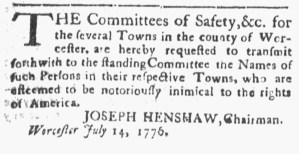
“Transmit … the Names of such Persons … notoriously inimical to the rights of America.”

It was another instance of an advertisement delivering news to newspaper readers.  In this instance, Joseph Henshaw placed an advertisement in the Massachusetts Spy with instructions for the “Committees of Safety … for the several Towns in the county of Worcester” in central Massachusetts.  Those committees “are hereby requested to transmit forthwith to the standing Committee the Names of such Persons in their respective Towns, who are esteemed to be notoriously inimical to the rights of America.”  Henshaw and his committee decided to make the request on July 14, 1776, the same day that residents of Worcester may have participated in the first public reading of the Declaration of Independence in Massachusetts.

The notice (and the Declaration of Independence) appeared in the July 17, 1776, edition of the Massachusetts Spy, the next one that came off the press in the only printing office in Worcester.  It ran at the bottom of the final column on the second page, immediately below news from Boston, dated July 11, and could have been mistaken for another news item selected by William Stearns and Daniel Bigelow except for the thick lines that traditionally separated news from paid notices.  Even if the compositor inserted those lines in error, the notice would have run just once if Stearns and Bigelow considered it a news item.  Instead, it ran again on July 24, this time at the bottom of the first column on the first page.  It followed two other advertisements.  The news for that issue began at the top of the next column.  This suggests that Stearns and Bigelow treated the call to submit the names of people “esteemed to be notoriously inimical to the rights of America” as a paid notice, an advertisement that generated revenue, rather than as a news items published as a public service.  In so doing, they took the same approach as the printers of Dunlap’s Maryland Gazette and the Maryland Journal who simultaneously published an advertisement with instructions for voting for delegates from Baltimore to attend a convention “for the express purpose of forming a New Government” for the state of Maryland.

July 23

What was advertised in a revolutionary American newspaper 250 years ago today?

Dunlap’s Maryland Gazette (July 23, 1776).

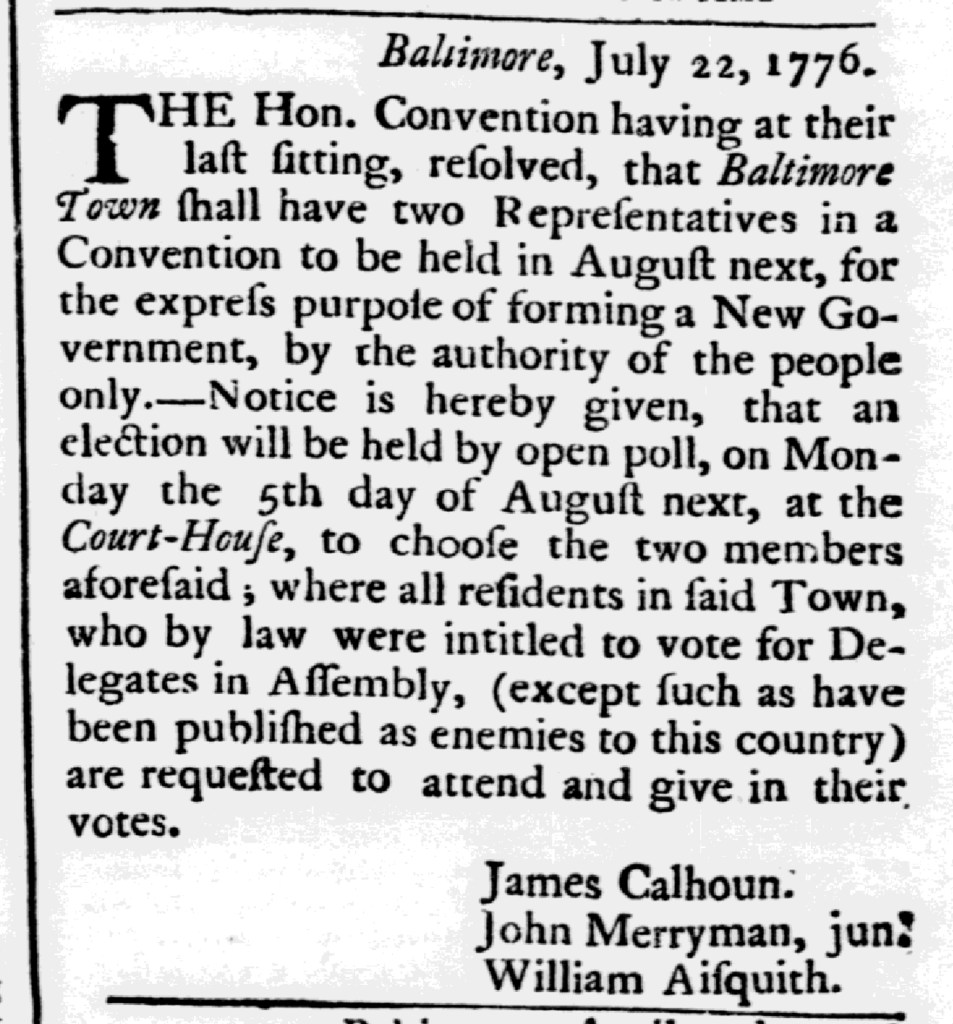
“All residents in said Town … are requested to attend and give in their votes.”

Newspaper advertisements sometimes made important announcements during the era of the American Revolution.  An advertisement in the July 23, 1776, edition of Dunlap’s Maryland Gazette, for instance, informed readers that the most recent provincial convention “resolved, that Baltimore Town shall have two Representatives in a Convention to be held in August next, for the express purpose of forming a New Government,” a government established “by the authority of the people only” in the wake of the Continental Congress declaring independence from Great Britain.  “Notice is hereby given,” the advertisement continued, “that an election will be held by open poll, on Monday the 5th day of August next, at the Court-House, to choose the two members aforesaid.”  Furthermore, “all residents in said Town, who by law were intitled to vote for Delegates in Assembly, (except such as have been published as enemies to this country) are requested to attend and give in their votes.”

That notice appeared among the other advertisements in Dunlap’s Maryland Gazette, alongside employment notices, descriptions of indentured servants who ran away, and an advertisement for “KEYSER’s FAMOUS PILLS” and other patent medicines.  The men who signed the notice – James Calhoun, John Merryman, Jr., and William Aisquith – apparently paid to insert it in Dunlap’s Maryland Gazette and in the Maryland Journal as well.  The printers of those newspapers could have included such important information with the news that they selected to disseminate to readers. They could have even given the notice a prominent place on the front page, publishing it as a public service as the state created its “New Government, by the authority of the people.”  Instead, they treated the notice as an advertisement rather than news, presumably generating revenue each time it appeared in their newspapers.  Readers knew that news of various sorts, including legal notices, often ran as advertisements.  They realized that the news in any issue of an early American newspaper did not necessarily end when the advertisements began.

June 11

What was advertised in a revolutionary American newspaper 250 years ago today?

Pennsylvania Evening Post (June 11, 1776).

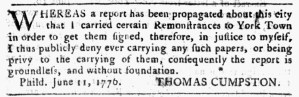
“I thus publicly deny ever carrying any such papers, or being privy to the carrying of them.”

As the printer and editor of the Pennsylvania Evening Post, Benjamin Towne made decisions about the news that appeared in his newspaper.  In the June 11, 1776, edition, for instance, he selected an open letter “To Mr. JAMES RANKIN, one of the Representatives for the country of York, in the province of Pennsylvania” from “A FREEMAN,” updates from Watertown, Massachusetts; New London, Connecticut; and New York, and local news from Philadelphia.  Yet that was not all the news that appeared in that issue of the Pennsylvania Evening Post.  Advertisers also played a role in choosing which news to disseminate, paying for the opportunity to do so.  Hamilton and Leiper announced the dissolution of their partnership in yet another newspaper, Captain Thomas Houston alerted the public about four men who “DESERTED … from on board the Provincial armed galley Warren,” and “Dr. L. BUTTE, Surgeon-Dentist,” advised the public of his new location on Chestnut Street.

Thomas Cumpston also placed an advertisement with the intention of spreading news that was especially important to him.  “WHEREAS a report has been propagated about this city,” he declared, “that I carried certain Remonstrances to York Town in order to get them signed, therefore in justice to myself, I thus publicly deny ever carrying such papers, or being privy to the carrying of them.”  To make it clear, he asserted that “the report is groundless, and without foundation.”  The open letter to Rankin from “A FREEMAN” that filled the entire first page and spilled over onto the second concerned the circulation of the “certain Remonstrances” that Cumpston supposedly carried to York to gather signatures,” though “A FREEMAN” did not mention Cumpston.  That letter was a response to Rankin’s own open letter “To the WORTHY INHABITANTS of YORK COUNTY” in the June 8 edition of the Pennsylvania Evening Post.  It also filled the entire first page and overflowed to the second page.  Rankin stated that he had been “injuriously treated by a Resolve of your County Committee, published in the several newspapers.”

The controversy revolved around Rankin’s reaction to the a resolution passed by the Second Continental Congress on May 15, 1776, a resolution that the “Assemblies and Conventions of the United Colonies, where no Government sufficient to the Exigencies of their affairs hath been hitherto established, … adopt such Government as shall in the Opinion of the Representatives of the People best conduce to the happiness and Safety of their Constituents in particular and America in General.”  In other words, each colony should establish its own government.  Tories and moderates took a different approach to this resolution than Patriots did.  In Pennsylvania, that resulted in both a “Remonstrance,” favored by Tories, and a “Protest,” favored by Patriots, circulating; “A FREEMAN” accused Rankin of embracing the former and ignoring the latter even though Rankin claimed that he wished to be guided by the views of all his constituents.  Rankin insisted that he acted from “love for the charter constitution of Pennsylvania” when he took into account “a Remonstrance …  sign[ed] by multitudes of the most respectable names in the city of Philadelphia, and the neighbouring counties, in opposition to the doctrines in the Protest.”  The “Remonstrance” argued that “public service has been, and might still be, carried on as vigorously by the Assembly of this province as by any other public body on the continent.”  Therefore, it was not necessary to create a new government.

Cumpston wanted no part of that controversy, at least not as an agent who circulated “certain Remonstrances … in order to get them signed.”  His advertisement served as a supplement to the news as he attempted to shape the narrative as far as his own actions were concerned.  Towne, the printer and editor, may not have had any interest in how the story that appeared on the first page of his newspaper had an impact on one resident of Philadelphia, but he did aim to generate revenue by selling advertising space.  Cumpston inserted a paid notice as a means of publishing news and rehabilitating his reputation as political debates in Pennsylvania intensified.

March 24

What was advertised in a revolutionary American newspaper 250 years ago this week?

Virginia Gazette [Purdie] (March 22, 1776).

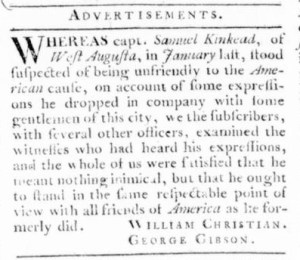
“He ought to stand in the same respectable point of view with all friends of America.”

As the imperial crisis intensified and became a war, some colonizers published newspaper advertisements intended to rehabilitate their reputations.  Many of the signers of an address to Thomas Hutchinson took to the pages of the newspapers published in New England to apologize and to explain the circumstances that led to their error.  In response to other incidents that called their support for American liberties into question, Asa Dunbar published “RECANTATIONS” in the New-England Chronicle, Lemuel Bower and Joseph Lyon both expressed regret for not showing support for nonimportation agreement in advertisements in the New-York Journal, and John Bergum promised to “conduct myself as a true friend to America” in the Pennsylvania Evening Post.

Samuel Kinkead got into similar trouble in Virginia in January 1776.  An advertisement in the March 22 edition of Alexander Purdie’s Virginia Gazette reported that Kinkead “stood suspected of being unfriendly to the American cause, on account of some expressions he dropped in company with some gentlemen” in West Augusta.  William Christian and George Gibson, and “several other officers, examined the witnesses who had heard his expressions.”  At the conclusion of their interviews, “the whole of us were satisfied that [Kinkead] meant that he ought to stand in the same respectable point of view with all friends of America as he formerly did.”  This advertisement delivered important news, at least from Kinkead’s perspective, so he may have been grateful that it ran first among the paid notices in that issue of the Virginia Gazette.  It thus served as a transition between news and editorials that kept readers informed about politics and the war and the advertisements placed for a variety of purposes.  This notice, like so many others, delivered local news to readers, bypassing the printer who made editorial decisions about what to include elsewhere in the newspaper.  Kinkead did not address readers himself as others had done, but he may have considered it more effective for Christian and Gibson to vouch for him.

December 7

What was advertised in a revolutionary American newspaper 250 years ago today?

Maryland Gazette (December 7, 1775).

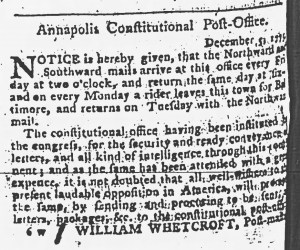
“Annapolis Constitutional Post-Office.”

In early December 1775, William Whetcroft became the latest postmaster to run a newspaper advertisement promoting a local branch of the Constitutional Post Office established by the Second Continental Congress.  In October, Mary Katharine Goddard placed a notice about the Baltimore office in the Maryland Journal.  Otherwise, advertisements for local branches appeared in newspapers published in New England, New York, and Pennsylvania, but not yet in newspapers from colonies south of Maryland.  The headline for this newest advertisement proclaimed, “Annapolis Constitutional Post-Office,” alerting readers of the Maryland Gazette that they had an alternative to the British imperial system.  Whetcroft commenced with an overview of his office’s schedule: “the Northward and Southward mail arrive at this office every Friday at two o’clock, and return the same day at six.”  In addition, “on Monday a rider leaves this town for Baltimore, and returns on Tuesday with the Northward mail.”

Yet Whetcroft used his advertisement to relay more than just the logistical details.  He gave an overview of the purpose that the Constitutional Post Office served as the imperial crisis intensified, hostilities commenced, and some colonizers considered whether they should declare independence rather than continue seeking redress of their grievances against Parliament.  “The constitutional office having been instituted by the congress,” the postmaster explained, “for the security and ready conveyance of letters, and all kinds of intelligence through this continent; and as the same has been attended with a great expence, it is not doubted that all well-wishers to the present laudable opposition in America, will promote the same, by sending and procuring to be sent all letters, packages, &c. to the constitutional post-office.”  Supporters of the American cause had a civic duty, Whetcroft asserted, to make use of this service.

Frederick Green, the printer of the Maryland Gazette, gave Whetcroft’s notice a privileged place the first time it appeared in that newspaper.  It appeared as the second advertisement following the news, preceded only by Green’s own advertisement for the almanac he just published and sold at the printing office.  As much as Green may have been a supporter of the Constitutional Post Office, he still had to earn his livelihood with his own endeavors!  Still, the printer had room for only two advertisements at the bottom of the final column on the second page.  He could have chosen from among several of a similar length to Whetcroft’s advertisement, yet he selected the notice about the Constitutional Post Office to appear alongside news of the revolutionary events taking place in Maryland and beyond.  In subsequent editions, that advertisement ran intermingled among others, but that was common practice for notices that printers initially gave privileged places the first time they ran in their newspapers.

November 17

What was advertised in a revolutionary American newspaper 250 years ago today?

Thomas’s Massachusetts Spy (November 17, 1775).

“A CONSTITUTIONAL POST-OFFICE is established in this town.”

Isaiah Thomas, the printer of Thomas’s Massachusetts Spy, gained a new title in the fall of 1775.  He became the postmaster for the “CONSTITUTIONAL POST-OFFICE” in Worcester.  In an advertisement in the November 17 edition of his newspaper, he informed the public that “the Post-Mater General of the United Colonies” established the post office in Worcester.  That meant that “letters sent to this office, may be dispatched to all the principal towns on the continent” via a network of post offices and riders authorized by the Second Continental Congress as an alternative to the imperial postal system.  Thomas provided a schedule.  Outgoing mail “sent by the Eastern Post is closed every Tuesday evening by six o’clock.”  For outgoing mail, the post office dispatched letter received “Friday morning by nine o’clock.”  That corresponded with the arrival of new mail: “The Western mail arrives at this OFFICE every Tuesday evening; and the Eastern, every Friday morning.”  Patrons who planned accordingly could use the new postal system to correspond with friends, relatives, and associates throughout the colonies.

Thomas gave this advertisement a prominent place when he published it, placing it immediately below a notice that the Second Continental Congress created a committee to compile a “just and well authenticated account of the hostilities committed by the ministerial troops and navy in America since March last,” including “proper evidence of the truth of the facts related.”  In documenting buildings destroyed, vessels seized, and stock taken, they justified their resistance and engaged in public relations to demonstrate that colonizers had legitimate grievances.  Thomas could have placed any number of other advertisements below that notice, yet he opted for one that promoted another effort undertaken by the Second Continental Congress to protect American liberties.  It was a fitting editorial decision for a newspaper with American Oracle of Liberty as its secondary title.  In this instance, Thomas deployed an advertisement as a continuation of news about current events, keeping readers updated not only about what occurred but also about how they could support the American cause.