
What was advertised in a colonial American newspaper 250 years ago today?
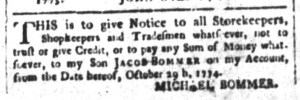
“Not to trust or give Credit … to my Son JACOB BOMMER on my Account.”
As the imperial crisis intensified and the colonies and Parliament were increasingly at odds in 1774, a rupture occurred in the relationship that Michael Bommer had with his son, Jacob. It may or may not have been the result of politics and disagreements over the Coercive Acts and how the colonies should respond. Just as likely, it had nothing to with politics. After all, colonizers continued to lead their daily lives even as momentous events unfolded around them. Fathers and sons quarreled about a variety of personal and financial issues that had little or nothing to do with politics.
Whatever the cause of their discord, it was significant enough to cause the father to take to the pages of the South-Carolina and American General Gazette with a notice “to all Storekeepers, Shopkeepers, and Tradesmen whatsoever, not to trust or give Credit, or to pay any Sum of Money whatsoever, to my Son JACOB BOMMER, on my Account, from the Date hereof, October 29th, 1774.” Three months later, the Bommers had not reconciled. Instead, the elder Bommer felt compelled to insert his advertisement in the January 27, 1775, edition of the South-Carolina and American General Gazette.
When he did so, he followed a format familiar to readers because it was so very regularly deployed by husbands against their wives in newspapers throughout the colonies. On the same day that Bommer’s notice appeared, for instance, Richard Mills informed readers of the New-Hampshire Gazette that he “hereby forbids any person crediting his Wife ANNA, on his Account, as he will not pay any Debts by her contracted.” Such notices offered a means for husbands to attempt to assert their authority in public after their wives had disdained that authority in private. On rare occasions, men adapted those sorts of newspaper notices when their relationships with other family members deteriorated. When Bommer did so, he protected his credit and finances, but at the expense of hinting at private affairs in the public prints. Such a spectacle had the potential to fuel gossip and draw more attention to the strife he and his son experienced.