
What was advertised in a colonial American newspaper 250 years ago today?
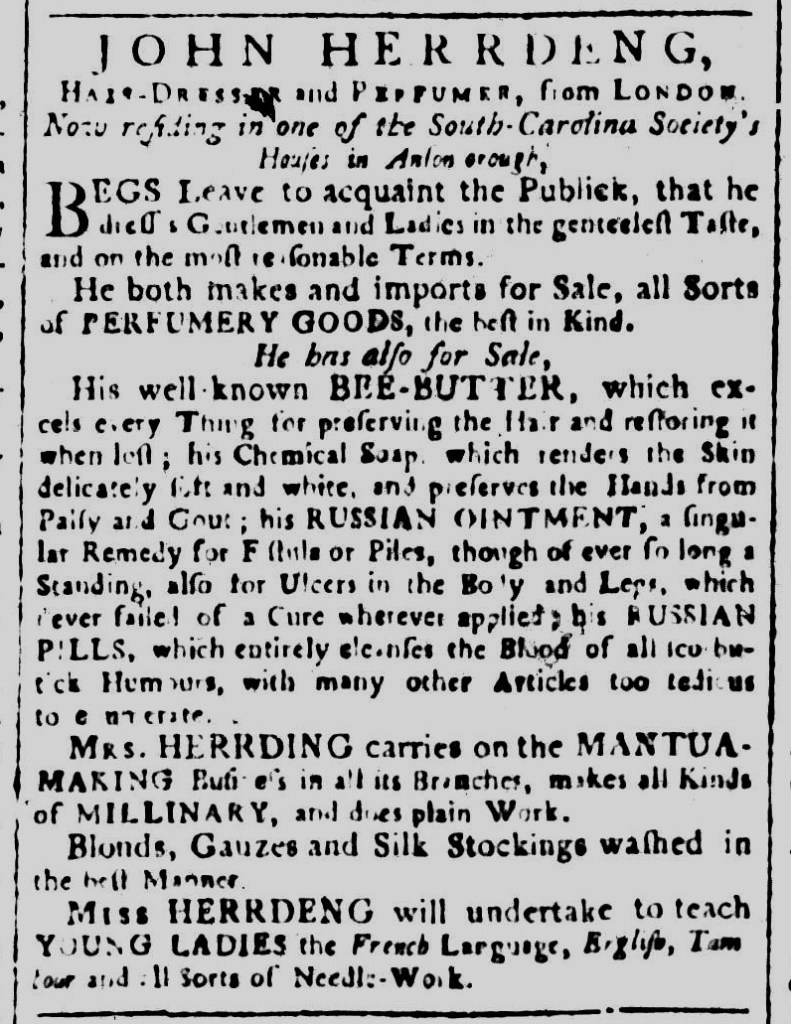
“JOHN HERRDENG, HAIR-DRESSER and PERFUMER.”
“MRS. HERRDING carries on the MANTUA-MAKING Business.”
“MISS HERRDENG will undertake to teach YOUNG LADIES the French Language.”
At a glance, the headline for an advertisement in the February 10, 1775, edition of the South-Carolina and American General Gazette promoted goods and services provided by John Herrdeng, a “HAIR-DRESSER and PERFUMER, from LONDON,” yet when they perused it more closely readers discovered that the notice also included entrepreneurial activities undertaken by other members of the Herrdeng household. Descriptions of “PERFUMERY GOODS” and medicines that Herrdeng made and sold accounted for the first two thirds of the advertisements. The final third outlined Mrs. Herrdeng’s “MANTUA-MAKING Business” and Miss Herrdeng offering lessons in French, English, and Needlework to the “YOUNG LADIES” of Charleston.
On occasion, the Adverts 250 Project has examined newspaper advertisements jointly placed by husbands and wives, brothers and sisters, or other relations residing in the same household. This unusual advertisement, however, featured three family members who each pursued their own occupations. As was often (but not always) the case, the man of the household received top billing. Not only did the description of John Herrdeng’s goods and services take up the most space in the advertisement, his name, in larger font, appeared as the headline. The order that the other members of the household appeared indicated their status and, likely, their experience.
Mrs. Herrdeng and Miss Herrdeng were not the only female entrepreneurs who advertised in that issue of the South-Carolina and American General Gazette. Ann Fowler ran an advertisement for paper hangings and textiles that she also placed in the South-Carolina Gazette and Country Journal. It filled almost as much space as the Herrdengs’ notice. At the top of the column, Jane Thomson, a milliner, encouraged consumers to avail themselves of her services. These advertisements made Fowler’s and Thomson’s presence in the marketplace much more visible in the public prints than Mrs. Herrdeng and Miss Herrdeng. The Herrdengs made different decisions about how to depict themselves as entrepreneurs, yet their advertisement testifies to the contributions they made to their household beyond assisting a husband and father in his occupation. The Herrdeng women practiced their own trades, engaged with their own clients, and resorted to advertising to facilitate their work.