April 2

What was advertised in a revolutionary American newspaper 250 years ago today?
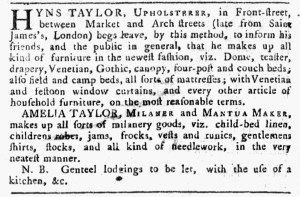
Pennsylvania Evening Post (April 2, 1776).

“HYNS TAYLOR, UPHOLSTERER, … AMELIA TAYLORS, MILANER and MANTUA MAKER.”

When Hyns Taylor, an upholsterer, relocated from London to Philadelphia, he introduced himself to prospective customers via an advertisement in the Pennsylvania Evening Post in the spring of 1776.  Like other artisans who migrated from the largest and most cosmopolitan city in the empire to the colonies, he encouraged consumers to associate sophistication with his prior experience.  Rather than merely stating that he was “from London,” as many did in their advertisements, he instead specified that he was “late from Saint James’s, London,” apparently believing that readers recognized the cachet of that address.  He also emphasized that he upholstered “all kind of furniture in the newest fashion,” including “drapery, Venetian, Gothic, canopy, four-post and couch beds.”  Even though the colonies were at odds with the empire, many colonizers even calling for independence as the anniversary of the battles at Lexington and Concord approached, they still looked to London for that “newest fashion,” yet Taylor also took current events into account by noting that he also worked on “field and camp beds” with “all sorts of mattresses.”

Members of Taylor’s household may have assisted him in the upholstery shop, yet Amelia Taylor, most likely his wife, but perhaps a daughter or other female relation, pursued her own enterprise as a “MILANER and MANTUA MAKER.”  Hyns and Amelia devised a join advertisement.  He received top billing in the first paragraph, while the second paragraph informed prospective customers that she “makes up all sorts of milanery goods,” such as “child-bed linen, childrens robes, jams, frocks, vests and tunics, gentlemens shirts, stocks, and all kinds of needlework.”  She emphasized her skill, stating that she did her work “in the very neatest manner,” though the Taylors likely intended for readers to note her origins “from Saint James’s, London,” when they considered engaging her services.  Although Amelia appeared second in the advertisement, her name and occupation in capital letters received the same treatment as Hyns’s name and occupation.  Only the drop cap, the large letter “H” that began the advertisement, distinguished his name from hers.  That may have been by their own design when they composed the copy or it may have been a decision made by the compositor when setting the type.  Either way, it signaled a partnership in which both Hyns and Amelia contributed to the livelihood of the Taylor household.
February 10

What was advertised in a colonial American newspaper 250 years ago today?

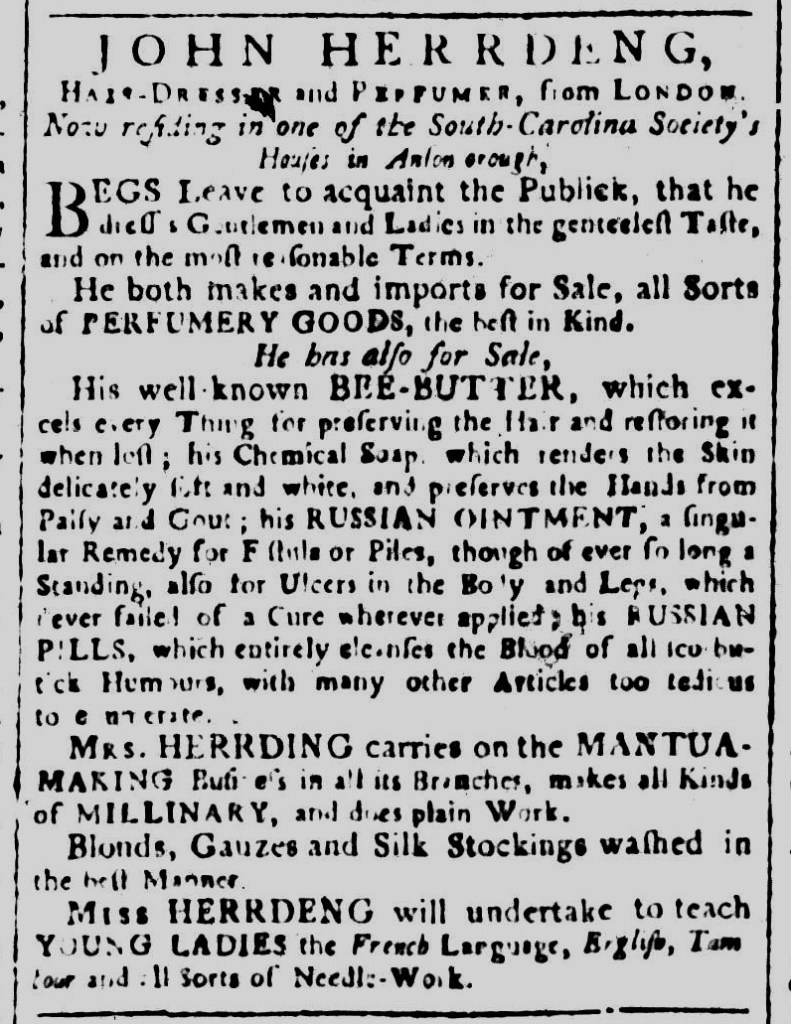
South-Carolina and American General Gazette (February 10, 1775).

“JOHN HERRDENG, HAIR-DRESSER and PERFUMER.”

“MRS. HERRDING carries on the MANTUA-MAKING Business.”

“MISS HERRDENG will undertake to teach YOUNG LADIES the French Language.”

At a glance, the headline for an advertisement in the February 10, 1775, edition of the South-Carolina and American General Gazette promoted goods and services provided by John Herrdeng, a “HAIR-DRESSER and PERFUMER, from LONDON,” yet when they perused it more closely readers discovered that the notice also included entrepreneurial activities undertaken by other members of the Herrdeng household.  Descriptions of “PERFUMERY GOODS” and medicines that Herrdeng made and sold accounted for the first two thirds of the advertisements.  The final third outlined Mrs. Herrdeng’s “MANTUA-MAKING Business” and Miss Herrdeng offering lessons in French, English, and Needlework to the “YOUNG LADIES” of Charleston.

On occasion, the Adverts 250 Project has examined newspaper advertisements jointly placed by husbands and wives, brothers and sisters, or other relations residing in the same household.  This unusual advertisement, however, featured three family members who each pursued their own occupations.  As was often (but not always) the case, the man of the household received top billing.  Not only did the description of John Herrdeng’s goods and services take up the most space in the advertisement, his name, in larger font, appeared as the headline.  The order that the other members of the household appeared indicated their status and, likely, their experience.

Mrs. Herrdeng and Miss Herrdeng were not the only female entrepreneurs who advertised in that issue of the South-Carolina and American General Gazette.  Ann Fowler ran an advertisement for paper hangings and textiles that she also placed in the South-Carolina Gazette and Country Journal.  It filled almost as much space as the Herrdengs’ notice.  At the top of the column, Jane Thomson, a milliner, encouraged consumers to avail themselves of her services.  These advertisements made Fowler’s and Thomson’s presence in the marketplace much more visible in the public prints than Mrs. Herrdeng and Miss Herrdeng.  The Herrdengs made different decisions about how to depict themselves as entrepreneurs, yet their advertisement testifies to the contributions they made to their household beyond assisting a husband and father in his occupation.  The Herrdeng women practiced their own trades, engaged with their own clients, and resorted to advertising to facilitate their work.