
What was advertised in a colonial American newspaper 250 years ago this week?
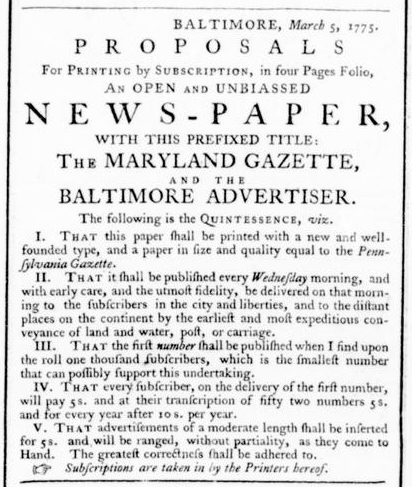
“Advertisements … will be ranged, without partiality as they come to Hand.”
Baltimore did not have its own newspaper until William Goddard commenced publication of the Maryland Journal on August 20, 1773. Less than two years later, John Dunlap, the printer of Dunlap’s Pennsylvania Packet, proposed publishing a second newspaper in that growing port on the Chesapeake Bay. He followed a model designed by Goddard, who had been publishing the Pennsylvania Chronicle in Philadelphia when he set about opening a second printing office and establishing another newspaper in a neighboring colony.
Dunlap disseminated subscription proposals widely, including inserting them in John Dixon and William Hunter’s Virginia Gazette. He announced a plan for an “OPEN AND UNBIASED NEWS-PAPER,” a claim made by many printers during the era of the American Revolution even though they often took an editorial stance that favored either Patriots or Loyalists. He planned to call it the “MARYLAND GAZETTE, AND THE BALTIMORE ADVERTISER,” distinguishing it from the Maryland Gazette published in Annapolis since 1745, but he would not take it to press until he attracted “one thousand subscribers, which is the smallest number that can possibly support this undertaking.” The proposed newspaper apparently drew that many subscribers (or at least enough that Dunlap considered it a viable enterprise) because he issued the “first number” of Dunlap’s Maryland Gazette; or the Baltimore General Advertiser on May 2, just two months after the date on the proposals. Perhaps subscribers grew eager for an additional source of news as the imperial crisis intensified, or perhaps news of the skirmishes at Lexington and Concord in April convinced Dunlap that the time was right to launch his newspaper, even if he did not yet have one thousand subscribers, because current events would guarantee its success.
His subscription proposal covered some of the usual nuts and bolts, what many printers called “conditions,” yet Dunlap referred to as “the QUINTESSENCE.” He indicated that the newspaper “shall be printed with a new and well-founded type, and a paper in size and quality to the Pennsylvania Gazette,” curiously drawing comparison to another newspaper published in Philadelphia rather than his own. He planned to publish a new issue “every Wednesday morning,” the same day that Goddard distributed copies of the Maryland Journal. He promised delivery “on that morning to the subscribers in the city and liberties.” Those in “the distant places on the continent,” such as readers of Dixon and Hunter’s Virginia Gazette, could expect “the earliest and most expeditious conveyance of land and water, post, or carriage.” Subscriptions cost five shillings, due at the time of delivery of the first issues, and then another five shillings upon receiving fifty-two issues. They continued at ten shillings each year.
While many subscription proposals for newspapers solicited advertisements, few specified how much they cost; instead, they declared that they charged the same fees as their competitors. In the proposals for the Pennsylvania Ledger that also circulated in the first months of 1775, for instance, Jame Humphreys, Jr., stated, “Advertisements to be inserted on the same Terms as is usual with other Papers in this City.” Similarly, Isaiah Thomas pronounced that advertisements in the Worcester Gazette would be “inserted in a neat and conspicuous [manner], at the same rates as they are in Boston.” Dunlap, in contrast, gave a price: “advertisements of a moderate length shall be inserted for 5s.” He did not, however, indicate how many times notices ran for that rate nor whether advertisers received discounts for subsequent insertions. He did assert that they “will be ranged, without partiality, as they come to Hand. The greatest correctness shall be adhered to.” In other words, he would print notices in the order they arrived in the printing office; no advertisements would receive a privileged place based on their content, the printer’s relationship with the advertiser, or other factors. All advertisers could depend on their notices appearing accurately in the Maryland Gazette. The inaugural issue featured one advertisement. The Adverts 250 Project will turn its attention to that advertisement and others in the coming months.