June 2

What was advertised in a revolutionary American newspaper 250 years ago this week?

Virginia Gazette [Dixon and Hunter] (June 1, 1776).

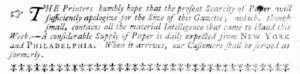
This Gazette … though small, contains all the material Intelligence that came to Hand this Week.”

The June 1, 1776, edition of John Dixon and William Hunter’s Virginia Gazette looked different than previous issues and opened with an explanation from the printers.  That newspaper usually consisted of four pages of three columns each with a large masthead at the top of the first page.  In addition to the title, date, names of the printers, and issue number, the usual masthead declared that the newspaper contained “THE FRESHEST ADVICES, BOTH FOREIGN AND DOMESTIC.”  Another line in the masthead proclaimed, “IN CIVITATE LIBERA LINGUAM MENTEMQUE LIBERAS ESSE DESERE” or “In a free state, there should be freedom of speech and thought.”  For a final layer, an advertisement for subscriptions, paid notices, and job printing ran across the bottom of the masthead.  An image depicting the arms of the monarch, similar to the one previously used by Alexander Purdie in the masthead of his Virginia Gazette, appeared in the center of Dixon and Hunter’s standard masthead.

The latest edition of their newspaper, however, consisted of four pages with two columns per page on a smaller sheet.  Rather than a masthead with five layers of text serving different purposes, a streamlined masthead gave the title on one line and the date, number, city, and names of the printers on the second line.  No image appeared in that masthead.  Subscribers could not help but notice that Dixon and Hunter’s Virginia Gazette had a new size and format.  Anticipating what kinds of reactions that might cause, the printers opened with a notice to readers: “THE Printers humbly hope that the present Scarcity of paper will sufficiently apologize for the Size of this Gazette.”  They tried to mollify their customers, asserting that the June 1 edition, “though small, contains all the material Intelligence that came to Hand this Week.”  They did not, however, make any sort of acknowledgment that some advertisements may have been omitted for lack of space.  “A considerable Supply of Paper is daily expected from NEW YORK and PHILADELPHIA,” the printers explained before ending with a promise.  “When it arrives, our Customers shall be served as formerly.”  It was not the first time during the Revolutionary War that colonizers in Virginia did not have access to as much news and advertising in the public prints as they had come to expect.  In January 1776, for instance, John Pinkney, the printer of another Virginia Gazette, ran an advertisement in Dixon and Hunter’s newspaper to explain that he missed an issue due to “a Disappointment in receiving Paper from the Northward.”  Dixon and Hunter faced the same challenge.  The following week they still did not have a new supply of paper, but they doubled the number of smaller pages to eight to serve their readers and their advertisers.

May 26

What was advertised in a revolutionary American newspaper 250 years ago this week?

Virginia Gazette [Dixon and Hunter] (May 25, 1776).

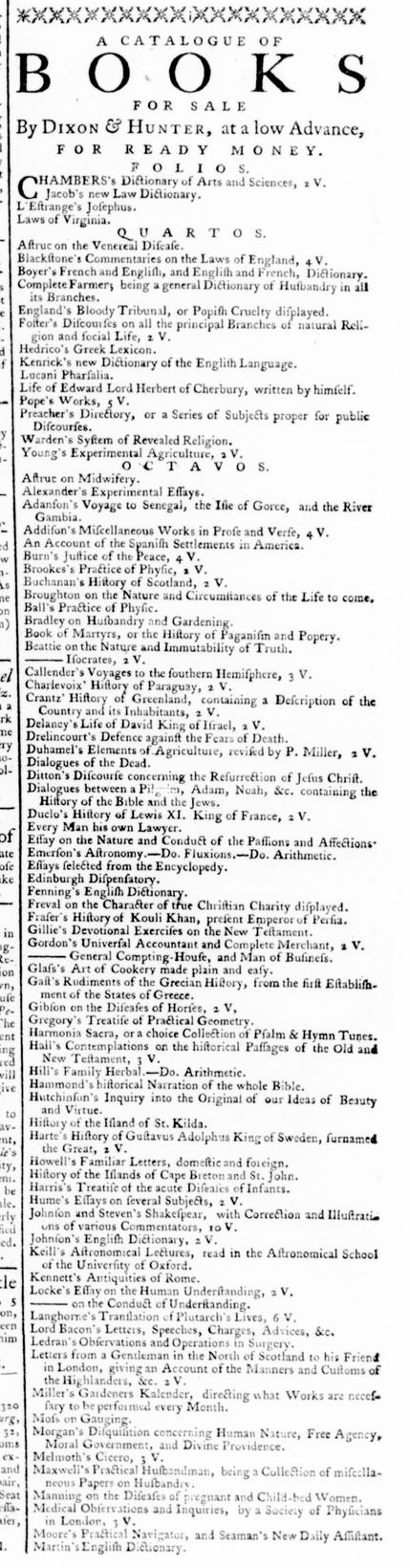
“A CATALOGUE OF BOOKS FOR SALE … By DIXON & HUNTER.”

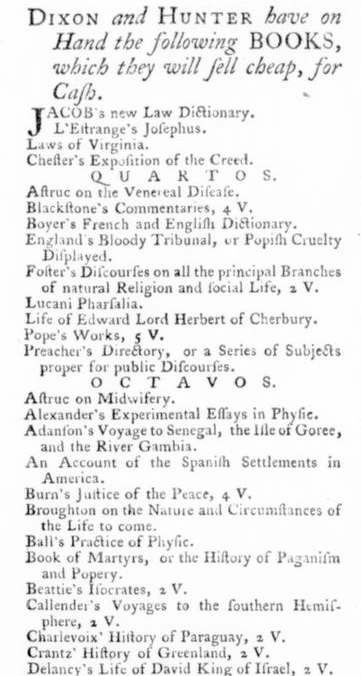
The May 25, 1776, edition of John Dixon and William Hunter’s Virginia Gazette concluded with a “CATALOGUE OF BOOKS” for sale at their printing office.  It filled most of the final column on the last page.  An advertisement for a “VIEW of the late BATTLE at CHARLESTOWN,” now known as the Battle of Bunker Hill, appeared immediately above it.  Dixon and Hunter also sold that print.  While they certainly wished to generate revenue beyond newspaper subscriptions and advertisements, it appears that the printers also used these notices as filler to complete that edition of their newspaper.

Consider, for instance, the contents of the book catalogue.  Dixon and Hunter updated a book catalogue that previously appeared in the Virginia Gazette six months earlier.  That version classified books by size – folios, quartos, octavos, and duodecimos – and listed titles in alphabetical order by author.  The printers made adjustments to the folios, quartos, and octavos listed in the new catalogue based on their current inventory.  They did not, however, include any duodecimos.  Indeed, the list of octavos ended abruptly with “Martin’s English Dictionary.”  This indicates that Dixon and Hunter included as much of the catalogue as would fit in that final column but did not make it a priority to publish the entire catalogue in that issue.  They may have been printing and distributing the catalogue as a separate broadside or pamphlet, taking advantage of type already set when they needed material for the last page of the May 25 issue.

When they did so, the printers did not attempt to highlight those titles that they thought most likely to attract customers, nor did they make any sales pitch except stating they sold the books “at a low Advance.”  In other words, they charged reasonable prices with only a small markup from what they paid to acquire the imported books.  They did expect customers to pay “READY MONEY” at the time of purchase rather than take away any of the titles on credit.  In the masthead, Dixon and Hunter gave the prices for an annual subscription to the newspaper (twelve shillings and six pence) and running advertisements “of a moderate Length” (three shillings for the first insertion and two shilling for each subsequent insertion).  They also stated that they did job printing “in the NEATEST Manner, with Care and Expedition.” Like most other newspaper printers, they supplemented revenue from printing with revenue from selling books.  They hoped that the incomplete book catalogue would entice prospective customers to find out what other volumes they offered for sale.

May 19

What was advertised in a revolutionary American newspaper 250 years ago this week?

Virginia Gazette [Dixon and Hunter] (May 18, 1776).

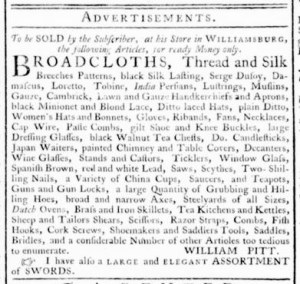
To be SOLD … a considerable Number of other Articles too tedious to enumerate.”

In the spring of 1776, William Pitt advised the readers of John Dixon and William Hunter’s Virginia Gazette that he stocked a variety of items “at his Store in WILLIAMSBURG.”  His advertisement had a familiar format, a short introduction followed by a dense paragraph of text with his name at the end and a final note that drew attention to items of particular interest.

In the introduction, Pitt declared that he sold “the following Articles, for ready Money only.”  Generous credit had been an important aspect of the consumer revolution, but in times of distress many retailers insisted that their customers had to pay at the time of purchase.  Pitt certainly was not alone in doing so after the war began with the skirmishes at Lexington and Concord.  The body of the advertisement consisted entirely of a catalog of Pitt’s merchandise, a means of demonstrating the array of choices he made available to consumers.  He stocked everything from fabrics and accessories to housewares and tools, including “BROADCLOTHS, … Muslins, Gauze, Cambrick, Lawn and Gauze Handkerchiefs and Aprons, black Minionet and Blond Lace, … Women’s Hats and Bonnets, Gloves, Ribands, Fans, Necklaces, … large Dressing Glasses, black Walnut Tea Chest, … Saws, Scythes, … a Variety of China Cups, Saucers, and Teapots, Guns and Gun Locks, … broad and narrow Axes, … Brass and Iron Skillets, … Sheep and Tailors Shears, Scissors, Razor Straps, Combs, Fish Hooks, Cork Screws, Shoemakers and Saddlers Tools, Saddles, [and] Bridles.”  The length of the list was an appeal to customers in and off itself.  Some of those items, especially the textiles, are not readily familiar to modern readers, but eighteenth-century consumers recognized them and could distinguish among them.  Just in case he had not convinced prospective customers of the variety that awaited at his store, Pitt proclaimed that he sold “a considerable Number of other Articles too tedious to enumerate.”  That was a common pitch throughout the colonies.  He concluded with a shorter entry.  Many advertisers used “N.B.” for nota bene (“take note”), but Pitt inserted a manicule for the same effect.  “I have also,” he noted, “a LARGE and ELEGANT ASSORTMENT of SWORDS.”  Gentlemen looking to outfit themselves for military service or simply to defend themselves, Pitt suggested, should visit his store.  Even with the final entry about swords, his advertisement looked much like those published before the war began.

May 11

What was advertised in a revolutionary American newspaper 250 years ago today?

Virginia Gazette [Dixon and Hunter] (May 11, 1776).

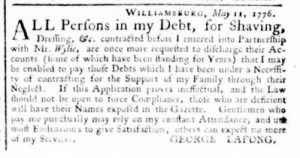
“Those who are deficient will have their Names exposed in the Gazette.”

George Lafong, a hairdresser in Williamsburg, meant business.  In the spring of 1776, he took to the pages of John Dixon and William Hunter’s Virginia Gazette to call on “ALL Persons in my Debt, for Shaving, Dressing,” and other services “to discharge their Accounts.”  In particular, he addressed clients from “before I entered into Partnership with Mr. Wylie” at the beginning of the year, reporting that some of those unsettled accounts “have been standing for years.”

He started by asking those clients to be reasonable and consider his own situation and, especially, his responsibilities to support his family.  He asked them to make payment “that I may be enabled to pay those Debts which I have been under a Necessity of contracting for the Support of my Family” but had been forced to “Neglect” because of his recalcitrant clients.  In other circumstances he could have threatened legal action against those who refused to pay their overdue bills, but Lafong suggested the possible that “the Law” (or the courts) might not “be open to force Compliance,” perhaps due to disruptions caused by the war that began at Lexington and Concord and spread to other colonies.  Without legal remedies, he would resort to public shaming by publishing the names of those who owed for the services he provided: “those who are deficient will have their Names exposed in the Gazette.”  Notices about settling accounts frequently appeared in early American newspapers, but rarely did anyone make such threats.  In November 1768, Daniel Fowle and Robert Fowle, the printers of the New-Hampshire Gazette, threatened to publish “a List of those Customers … whose Accounts are of long standing, with the Sum due, in order to show how injuriously they are treated by them,” though they did not follow through on it.  In September 1774, Charles Willson Peale did publish an advertisement calling on Elie Vallette to pay for a family portrait he had painted.  Peale and Vallette made their dispute public with a series of advertisements in the Maryland Gazette.

Would Lafong publish the names of clients who did not settle accounts?  He made clear that “Gentlemen who pay me punctually may rely on my constant Attendance, and utmost Endeavours to give Satisfaction,” yet “others can expect no more of my Service.”  At the very least, they could not depend on Lafong extending additional credit, but the possibility of even more drastic consequences remained.

April 6

What was advertised in a revolutionary American newspaper 250 years ago today?

The celebrated high bred Horse YOUNG FEARNOUGHT, WILL … cover Mares …”

Virginia Gazette [Dixon and Hunter] (April 6, 1776).

With the arrival of spring in 1776, the final page of the April 6 edition of John Dixon and William Hunter’s Virginia Gazette looked as though it could have doubled as a catalog of stud horses.

  • “KING HEROD STANDS here [at Rosegill], and will cover Mares …”
  • “The noted swift Horse TRISTRAM SHANDY … will cover Mares …”
  • “FEARNOUGHT STANDS at Hick’s Ford … to cover …”
  • The celebrated high bred Horse YOUNG FEARNOUGHT, WILL … cover Mares …”
  • The beautiful high blooded bay Horse LAUREL … will cover Mares …”
  • “OSCAR, A BEAUTIFUL Sorrel … stands this Year to cover Mares …”
  • The beautiful high bred chestnut Horse DAMON … will cover Mares …”
  • “CYPHAX … covers Mares …”
  • GODOLPHIN, A BEAUTIFUL bright Bay … to cover Mares …”
  • ROCKINGHAM, A FINE bay Horse … to cover Mares …”
  • The noted Horse OLD PARTNER … WILL cover Mares this Season …”

Some advertisers claimed that their horses already had such reputations that they needed to say little to promote them, though that did not stop them from making a pitch.  Thomas Field, for instance, stated that the “number of Mares put to Godolphin, since he has been allowed to cover, has gained him such Reputation, as well for the Certainty of his getting Colts, as for their Size and Beauty, that a further Description of him is needless.”  William Gay proclaimed that Young Fearnought’s “Figure, together with the Size and Form of his Colts, are such to render him, in the Esteem of the best Judges, deservedly one of the best covering Horses in America,” while also asserting that the “Pedigree of this Horse is so well known as to make a Description needless.”  In contrast, others went into detail about pedigrees.  According to Neill Buchanan, Jr., Oscar was “got by YOUNG SNIP, his Dam by Lord Morton’s ARABIAN, his Grandam by OLD CRAB, his Great Grandam by the BALD GALLOWAY, his Great Great Grandam by Darley’s ARABIAN, out of BAY BOLTON’s Dam.”

Advertisements placed for other purposes also appeared in the Virginia Gazette, yet notices for stud horses dominated that issue.  They testified to the popularity of horse breeding among the colony’s gentry and the popularity of horse racing as a pastime in Virginia during the era of the American revolution.

**********

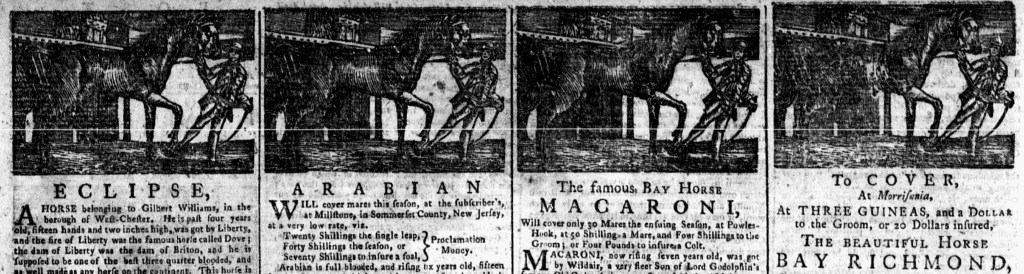
Advertisements in the New-York Gazette and Weekly Mercury that same week showed a similar enthusiasm for breeding horses.  That newspaper also incorporated images.

New-York Gazette and Weekly Mercury (April 8, 1776).

February 10

Who was the subject of an advertisement in a revolutionary American newspaper 250 years ago today?

Virginia Gazette [Dixon and Hunter] (February 10, 1776).

“Runaway Negroes … going to the Governor.”

For several weeks in January and February 1776, the Virginia Gazette carried an advertisement about a canoe recovered from “some runaway Negroes” making their way down the James River.  John Watkins described the canoe and noted that the enslaved men also possessed “sundry Clothes, some of which were stolen, and have since been claimed by the Owners.”  He assumed that the remaining clothes belonged to the enslaved men.  Watkins offered the canoe to its rightful owner and the clothes to the enslavers of the Black men who sought to liberate themselves.  He did not, however, indicate that those men had been captured and imprisoned until their enslavers claimed them.  Perhaps the men managed to make their escape when Watkins seized the canoe.

Whatever happened, Watkins believed that the men “were going to Governor.”  That detail meant a lot to eighteenth-century readers of the Virginia Gazette and even more to enslaved people residing in the colony.  On November 7, 1775, John Murray, the earl of Dunmore and royal governor of Virginia, issued a proclamation that declared martial law in the colony.  He hoped to restore order as the fighting that started at Lexington and Concord in Massachusetts spread to Virginia.  To that end, he “declare[d] all indented Servants, Negroes, or others, (appertaining to Rebels,) free that are able and willing to bear Arms, they joining His MAJESTY’s Troops as soon as may be.”  In other words, Dunmore offered freedom to enslaved people (and indentured servants and other unfree laborers) who fled from their enslavers, joined his forces, and fought for the king (but only those Black people enslaved by Patriots since the governor did not want to alienate Loyalists).  As word spread, enslaved men, women, and children flocked to Dunmore’s lines.  The men who stole the canoe that Watkins advertised had good reason for acting when they did.  They recognized what may very well have been their best possible chance to make good on their escape and achieve freedom.  As colonizers complained about their figurative enslavement by Parliament, enslaved people saw this offer by the British as a beacon of liberty.  Several months later, the Declaration of Independence counted Lord Dunmore’s Proclamation among the many grievances against George III.  The charge that the king “has excited domestic insurrections amongst us” referred to Dunmore’s efforts to rally enslaved people to join him in fighting against the “Rebels” who opposed the king.

January 28

What was advertised in a revolutionary American newspaper 250 years ago this week?

Virginia Gazette [Dixon and Hunter] (January 27, 1776).

“I cannot publish such Advertisements as ought to have appeared this Week.”

John Pinkney should have printed and distributed an edition of his weekly newspaper, the Virginia Gazette, on January 27, 1776, but he did not.  Instead, he placed a notice in the newspaper printed by John Dixon and William Hunter, also named the Virginia Gazette.  “AFTER having received so many Instances of public Favour,” he explained, “I should think myself inexcusable did I not make known the Reason why I do not this Week publish a Gazette.”  It turned out that he experienced the same disruption in his supply of paper that many other printers faced during the first year of the Revolutionary War.  He did not publish a new issue “owing to a Disappointment in receiving Paper from the Northward.”  In their own notice on the next page, Dixon and Hunter confirmed that “a stock of printing-paper … at this time is very scarce” and acquiring it involved “an infinite deal of trouble and expence in transporting it from Pennsylvania.”  Pinkney claimed that “no human Prudence could have prevented” the situation.

He also informed readers that “Next Week … or in a short Time, I expect a very considerable Quantity” and when it arrived he would “endeavour to make up for all Deficiencies.”  Through “unwearied Diligence,” he would continue to collate and disseminate items of “instructive Amusement” and “every Piece of authentic Intelligence.”  He concluded with an acknowledgement for advertisers: “It gives me the greatest Uneasiness that I cannot publish such Advertisements as ought to have appeared this Week, but as far as a Restitution of Money can atone for the Disappointment, it shall be made.”  Advertising was an important revenue stream for most printers who published newspapers.  This “Restitution of Money” put Pinkney in an even more precarious position, especially since Dixon and Hunter indicated that paper “cannot be had without cash.”  Pinkney could not purchase paper on credit.  He managed to get his hands on enough paper to print a new issue on February 3, as promised in his notice, but most likely did not continue printing for long after that.  The February 3 edition is the last known.  Disruptions in Pinkney’s supply of paper likely played a significant role in his Virginia Gazette folding.

January 6

What was advertised in a revolutionary American newspaper 250 years ago today?

Virginia Gazette [Dixon and Hunter] (January 6, 1776).

Monsieur LAFONG, HAIR-DRESSER, &c. AND BARBER GENERAL!”

George Lafong, a “French HAIR-DRESSER” in Williamsburg, occasionally placed newspaper advertisements in the early 1770s.  When he took to the pages of the first issue of John Dixon and William Hunter’s Virginia Gazette for 1776, he presented himself as “Monsieur LAFONG, HAIR-DRESSER, &c. AND BARBER GENERAL!”  That elaborate and spectacular title served as the headline for his advertisement.  He had not previously dropped his first name in favor of referring to himself as “Monsieur LAFONG,” but apparently decided that circumstances merited this affectation.

That may have been because he jointly placed the advertisement with his new partner, Alexander Wiley, explaining that they went into business together “IN Order to carry on the business more extensively.”  Wiley possessed “great Abilities in Hair-Dressing,” according to the advertisement, yet neither his name nor reputation seemed to suggest any connection to French styles.  Hairdressers frequently benefited from the cachet that their clientele associated with French fashion, something that Lafong understood when he introduced himself as a “French HAIR-DRESSER” and there in a French phrase, “TOUT A LA MODE,” in 1770.  He doubled down on that in his new advertisement, naming himself “Monsieur Lafong” in the body as well as “Monsieur LAFONG” in the headline.

The new partners hoped that the combination of Wiley’s “great Abilities in Hair-Dressing, and the general Satisfaction which Monsieur Lafong flatters himself to have hitherto given” would yield “Encouragement” (or appointments) “from the Ladies and Gentlemen of this City.”  Lafong deserved to lean on his reputation.  According to the entry on wigmakers from the Williamsburg Craft Series, Lafong operated one of the premiere wig shops in the town in the early 1770s.[1]  In his own marketing, he declared that he “makes Head Dresses for Ladies, so natural as not to be distinguished by the most curious Eye.”  If former clients (or their acquaintances who knew who dressed their hair) agreed with that assessment, it did indeed suggest a “general Satisfaction” with Lafong’s work.  Furthermore, Lafong and Wiley promised that “the greatest Pains will be taken” to earn the approval of their clients.

**********

[1] Thomas K. Bullock and Maurice B. Tinkin, Jr., The Wigmaker in Eighteenth-Century Williamsburg: An Account of his Barbering, Hair-Dressing, and Peruke-Making Services, and Some Remarks on Wigs of Various Styles (Colonial Williamsburg: 1959, 1987).

December 23

What was advertised in a revolutionary American newspaper 250 years ago today?

Virginia Gazette [Dixon and Hunter] (December 23, 1775).

“A large and exact VIEW of the late BATTLE at CHARLESTOWN.”

Like other printers, John Dixon and William Hunter sold books, pamphlets, almanacs, stationery, and other merchandise to supplement the revenues they generated from newspaper subscriptions, advertisements, and job printing.  They frequently placed advertisements in their newspaper, the Virginia Gazette, to generate demand for those wares.  The December 23, 1775, edition, for instance, included three of their advertisements, one for “SONG BOOKS and SCHOOL BOOKS For SALE at this OFFICE” and another for the “Virginia ALMANACK” for 1776 with calculations “Fitting VIRGINIA, MARYLAND, [and] NORTH CAROLINA” by “the ingenious Mr. DAVID RITTENHOUSE of Philadelphia,” the same mathematician who did the calculations for Father Abraham’s Almanack marketed in Philadelphia and Baltimore.

Their third advertisement promoted memorabilia related to the hostilities that erupted at Lexington and Concord earlier in the year.  “Just come to Hand, and to be SOLD at this PRINTING-OFFICE,” Dixon and Hunter proclaimed, “A large and exact VIEW of the late BATTLE at CHARLESTOWN,” now known as the Battle of Bunker Hill.  The copies they stocked were “Elegantly coloured” and sold for “one Dollar.”  Dixon and Hunter apparently carried a print, “An Exact View,” engraved by Bernard Romans and published by Nicholas Brooks, rather than a striking similar (and perhaps pirated) print, “A Correct View,” that Robert Aitken included in a recent issue of the Pennsylvania Magazine, or American Monthly Museum and sold separately.  Romans and Brooks had advertised widely and designated local agents to accept subscriptions for the print.  Dixon and Hunter also advertised another collaboration between Romans and Brooks, “an accurate MAP of The present SEAT of CIVIL WAR, Taken by an able Draughtsman, who was on the Spot at the late Engagement.”  The map also sold for “one Dollar.”  Previous efforts to market the map included a broadside subscription proposal that listed local agents in various towns, including “Purdie and Dixon, Williamsburgh.”  Romans and Brooks apparently had not consulted with all the printers, booksellers, and other men they named as local agents when they drew up the list or else they would have known that Alexander Purdie and John Dixon had dissolved their partnership in December 1774.  Dixon took on Hunter as his new partner while Purdie set about publishing his own Virginia Gazette.  Those details may have mattered less to Romans and Brooks than their expectation that printers, booksellers, and others with reputations for supporting the American cause would indeed aid them in marketing and selling a map depicting the conflict underway in Massachusetts.  Whether or not Purdie or Dixon and Hunter collected subscriptions, local agents in Williamsburg did eventually sell the print and the map that supplemented newspaper accounts and encouraged feelings of patriotism among the consumers who purchased them.

November 26

What was advertised in a revolutionary American newspaper 250 years ago this week?

Virginia Gazette [Dixon and Hunter] (November 25, 1775).

“FOLIOS … QUARTOS … OCTAVOS … DUODECIMOS.”

John Dixon and William Hunter, printers of the Virginia Gazette, published a “Catalogue of BOOKS for Saleat their Printing-Office” in the November 25, 1775, edition.  It covered most of the first page, except for the masthead and a short advertisement in which William Hewitt announced his intention to leave the colony and called on associates to settle accounts, and continued onto the second page, where it filled an entire column and overflowed into another.  Overall, Dixon and Hunter’s book catalog accounted for four of the twelve columns of news and advertising in that issue.  The printers could have printed a separate catalog (and very well may have done so), but disseminating the list of books they sold in the newspaper guaranteed that they reached consumers throughout the colony and beyond.

The printers deployed two principles in organizing the contents of their book catalog.  First, they separated the books by size – folios, quartos, octavos, and duodecimos – and then they roughly alphabetized them.  The catalog featured only half a dozen folios, including “CHURCH Bibles,” “Chambers’s Dictionary of Arts and Sciences” in two volumes, and the “Laws of Virginia,” along with nearly a score of quartos.  Dixon and Hunter stocked many more octavos and duodecimos with more than one hundred of each for prospective customers to choose.  In roughly alphabetizing the titles, they first indicated the author and then, if the book did not have an author associated with it, the title.  They clustered titles together by the first letter, but they did not observe strict alphabetical order within those clusters.  For example, the entries for “A” among the duodecimos appeared in this order:

     Addison’s Mescellaneous Works in prose and verse, 4 V.
Adventurer, 4 V.
American Gazetteer, 3 V.
Adventures of a Jesuit, with several remarkable Characters and Scenes in real Life, 2 V.
Agreeable Ugliness, or the Triumph of the Graces.
Apocrypha.
Alleine’s, Alarm to Unconverted Sinners.

A single entry for “Y” – “Yorrick’s Sermons, 7 V.” – appeared at the end of the catalog, immediately above “INTELLIGENCE from the Northern Papers.”

Even with all the “INTELLIGENCE” from London and Philadelphia and proclamation from the royal governor of Virginia, Dixon and Hunter made room in the Virginia Gazette for their book catalog.  They delivered news to their readers, but they also depended on book sales to supplement subscriptions, advertising, and job printing.  Compared to many book catalogs published earlier in the century, they presented a more organized list of titles.  Earlier book catalogs often separated titles by size.  By roughly alphabetizing the entries, Dixon and Hunter attempted to help prospective customers find the titles that interested them.