
What was advertised in a revolutionary American newspaper 250 years ago today?
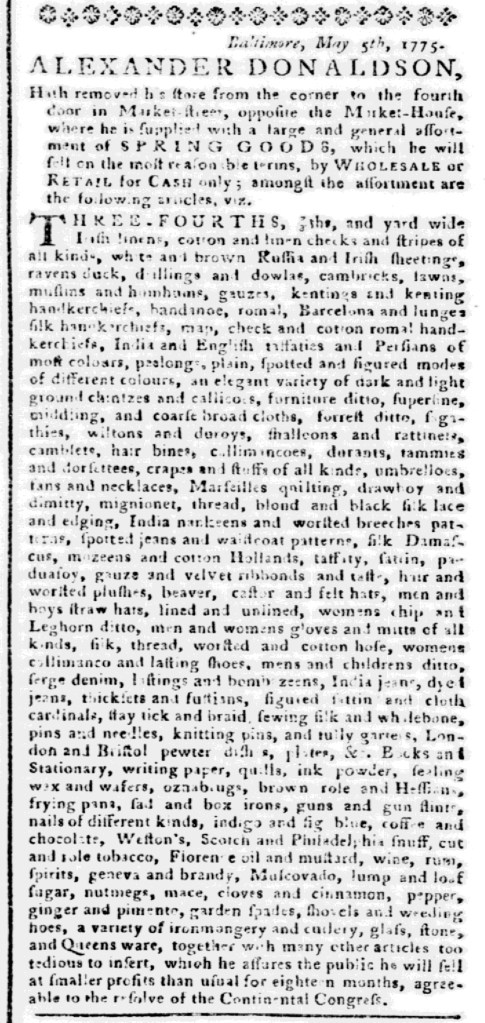
“He will sell at smaller profits than usual … agreeable to the resolve of the Continental Congress.”
Alexander Donaldson advertised a “large and general assortment of SPRING GOODS” available at his store in Baltimore in Dunlap’s Maryland Gazette in the spring of 1775. To entice prospective customers, he provided an extensive list of textiles, accessories, housewares, and other items. His inventory included, for instance, “India and English taffaties and Persians of most colours,” “an elegant variety of dark and light ground chintzes and callicoes,” “umbrelloes, fans and necklaces,” “taffaty, sattin, paduasoy, gauze and velvet ribbonds,” “men and womens gloves and mitts of all kinds,” “London and Bristol pewter,” “a variety of ironmongery and cutlery,” and “writing paper, quills, ink powder, [and] sealing wax and wafers.” Donaldson also stocked “many other articles too tedious to insert,” though his concern may have been the additional cost to catalog even more of his merchandise in an already-lengthy newspaper notice.
The merchant ended with a note that he “will sell at smaller profits than usual for eighteen months, agreeable to the resolve of the Continental Congress.” In doing so, he invoked the ninth article of the Continental Association, a nonimportation, nonconsumption, and nonexportation agreement devised by the First Continental Congress in response to the Coercive Acts. That article specified, “That such as are Venders of Goods or Merchandise will not take Advantage of the Scarcity of Goods thar may be occasioned by this Association, but will sell the same at the Rates we have been respectively accustomed to do for twelve Months last past.” In other words, merchants and shopkeepers would not gouge customers by jacking up prices once the Continental Association went into effect on December 1, 1774. The ninth article also spelled out the consequences: “if any Venders of Goods or Merchandise shall sell any Goods on higher Terms, or shall in any Manner, or by any Device whatsoever, violate or depart from this Agreement, no Person ought, nor will any of us deal with any such Person, or his or her Factor or Agent, at any Time thereafter, for any Commodity whatever.”
Considering such penalties, Donaldson very carefully explained that he set fair prices. Even better, he offered bargains to his customers. The Continental Association called for selling at the “Rates” or prices established during the year before it went into effect, yet Donaldson declared that he “will sell at smaller profits than usual.” He did not indicate when his good arrived in the colonies, leaving it to readers to assume that since he abides by the price controls that he also observed the deadline for receiving imported goods. The favorable “Rates” for his wares may have also distracted colonizers from asking too many questions about when Donaldson’s inventory had been ordered and shipped or when it arrived in an American port. In addition, the merchant did not list tea, forbidden by the third article, alongside other popular beverages, coffee and chocolate, another indication that he adhered to the Continental Association. Donaldson signaled to customers that they could shop at his store while still supporting the American cause.