
What was advertised in a revolutionary American newspaper 250 years ago this week?
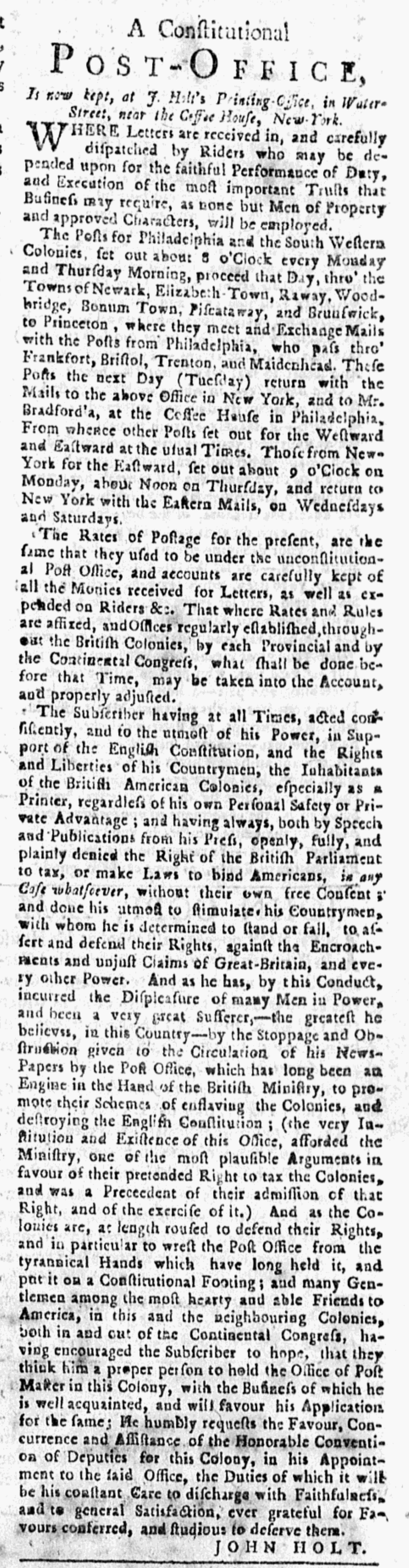
“A Constitutional POST-OFFICE, Is now kept, at J. Holt’s Printing-Office, in … New-York.”
William Goddard’s Pennsylvania Chronicle had a reputation for supporting the Patriot cause, so much so that the Crown Post drove it out of business by refusing to deliver it. That prompted Goddard to establish the Constitutional Post, independent of British authority, as an alternative. That service began with a route that connected Baltimore and Philadelphia in the summer of 1773. The network expanded, yet the First Continental Congress decided to table Goddard’s plan rather than endorse it when he submitted it for consideration in the fall of 1774. The Second Continental Congress took it up again following the battles at Lexington and Concord, adopting the plan on July 16, 1775. To Goddard’s disappointment, the delegates named Benjamin Franklin as the first Postmaster General; he settled for serving as Riding Surveyor.
By the time that the Second Continental Congress acted on the measure, Goddard and others had already made progress putting an infrastructure in place. For instance, newspaper advertisements confirm that “CONSTITUTIONAL Post-Riders” operated in Connecticut in the summer of 1774 and Massachusetts in the spring of 1775. In June 1775, John Holt, the printer of the New-York Journal, advertised that a “Constitutional POST-OFFICE, Is now kept” at his printing office in New York. He provided a schedule and noted that the “Rates of Postage for the present, are the same that they used to be under the unconstitutional Post Office.” He would adjust the “Rates and Rules” as provincial congresses in the several colonies and the Continental Congress approved them. In addition, “accounts are carefully kept of all the Monies received for Letters, as well as expended on Riders” and other costs. Holt anticipated that the Continental Congress would indeed adopt Goddard’s plan for the Constitutional Post in the aftermath of Lexington and Concord. Seeking an appointment as postmaster for New York, he devoted half of his advertisement to giving his credentials in hopes of attracting the attention of the delegates and other who might influence them:
“The Subscriber having at all Times, acted consistently, and to the utmost of his Power, in Support of the English Constitution, and the Rights and Liberties of his Countrymen, the Inhabitants of the British American Colonies, especially as a Printer, regardless of his own Personal Safety or Private Advantage; and having always, both by Speech and Publications from his Press, openly, fully, and plainly denied the Right of the British Parliament to tax, or make Laws to bind Americans, in any Case whatsoever, without their own free Consent; and done his utmost to stimulate his Countrymen, with whom he is determined to stand or fall, to assert and defend their Rights, against the Encroachment and unjust Claims of Great-Britain, and every other Power.”
That rationale corresponded to arguments advanced far and wide by Patriots. Holt continued making his case with a review of the consequences he endured for his devotion to the cause: “And as he has, by this Conduct, incurred the Displeasure of many Men in Power, and been a very great Sufferer,– the greatest he believes, in this Country – by the Stoppage and Obstruction given to the Circulation of his News-Papers by the Post Office, which has long been an Engine in the Hands of the British Ministry, to promote their Schemes of enslaving the Colonies, and destroying the English Constitution.”
With the siege of Boston continuing, Holt asserted that “the Colonies are, at length roused to defend their Rights, and in particular to wrest the Post Office from the tyrannical Hands which have long held it, and put it on a Constitutional Footing.” Having established a Constitutional Post Office in New York, Holt hoped that the Continental Congress would appoint him “Post Master in this Colony.” To that end, he “humbly requests the Favour, Concurrence and Assistance of the Honorable Convention of Deputies for this Colony, in his Appointment to the said Office,” pledging that “it will be his constant Care to discharge” the duties “with Faithfulness.” From Holt’s perspective, there was no better candidate for the position.
The printer’s lengthy advertisement served two purposes. He attempted to attract customers for the Constitutional Post Office now that New York had a branch at his printing office. He did so by deploying familiar rhetoric that outlined the stance taken by those who supported the American cause against the abuses of Parliament. He intended that as both a reason for colonizers to entrust their letters to the Constitutional Post Office and a demonstration of his devotion to the cause that merited an appointment as postmaster for the colony. Holt supplemented familiar arguments with his own experience, further demonstrating that he deserved to be appointed as postmaster. He sought the patronage of those who could award him the position while simultaneously seeking patrons for the Constitutional Post Office.
[…] William Goddard’s Pennsylvania Chronicle had a reputation for supporting the Patriot cause, so much so that the Crown Post drove it out of business by refusing to deliver it. That prompted Goddard to establish the Constitutional Post, independent of British authority, as an alternative. That service began with a route that connected Baltimore and Philadelphia in the summer of 1773. The network expanded, yet the First Continental Congress decided to table Goddard’s plan rather than endorse it when he submitted it for consideration in the fall of 1774. The Second Continental Congress took it up again following the battles at Lexington and Concord, adopting the plan on July 16, 1775. To Goddard’s disappointment, the delegates named Benjamin Franklin as the first Postmaster General; he settled for serving as Riding Surveyor. By the time that the Second Continental Congress acted on the measure, Goddard and others had already made progress putting an infrastructure in place. For instance, newspaper advertisements confirm that “CONSTITUTIONAL Post-Riders” operated in Connecticut in the summer of 1774 and Massachusetts in the spring of 1775. In June 1775, John Holt, the printer of the New-York Journal, advertised that a “Constitutional POST-OFFICE, Is now kept” at his printing office in New York. Read more… […]