
What was advertised in a revolutionary American newspaper 250 years ago today?
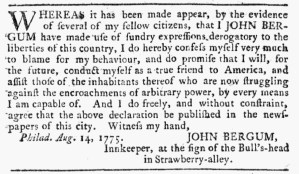
“I will, for the future, conduct myself as a true friend to America.”
It was another confession accompanied with an apology. John Bergum, an “Innkeeper, at the sign of the Bull’s-head in Strawberry-alley” in Philadelphia, acknowledged his infraction and promised that he had reformed. Such items had been appearing among the advertisements in newspapers in Massachusetts for some time. For the past year, colonizers who signed an address to the former governor, Thomas Hutchinson, when he departed for England had reconsidered their position … or been pressured into recanting by Patriots who did not care for their Tory stance. More recently, similar advertisements appeared in newspapers outside of New England, especially after hostilities commenced at Lexington and Concord in April 1775.
Bergum inserted his advertisement in the August 15, 1775, edition of the Pennsylvania Evening Post. “WHEREAS it has been made appear, by the evidence of several of my fellow citizens,” he declared, “that I JOHN BERGUM have made use of sundry expressions derogatory to the liberties of this country, I do hereby confess myself very much to blame for my behaviour.” Bergum did not reveal any of those “sundry expressions” but instead focused on assuring the public that he would not utter anything like them again. He promised, “I will, for the future, conduct myself as a true friend to America, and assist those of the inhabitants thereof who are now struggling against the encroachments of arbitrary power, by every means I am capable of.” Bergum claimed would comport himself as a Patriot in both word and deed as the crisis continued to consume the colonies.
“I do freely, and without constraint,” the innkeeper added, “agree that the above declaration be published in the newspapers of this city.” That made it sound like someone else had a hand in convincing Bergum of his error and running the advertisement. William Huntting Howell posits that local Committees of Safety in Massachusetts pressured signatories of the address to Hutchinson into public confessions that concluded with an endorsement of the Patriot position. The wording in Bergum’s advertisement – “I do freely … agree that the above declaration be published in the newspapers” – suggests that maybe he had an encounter with a local committee that convinced him that it was in his best interests to recant his previous statements and pledge his support in defending “the liberties of this country.”