
What was advertised in a revolutionary American newspaper 250 years ago today?
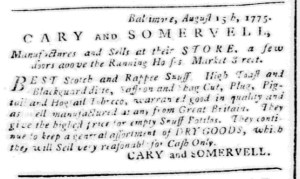
“BEST Scotch and Rappee Snuff … warranted good in quality and as well manufactured as any from Great Britain.”
The partnership of Cary and Somervell stocked and sold “a general Assortment of DRY GOODS” at their store in Baltimore in the summer of 1775, but that was not their primary reason for running an advertisement in the August 22 edition of Dunlap’s Maryland Gazette. Instead, they wished to advise the public that their firm “Manufactures and Sells … BEST Scotch and Rappee Snuff, High Toast and Blackguard [snuff], Saffron and Shag Cut, Plug, Pigtail and Hogtail Tobacco.” Cary and Somervell offered tobacco users an array of choices of familiar products. They also paid “the highest price for empty Snuff Bottles,” encouraging prospective customers to offset the cost of their purchases by trading in bottles that they no longer needed.
In promoting the tobacco products that they made in Baltimore, Cary and Somervell published promises about their wares: “warranted good in quality and as well manufactured as any from Great Britain.” That was a familiar aspect of “Buy American” advertisements prior to the American Revolution, yet it had greater resonance once the Continental Association went into effect on December 1, 1774, and, especially, following the battles at Lexington and Concord on April 19, 1775. The Continental Association, a nonimportation agreement devised by the First Continental Congress in response to the Coercive Acts, called for “encourag[ing] Frugality, Economy, and Industry; and promot[ing] Agriculture, Arts, and the Manufactures of this Country” as alternatives to imported goods. Thus, the nonimportation agreement also outlined the responsibilities of both producers and consumers in the colonies. Such civic duties gained even greater urgency in the wake of battles fought in Massachusetts.
Even without taking current events into consideration, Cary and Somervell issued a familiar challenge when they asserted that their tobacco products were as “good in quality and as well manufactured as any from Great Britain.” How would consumers know unless they tested Cary and Somervell’s snuff and tobacco for themselves? The partners used a bold assertion to entice prospective customers to sample their products and become the final arbiters of whether they, the consumers, agreed with the claims made in the newspaper advertisement.