
What was advertised in a revolutionary American newspaper 250 years ago today?
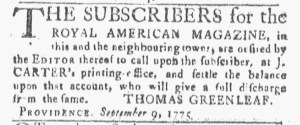
“SUBSCRIBERS for the ROYAL AMERICAN MAGAZINE … are desired by the EDITOR thereof to … settle the balance upon that account.”
Joseph Greenleaf acquired the Royal American Magazine in the summer of 1774 and less than a year later suspended publication following the battles at Lexington and Concord. Some subscribers apparently had not paid for issues already delivered to them, prompting Greenleaf to insert a notice in the June 9, 1775, edition of the Essex Journal. It called on “Subscribers for the American Magazine at Newbury, Newbury-Port, and the vicinity … to pay their respective ballances to the month of March.” That corresponded with the final issue of the magazine.
Three months later, Greenleaf’s son, Thomas, ran a similar advertisement in the Providence Gazette. “THE SUBSCRIBERS for the ROYAL AMERICAN MAGAZINE, in this and the neighbouring towns,” the notice stated, “are desired by the EDITOR thereof,” Joseph, “to call upon the subscriber,” Thomas, “at J. CARTER’S printing-office, and settle the balance upon that account.” In turn, Thomas “will give a full discharge.” The younger Greenleaf “learned printing” from Isaiah Thomas, the printer of the Massachusetts Spy and the founder of the Royal American Magazine, and “managed his father’s printing house” in Boston until it closed in 1775.[1] He left the city and migrated to Rhode Island, where he worked as a journeyman printer for John Carter, the printer of the Providence Gazette, from September 6, 1775, to April 10, 1776.[2] The advertisement calling on local subscribers to the Royal American Magazine to settle accounts appeared in the first issue of the Providence Gazette published after Greenleaf began working in that printing office. Even as he set about his new responsibilities, the journeyman renewed the efforts to collect payment from delinquent subscribers who had not paid for the magazines they received. His advertisement was not as lively as the one placed by his father. He did not lament “being driven from his house and business by the perfidious [General Thomas] Gage,” the governor and king’s representative in Massachusetts. Instead, he left it to subscribers to realize why he no longer resided in Boston. Some may have hoped that they could avoid settling accounts with the Greenleafs while they remained in Massachusetts, but the advertisement in the Providence Gazette reminded them of their obligation.
**********
[1] Isaiah Thomas, The History of Printing in America: With a Biography of Printers and an Account of Newspapers (1810; New York: Weathervane Books, 1970), 175.
[2] Marcus A. McCorison, “The Wages of John Carter’s Journeyman Printers, 1771-1779,” Proceedings of the American Antiquarian Society, 2nd ser., 81 (1971): 273-303.