
What was advertised in a revolutionary American newspaper 250 years ago today?
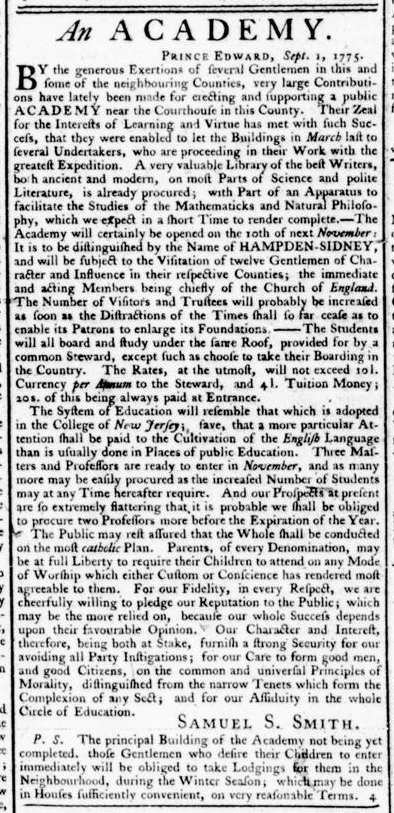
“An ACADEMY … distinguished by the Name of HAMPDEN-SIDNEY.”
An advertisement for a new academy “distinguished by the Name of HAMPDEN-SIDNEY” ran for the first time in the October 7, 1775, edition of John Dixon and William Hunter’s Virginia Gazette. It delivered an overview of the last American college founded before the Declaration of Independence, announcing that classes would begin on November 10. As the “History of Hampden-Sydney College” posted on the institution’s website explains, “The first president, at the suggestion of Dr. John Witherspoon, the Scottish president of the College of New Jersey (now Princeton University), chose the name Hampden-Sydney to symbolize devotion to the principles of representative government and full civil and religious freedom which John Hampden (1594-1643) and Algernon Sydney (1622-1683) had outspokenly supported, and for which they had given their lives, in England’s two great constitutional crises of the previous century.”
That first president of Hampden-Sydney College was Samuel Stanhope Smith, the valedictorian of the College of New Jersey (now Princeton University) in 1769. Six years later, his connections to that institution influenced more than just the name of the academy he founded in Virginia. “The System of Education will resemble that which is adopted in the College of New Jersey,” he noted in the advertisement, “save, that a more particular Attention shall be paid to the Cultivation of the EnglishLanguage than is usually done in Places of public Education.” Three “Masters and Professors” had already been hired, yet Smith anticipated that enrollments would justify engaging two more instructors “before the Expiration of the Year.” The academy had also procured a “very valuable Library of the best Writers, both ancient and modern, on most Parts of Science and polite Literature.” Construction of the “principal Building of the Academy” had begun but would not be complete before classes commenced on November 10. Students would need to find lodging “in the Neighbourhood, during the Winter Season,” though Smith assured prospective pupils and their parents that there were “Houses sufficiently convenient” available “on very reasonable terms.”
For governance and oversight, the academy “will be subject to the Visitation of twelve Gentlemen of Character and Influence in their respective Counties.” They included, according to the College’s “History,” James Madison, Patrick Henry, and “other less well-known but equally vigorous patriots.” Smith mused that the “Number of Visitors and Trustees will probably be increased as soon as the Distractions of the Times shall so far cease as to enable its Patrons to enlarge its Foundation.” He referred, as readers knew, to events in Massachusetts over the past six months, including the battles at Lexington and Concord, the siege of Boston, and the Battle of Bunker Hill.
The imperial crisis that led to those events certainly played a role in naming the academy and formulating its mission. Even though the first trustees were “chiefly of the Church of England,” Smith pledged that “the Whole shall be conducted on the most catholic” or universal “Plan.” Inspired by Hampden and Sydney’s commitment to civil and religious freedom, the academy adopted a policy of toleration: “Parents, of every Denomination, may be at full Liberty to require their Children to attend on any Mode of Worship which either Custom or Conscience has rendered most agreeable to them.” Smith also made a series of promises grounded in the academy’s “Character and Interest,” stating that the faculty and trustees “furnish a strong Security for our avoiding all Party Instigations; for our Care to form good men, and good Citizens, on the common and universal Principles of Morality, distinguished from the narrow Tenets which form the Complexion of any Sect; and for our Assiduity in the whole Circle of Education.” From its inception during the era of the American Revolution, Smith’s academy, Hampden-Sydney College, emphasized civic virtue and religious freedom as hallmarks of the education it provided for young men.
**********
Hampden-Sydney College features an image and transcription of the advertisement on its website as well as a brief “History of Hampden-Sydney College.”