
What was advertised in a revolutionary American newspaper 250 years ago today?
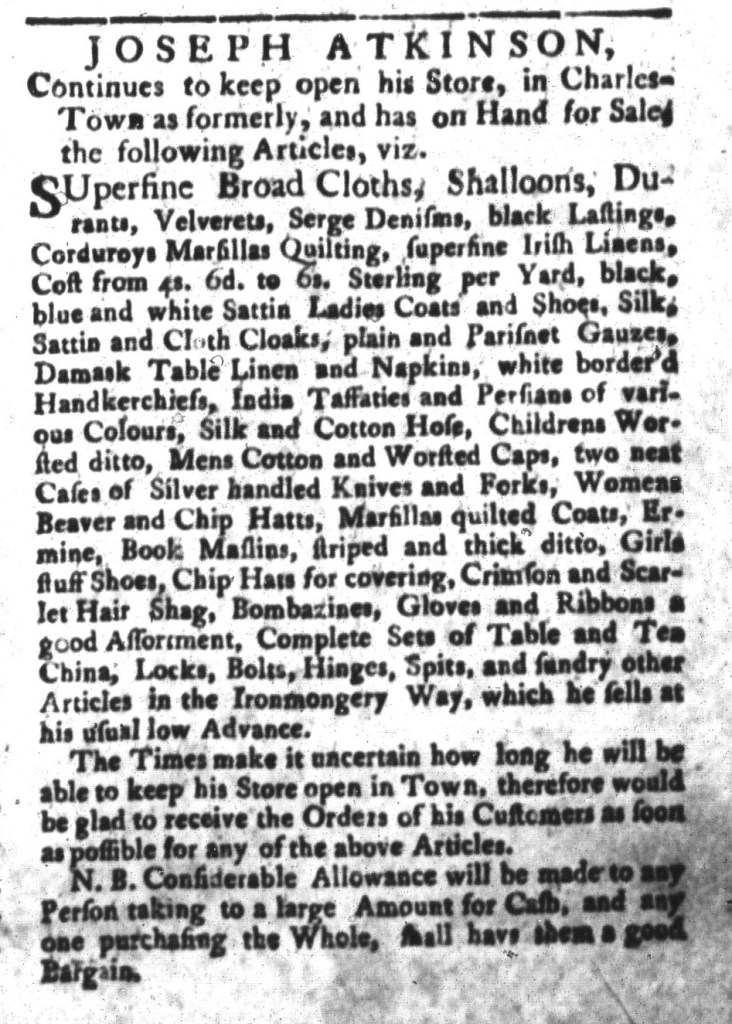
“The Times make it uncertain how long he will be able to keep his Store open in Town.”
Joseph Atkinson placed an advertisement in the December 11, 1775, edition of the South-Carolina Gazette to advise prospective customers that he “Continues to keep open his Store, in Charles-Town as formerly.” He listed an array of merchandise, including a variety of textiles, “Mens Cotton and Worsted Caps, two Cases of Silver handled Knives and Forks, Womens Beaver and Chip Hats, … Gloves and Ribbons a good Assortment, Complete Sets of Table and Tea China, … and sundry other Articles in the Ironmongery Way.” Atkinson sought to liquidate his stock, declaring that “Considerable Allowance will be made to any Person taking to a large Amount for Cash.” Furthermore, “any one purchasing the Whole, shall have them at a good Bargain.”
The shopkeeper also confessed that the “Times make it uncertain how long he will be able to keep his Store open in Town.” He declared that he “therefore would be glad to receive the Orders of his Customers as soon as possible.” To underscore the point about uncertain times, the items on the first page of that issue featured updates from the Second Continental Congress in Philadelphia and the colony’s own congress, including a call for provisions “to supply the REGIMENT of ARTILLERY in the Service of this Colony.” What Atkinson and readers of the South-Carolina Gazette did not know was that the newspaper would soon cease publication. The December 11 edition became the last known issue, though Clarence S. Brigham reports it “was followed by one other number, probably Dec[ember] 18.”[1] Peter Timothy, the printer, revived the newspapers as the Gazette of the State of South-Carolina sixteen months later, on April 9, 1777. As the title indicates, the colonies declared independence by the time Timothy resumed publishing his newspaper.
The demise of the South-Carolina Gazette meant less news and advertising circulating in that colony and the region. Four months earlier, the South-Carolina Gazette and Country Journal folded. Now only the South-Carolina and American General Gazette remained. For nearly a decade, three competing newspapers served Charleston and the rest of the colony, many issues devoting more space to advertising than news. Although the South-Carolina and American General Gazette continued publication, with occasional suspensions, until February 28, 1781, issues published after 1775 have not been preserved and digitized for wider access. That means that advertisements from South Carolina, including the urban port of Charleston, will no longer be part of the Adverts 250 Project and the Slavery Adverts 250 Project. As the projects continue to tell stories about the era of the American Revolution, they will focus on New England, New York, Pennsylvania, and the Chesapeake, drawing on those newspapers that continued publication (or commenced publication during the Revolutionary War) and that have been preserved and digitized. So many stories remain to be told, but, for a time, South Carolina will be largely absent from this project’s featured advertisements.
**********
[1] Clarence S. Brigham, History and Bibliography of American Newspapers, 1690-1820 (Worcester: American Antiquarian Society, 1947), 1038.